Consolidated Facts on Carla Gericke’s Arrest (March 24, 2010) and Landmark Case
Late on March 24, 2010 (~11:30 p.m.), in Weare, New Hampshire, Carla Gericke (then president of New Hampshire’s Free State Project) was following her friend Tyler Hanslin’s car when police pulled him over for a traffic stop. Gericke parked nearby, got out, and openly began filming Sgt. Joseph Kelley with a video camera from about 30 feet away. She announced she was recording. Kelley ordered her back into her car; she complied but kept filming from inside. Another officer (Brandon Montplaisir/Begin) confronted her, demanded her camera and ID, and arrested her when she refused to cooperate fully.
She was charged with disobeying a police officer, obstructing a government official, and felony illegal wiretapping (unlawful interception of oral communications) under New Hampshire law — a serious felony that carried prison time. (Note: her camera actually malfunctioned and recorded nothing, but police didn’t know that at the time.) All charges were dropped; prosecutors declined to pursue them.
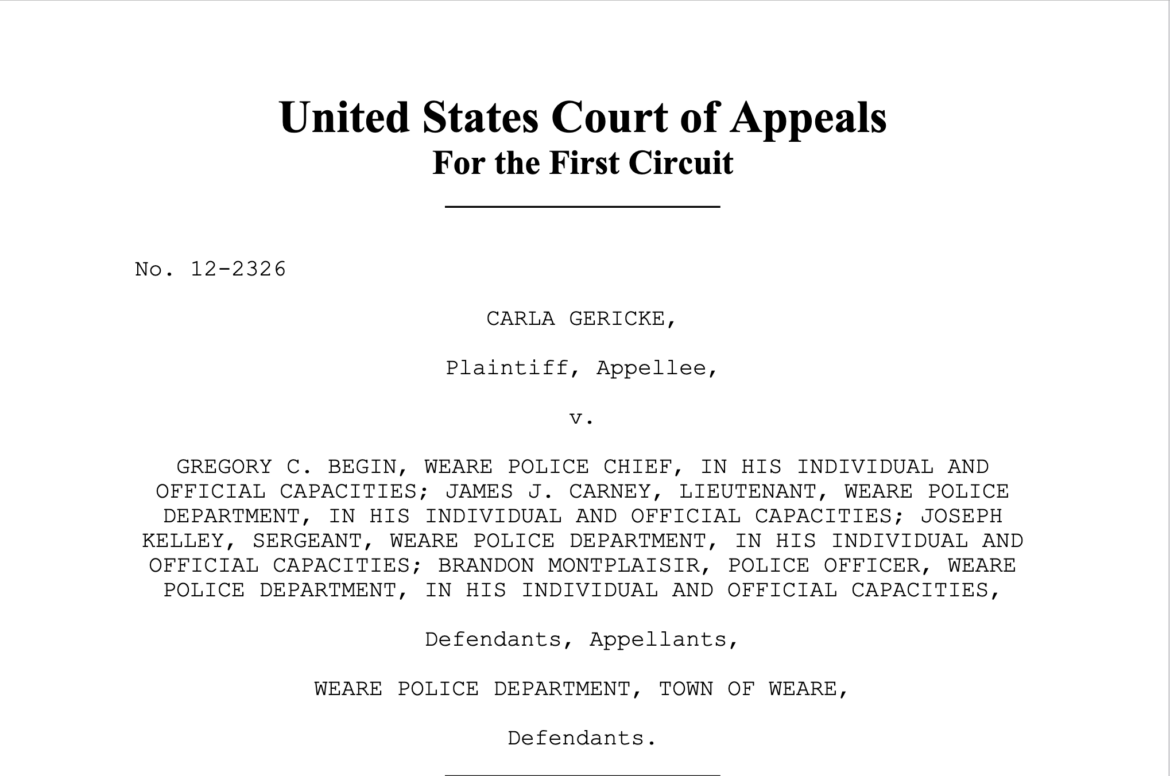
Gericke sued the officers, Weare Police Department, and the town under 42 U.S.C. § 1983 for violating her First Amendment rights via retaliatory prosecution. In the landmark Gericke v. Begin (1st Cir. 2014), the U.S. Court of Appeals for the First Circuit ruled that citizens have a clearly established First Amendment right to openly film police officers performing their duties in public — including routine traffic stops — unless officers impose a reasonable, content-neutral restriction for safety reasons. The court denied the officers qualified immunity on the retaliatory wiretapping charge and allowed the civil suit to proceed. The case settled in June 2014 for $57,500 (no admission of wrongdoing by the town). It built on the earlier Glik v. Cunniffe precedent and became a key victory for police-accountability filming rights nationwide.
Here’s what I could pull together from New Hampshire Union Leader coverage (and references to it) on Carla Gericke’s March 24, 2010 arrest in Weare and the resulting civil case. Many older articles sit behind the paper’s paywall or captcha, so full text isn’t freely accessible, but headlines, summaries, and key excerpts from available sources paint a clear picture:
Key Union Leader Articles & Coverage
- May 16, 2011: “Weare police face more federal lawsuits” (by Dan O’Brien)
Reports that Carla Gericke of West Lebanon filed a federal §1983 lawsuit in U.S. District Court in Concord against the Weare Police Department. It notes she was arrested for wiretapping (felony charge) after videotaping a police traffic stop the previous year (2010). Her attorney Stephen Martin is quoted in the piece. - May 25, 2014: “Court rules Free State Project president had right to film Weare police during a traffic stop” (by Kathryn Marchocki)
Covers the 1st Circuit Court of Appeals decision in the Gericke case. It states individuals have a First Amendment right to film police during traffic stops (with possible reasonable, content-neutral limits for officer safety). The ruling came in the 2010 case filed by Free State Project President Carla Gericke against Weare police. A quote from Judge Kermit V. Lipez is highlighted in the coverage. - June 7, 2014: “Weare settles police lawsuit over arrest for video recording” (by Doug Alden)
Reports the settlement of Gericke’s lawsuit. Carla Gericke (then Free State Project president) was arrested in March 2010 and initially charged with illegal wiretapping (among other charges) for recording police. The town/ department settled the civil suit. - June 27, 2014: “Weare officers to wear body cameras”
Mentions the Gericke settlement ($57,500) as one of two cases resolved that month involving Weare police. - Editorial: “Recording NH officers: Let’s have no more arrests” (undated in snippets, but tied to the 2014 ruling)
References the district court ruling in Carla Gericke v. Weare Police Department, Town of Weare. The paper urges all NH law enforcement to heed the decision so there are “no more arrests” for citizens recording officers in public. It calls the ruling a clear guide for handling video-recording situations.
Other Union Leader pieces from 2013–2014 discuss Weare PD as a “troubled police department” and mention Gericke in the context of multiple federal lawsuits and settlements involving Free State Project members, but they focus more broadly on the department’s issues rather than deep details of her specific arrest.
Context from the Articles
The coverage consistently frames the 2010 incident as Gericke filming a traffic stop (while not herself being stopped), leading to her arrest and the felony wiretapping charge. The civil suit alleged retaliatory prosecution and First Amendment violations. The 1st Circuit’s 2014 ruling affirmed the right to openly record police performing public duties, denied qualified immunity on key claims, and paved the way for the settlement (reported as $57,500 with no admission of wrongdoing).
If you have a Union Leader subscription, the direct links above should give you the full archived articles. Let me know if you want me to dig for more recent mentions or related coverage!
Other notable articles and coverage (beyond Union Leader)
Here’s a roundup of key non-Union Leader pieces from 2014 onward that covered Carla Gericke’s 2010 arrest, the federal lawsuit, and the landmark 1st Circuit ruling in Gericke v. Begin, 753 F.3d 1 (1st Cir. 2014). I focused on mainstream, legal, and advocacy sources:
- Ars Technica (May 28, 2014): “Court upholds ‘First Amendment’ right to film police.” Straightforward tech-policy breakdown of the appeals court decision, emphasizing that Gericke was exercising a clearly established right when she filmed the traffic stop without interfering. It notes the felony wiretapping charge and the denial of qualified immunity.
- WMUR (June 6, 2014): “Weare reaches settlement with woman who videotaped traffic stop.” Local TV news on the $57,500 settlement (no admission of wrongdoing). It recaps the midnight arrest, dropped charges, and how the case affirmed filming rights during routine stops.
- Prison Legal News (Nov. 17, 2015): Detailed case summary titled “First Circuit: First Amendment Right to Film Traffic Stops.” Explains the facts, the court’s holding that the right remains “unfettered” absent reasonable restrictions, and why officers weren’t entitled to qualified immunity.
- Reporters Committee for Freedom of the Press (RCFP) resources (ongoing, updated post-2014): Lists Gericke alongside Glik v. Cunniffe as establishing the right to record police in public spaces, including traffic stops, in the 1st Circuit. Used in their state-by-state “Right to Record” guides.
- Legal scholarship & analysis:
- Suffolk Journal of Trial & Appellate Advocacy (2015): “Constitutional Law—First Circuit Court of Appeals Upholds a Citizen’s First Amendment Right to Record Police Officers During Traffic Stops.” Academic take on the ruling’s significance.
- UIC Law Review (2015): “First Amendment Right to Record Police” – discusses Gericke in the broader circuit split context.
- Texas A&M Law Review (2015): “The First Amendment Right to Record Images of Police in Public Places” (cited 25+ times) – analyzes how Gericke extended protections to traffic stops.
- Columbia Human Rights Law Review (2024): “Codifying the Right to Record Police” – heavily cites Gericke when discussing attempts to restrict filming (e.g., Arizona bills) and why such laws fail strict scrutiny.
- Simple Justice blog (May 27, 2014): “A Small Right With A Huge Loophole” – skeptical take praising the reaffirmation but criticizing the broad safety exception for officers.
- Other mentions: EFF (2021) on secret vs. open recording; Heritage Foundation legal memo (2014) affirming the right; Free Keene / Free State Project blogs (2014) with insider perspectives from the activist community.
Where and how Gericke v. Begin is cited (legal impact)
The case is frequently cited as binding precedent in the 1st Circuit (ME, MA, NH, RI) and persuasive authority elsewhere. Key examples:
- In other federal cases: Quoted or relied upon in Turner v. Lieutenant Driver (5th Cir. 2017), Fields v. City of Philadelphia (3rd Cir. 2017), Irizarry v. Yehia (10th Cir. 2022), and Supreme Court cert petitions (e.g., 2023 brief citing it for the “clearly established” right to film police in public).
- In legal scholarship and advocacy: Appears in law review articles discussing the “growing consensus” across six circuits (1st, 3rd, 4th, 7th, 9th, 11th) that the First Amendment protects recording police performing public duties. It’s often paired with Glik to show the right extends beyond protests to everyday encounters like traffic stops.
- In policy/training contexts: Referenced in materials on “First Amendment audits,” police body-cam policies (Weare PD adopted them shortly after the settlement), and challenges to recording-restriction bills.
How it made a difference
Gericke didn’t create the right from scratch (that was Glik), but it clarified and strengthened it in practical ways:
- Explicitly applied the right to traffic stops (previously a gray area some officers exploited).
- Held that the right is “unfettered” unless officers reasonably conclude filming is (or is about to) interfere with duties—giving activists and journalists a clear test.
- Denied qualified immunity on the retaliatory wiretapping charge, making it riskier for police to slap felony charges on filers.
- Led directly to the $57,500 settlement and helped prompt Weare PD’s body-camera rollout.
- Became a cornerstone precedent cited in dozens of lawsuits, scholarly works, and even failed legislative attempts to curb filming—reinforcing nationwide accountability efforts and deterring retaliatory arrests in the 1st Circuit.
It remains one of the cleanest, most-cited examples of courts pushing back on “don’t film us” policing. If you want PDFs of any specific opinion or article, or a deeper dive into one source, let me know!
I recently sat down with my then lawyer, Seth Hipple, to discuss the landmark First Amendment case Gericke v Begin: https://www.youtube.com/live/XagVNkVjRoE?si=HjtjxiYP5L0DTmY1 can you summarize?
Here’s a clear, structured summary of the ~1 hour 26 minute YouTube live video “Weare It All Began | The Independents (After Hours)” featuring Carla Gericke in conversation with her former attorney Seth Hipple (from the Law Offices of Martin & Hipple).
The discussion is casual, reflective, and often humorous — mixing case history with behind-the-scenes stories, personal anecdotes, and broader thoughts on police accountability, activism, and lessons learned. It was recorded as a freewheeling anniversary-style reflection.
Background & The Arrest (March 24, 2010, Weare, NH)
- It was a dark, stormy night. Carla was following a friend’s vehicle during a traffic stop, parked nearby in a school lot, and began openly filming with a new video camera (a recent birthday gift).
- She announced she was recording. Officers (including Sgt. Joseph Kelley and young Officer Brandon Montplaisir) ordered her back in her car; she complied but continued filming from inside.
- Escalation followed: demands for ID/camera, threats to “break your window,” and arrest when she refused full cooperation. She was cuffed and placed in a cruiser (uncomfortable plastic seat, hands behind her).
- Charges: Disobeying an officer + a felony illegal wiretapping charge under NH’s RSA 578 (claiming officers had a “reasonable expectation of privacy” while performing public duties on a public road).
- Key twist: Her camera actually malfunctioned and recorded nothing (memory full from a prior unrelated recording), but police didn’t know that — they treated it as active recording. Police reports contained inconsistencies and alleged falsehoods (e.g., camera described as looking like a “sniper rifle” due to a red light that didn’t exist).
The Criminal Case & Transition to Civil Suit
- All criminal charges were eventually dropped (misdemeanors first; felony not pursued).
- The camera was held for about a year until the statute of limitations ran out.
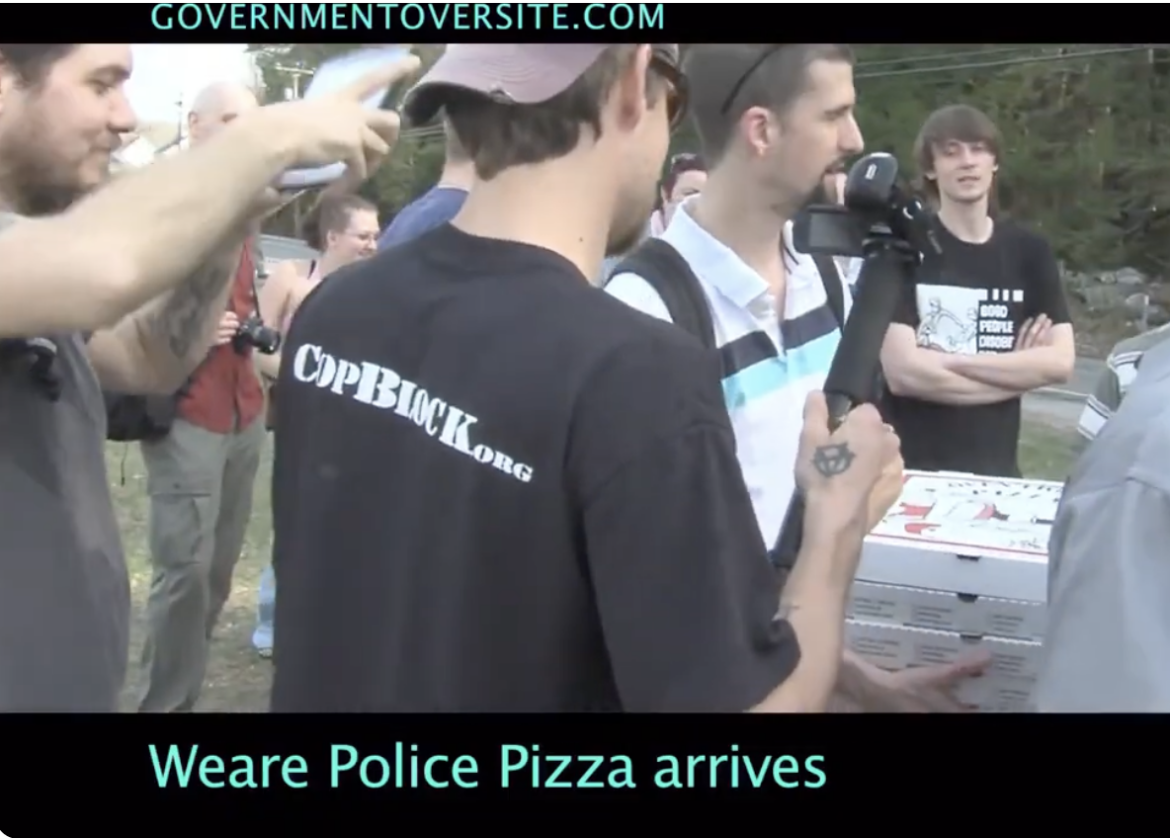
- A celebratory protest outside Weare PD drew 30-40 people with flags, grilling, and honking; police reportedly sent pizzas with a cheeky note (“from your porky pig friends”).
The Landmark Civil Lawsuit: Gericke v. Begin (2014)
- Filed as a §1983 action alleging retaliatory prosecution and First Amendment violations (right to gather information about government officials performing public duties — framed under freedom of the press).
- Seth Hipple (then a young attorney — noted as one of the youngest to argue before the 1st Circuit in this matter) and Stephen Martin handled the case. Strategy focused on the First Amendment rather than Fourth Amendment issues.
- District Court: Some claims survived; officers moved for qualified immunity.
- 1st Circuit Court of Appeals (May 23, 2014): Unanimous 3-0 decision (opinion by Judge Lipez, with Judges Thompson and Selya).
- Held that there is a clearly established First Amendment right to openly record police performing their duties in public (including routine traffic stops).
- Officers have no reasonable expectation of privacy when acting in public.
- Nighttime/rural setting did not create a meaningful distinction from the earlier Glik v. Cunniffe precedent (2011, daytime Boston Common recording).
- Denied qualified immunity on key claims (especially the retaliatory wiretapping charge).
- The camera’s failure to record was treated as irrelevant — the arrest was based on the perceived recording.
Outcome & Broader Impact
- The town/ department settled for $57,500 (no admission of wrongdoing).
- The ruling has been cited in dozens of cases (Hipple mentions over 70) across the 1st Circuit (NH, MA, ME, RI) and beyond, including Puerto Rico. It strengthened and clarified the right to record in the Northeast, building directly on Glik.
- Ripple effects: Prompted body camera adoption in Weare, leadership changes at the department, and influenced policy/discussions on public recordings, dash cams, and body cam disclosure rules in NH.
Behind-the-Scenes & Reflections
- Depositions were combative and sometimes absurd (e.g., questions about “free staters and raw milk,” “thin blue line” meaning literally the line on pants).
- Police reports and testimony had notable inconsistencies exposed under questioning.
- Hipple was aggressive in negotiations and oral arguments; the panel (including strong First Amendment protector Judge Selya) grilled defense counsel.
- Both reflect on the visceral fear of the arrest, the power of video as objective evidence (“roll the tape”), and how the case shifted dynamics from “officer says vs. citizen says” to documented accountability.
- Personal lessons: Carla discusses the emotional toll and importance of documenting government actions; Seth touches on career impact, dealing with “lies in reports,” and the rarity of denying qualified immunity.
- Broader context: Ties into Free State Project activism, multiple related lawsuits against Weare PD at the time, and ongoing fights for transparency.
The conversation occasionally digresses into social media, outrage culture, and personal growth (e.g., detoxing from constant negativity), but stays grounded in the case as a pivotal “banger” victory that turned one stormy-night arrest into lasting precedent for citizen oversight of police.
If you’d like a shorter version for social media, key quotes pulled out, or a focus on specific parts (e.g., just the 1st Circuit ruling or Seth’s legal insights), let me know! The full video is worth watching for the relaxed, insider storytelling.
Here’s a clear, structured summary of the YouTube live video you linked:
Title: Weare It All Began PART 2 | The Independents (After Hours)
Channel: Carla Gericke
Length: Approximately 1 hour 31 minutes
Style: Casual, anniversary-style retrospective with video clips, personal stories, and reflections. It’s a relaxed conversation between longtime Free State Project friends, mixing humor, outrage at police behavior, and lessons on accountability.
Speakers
- Carla Gericke (host) — shares her arrest experience and moderates.
- William Kostric (main guest) — recounts his own arrest that same night and his perspective as someone trying to help.
- Brief mentions/clips feature Ian Freeman, various Weare officers (e.g., Bob Peterson as the “reasonable” one, Chief Beegan, Lt. Brandon Montplaisir/Montier, Lt. Jim Carney), and other activists.
Core Story: The Night of March 24, 2010 (The “Dark and Stormy Night”)
The video dives into the intertwined arrests of Carla Gericke and William Kostric during/after the same traffic stop in Weare, NH.
- Carla’s Arrest (recap with new details):
Around 11:30 p.m. on a stormy night, Carla was pulled over for speeding on NH-114 while following a friend. She openly filmed the officers with a new video camera (birthday gift). Officers grew suspicious of a red light on her camera/phone, mistaking it for a gun scope or “sniper rifle” — they feared she was “lining up to shoot” them from the nearby school parking lot. She was ordered back in her car but continued filming. Escalation led to arrest: tight handcuffs (she complained of pain and swelling; officers allegedly tightened them further), impounded car with personal items (including a pocket Constitution) rummaged through in a “mean for the sake of mean” way. She spent the night in a cell, describing it as feeling like a “bad cop movie.” - William Kostric’s Arrest (the new/expanded focus):
Kostric arrived at the Weare Police Department shortly after to bail Carla out. Upon entering, officers immediately confronted him, accusing him of filming/privacy violations — even though he wasn’t recording at that moment. They demanded he leave. When he stepped outside to the public sidewalk (still trying to resolve the bail situation), they arrested him for trespassing (claiming he didn’t leave fast enough) plus absurd wiretapping charges (despite no recording) and profanity (for cursing while complying).
He was detained overnight; the two could hear/communicate through doors during fingerprinting/processing. A court bailiff later whispered recognition: “This is very weird” upon seeing them as “Free Staters.” - How the Arrests Intertwined:
Kostric’s attempt to help Carla directly triggered his own arrest, turning one traffic stop into a double detention. Both faced overlapping charges involving wiretapping (a pattern the department used against activists filming or perceived as filming). The night highlighted police aggression, inconsistencies in reports, and discomfort with public oversight.
Video Clips & Behind-the-Scenes Stories
The episode plays rare footage:
- Activists (including Ian Freeman) the next day confronting officers at the station about confiscated cameras, firearms, and vehicles — with no receipts provided. Officers dodge questions, close the station early, and refer everything to the chief.
- Humorous/absurd moments: Police allegedly sent “all-meat” pizzas to a protest barbecue on the lawn with a sarcastic note (“Porky Pig special from your friends at the Weare PD”). Dumpster flowers, honking, and grilling ensued.
- Other anecdotes: An officer with white powder on his nose; misreported police claims that Carla was “screaming ‘remember the cause’ while running”; the shift from aggressive behavior the night of the arrests to sudden politeness the next day when activists showed up armed with cameras.
Legal Outcomes & Reflections
- Carla’s Case: Led to the landmark Gericke v. Begin (1st Cir. 2014), which affirmed the First Amendment right to openly record police in public (including traffic stops), denied qualified immunity on key claims, and resulted in a $57,500 settlement. Chief Beegan was later fired.
- Kostric’s Case: Not litigated to the same degree (charges dropped or resolved quietly); the focus remains on the shared experience and broader pattern of retaliation against Free State Project members.
- Broader impact discussed: The arrests helped push Weare PD toward body cameras, exposed “lies in reports,” and reinforced the importance of filming police (“public servants on the job have no reasonable expectation of privacy”). They criticize qualified immunity as giving officers “extra rights,” lament growing surveillance culture, and slam proposed bills like HB145 that would restrict recording.
Tone & Key Themes
The conversation is proud, defiant, and laced with dark humor — celebrating how one stormy night of overreach “backfired” on the department and became a catalyst for accountability. Recurring messages:
- Always record police in public.
- Documentation shifts power from “officer’s word” to verifiable truth.
- Free State activism often triggers strong reactions from authorities.
- Privacy is “dead” in the modern surveillance age anyway.
This PART 2 complements the earlier videos (with Seth Hipple) by adding Kostric’s firsthand account, making the events feel more like a connected group story rather than just Carla’s solo ordeal. It includes more raw emotion about the meanness (e.g., tightened cuffs) and lighter moments (pizza note, barbecue).
If you’d like a shorter version for sharing, key quotes extracted, a comparison across all three videos, or help turning any part into a post/anniversary note, just say the word!