Good morning, Chairman and members of the Committee on State–Federal Relations and Veterans Affairs.
Thank you for the opportunity to testify today in strong support of House Resolution 33, which affirms the State of California’s request to divide into two states by supporting the passage of California Assembly Joint Resolution 23.
My name is Carla Gericke. I am a New Hampshire resident and a longtime advocate for decentralization, states’ rights, and self-governance. I am here today because HR33 speaks to a foundational American principle: the right of a people to self-determination.
HR33’s preamble captures this clearly:
“Whereas, the right of a people to self-determination through the creation of a new political entity has long been a fundamental principle of American democracy and is consistent with the principles of federalism as outlined in the United States Constitution.”
This principle reaches back to the Declaration of Independence, which reminds us that governments derive their just powers from the consent of the governed—and that when a political arrangement no longer serves the people, they retain the right to alter it.
That idea is not radical.
It is American.
The U.S. Constitution itself anticipates this reality. Article IV, Section 3 explicitly allows new states to be formed from existing ones with the consent of the affected state legislature and Congress. HR33 respects that constitutional process. It does not mandate division. It does not bypass Congress. It simply affirms that Californians are acting lawfully and peacefully in seeking a structural solution to a long-standing governance problem.
California today is governed as a single political unit despite enormous geographic, economic, and cultural diversity. Coastal urban centers dominate policy outcomes due to population concentration, while inland and rural regions—home to agriculture, energy production, manufacturing, and millions of residents—find themselves subject to laws and regulations they have overwhelmingly opposed.
HR33 acknowledges this reality directly:
“Whereas, citizens and regions have long been frustrated at being subjected to laws and regulations that they and their representatives have overwhelmingly opposed but were nonetheless passed and authorized by the more populous regions.”
This is not a failure of civic participation.
It is a failure of scale.
When governance becomes too centralized and too distant, representation becomes symbolic rather than real.
Dividing California into two states—one primarily coastal and urban, the other inland and rural—would restore meaningful self-governance by aligning political authority more closely with lived realities.
Under AJR23, the proposed inland state would include approximately 35 counties and more than 10 million residents—hardly a fringe population. These citizens would gain the ability to tailor policies around water rights, energy development, housing affordability, taxation, and public safety in ways that reflect their priorities rather than being perpetually overridden by distant majorities.
HR33 also highlights an additional benefit:
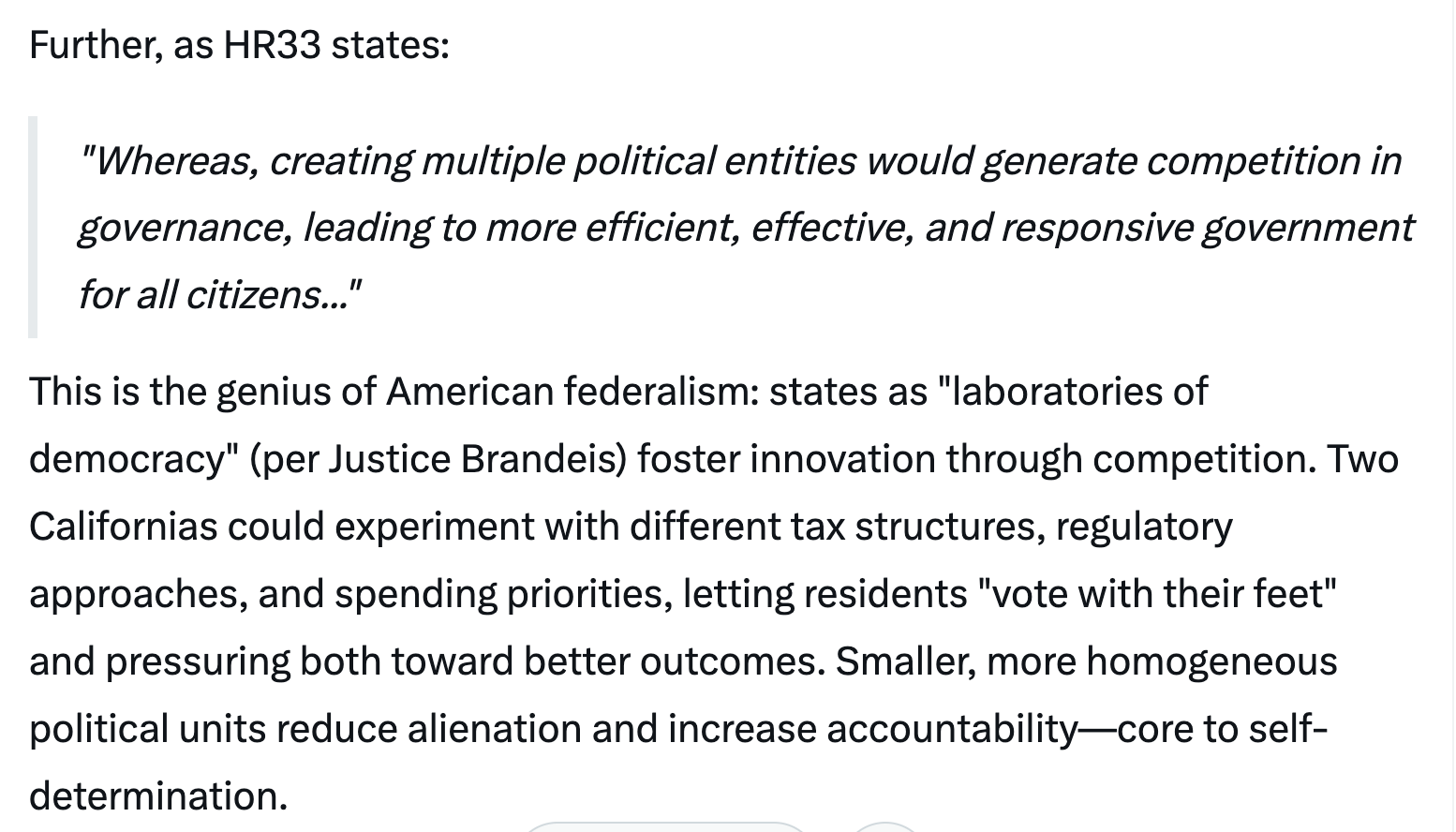
“Whereas, creating multiple political entities would generate competition in governance, leading to more efficient, effective, and responsive government for all citizens.”
This is the genius of American federalism. States serve as laboratories of democracy. Competition disciplines power. Smaller political units improve accountability. When people can “vote with their feet,” governments must earn trust rather than assume compliance.
History supports this approach. West Virginia was formed from Virginia with congressional approval. California itself has faced repeated calls for division since the 19th century, reflecting a persistent structural tension rather than a passing political dispute. AJR23 provides the constitutionally required state-level consent and properly places the final decision before Congress.
New Hampshire understands this instinct deeply.
Our motto—Live Free or Die—is not a slogan of rebellion. It is a declaration of self-rule. Supporting HR33 does not require us to agree with Californians politically. It requires us to respect their right, as Americans, to decide how closely they wish to be governed.
Passing HR33 costs New Hampshire nothing.
But it affirms something invaluable: that peaceful self-determination is preferable to alienation, that consent matters, and that federalism remains a living principle—not a relic. I urge the committee to support HR33 and affirm the right of Californians to pursue lawful, democratic self-governance.
Thank you for your time and consideration. I’m happy to answer any questions.
When small men cast big shadows, the sun is about to set (on the Empire).