Election-related posts
The Free State is still viable. The election results give us work to do, and some useful evidence about where to put our energy.
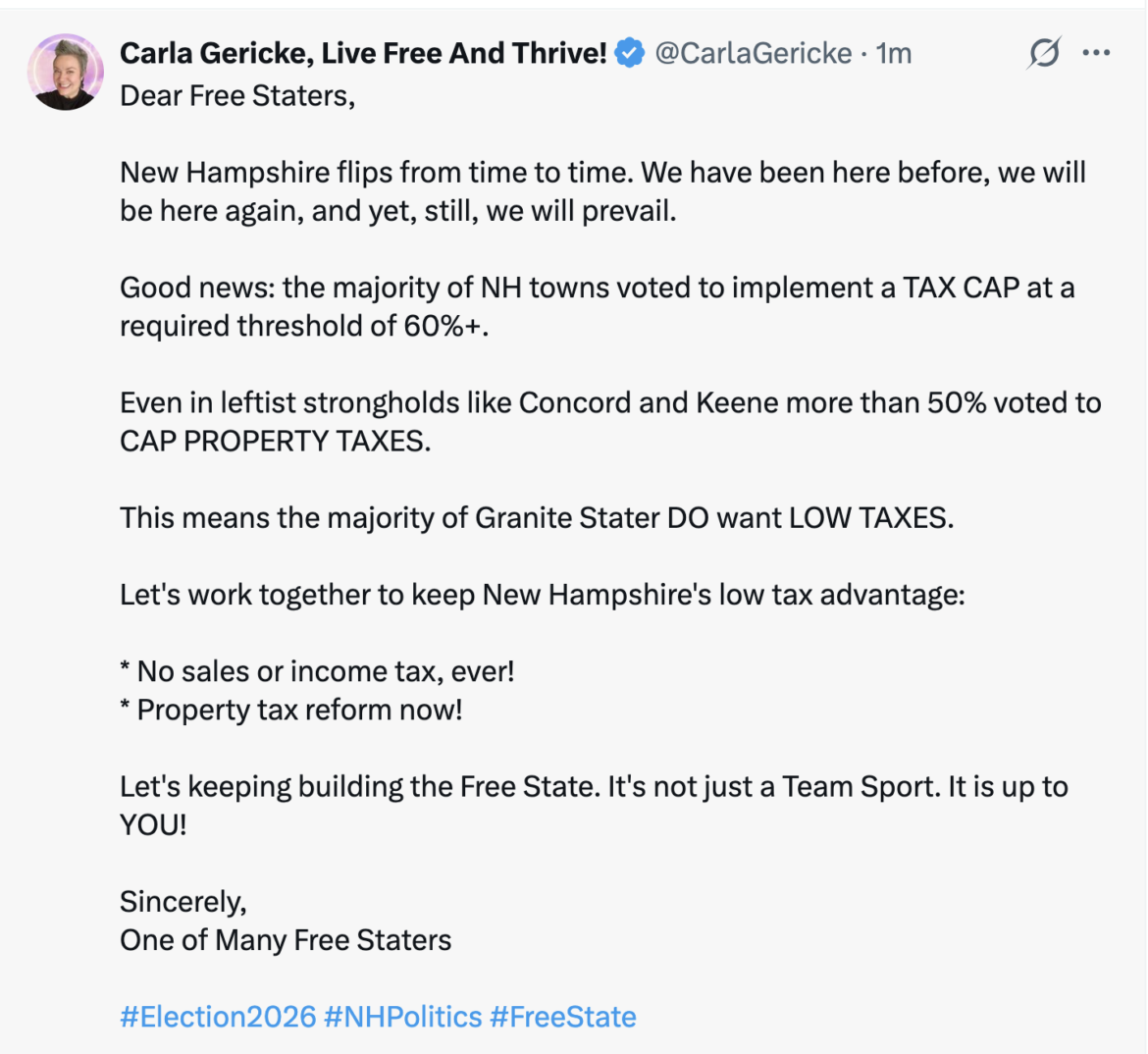
Start with this: Question 2—the local school property tax cap under HB 1300—passed in dozens of towns and districts. Where reported, the combined “Yes” vote came in just above three-fifths. Adoption required that supermajority in each jurisdiction, as would any independence question on the ballot in the future.
Apparently, “You cannot keep spending more of my money forever” still has an audience here.
Local choice. Voters using it. Taxpayers putting a boundary around the bill.
This is the Free State doing what it does best. People showing up in their own towns, making a practical case, and persuading enough neighbors to win. A supermajority of Granite Staters want to keep taxes low. This is why we are in the right state.
It’s a good time to remember that persuading our neighbors helped build the earlier wins: constitutional carry, education freedom accounts, licensing reforms, and tax changes. People moved here. Learned how things worked. Plugging away. Often for years. Often without much of an audience.
The Free State Project’s original theory of change was concentration: get enough liberty-minded people to move to one small state, put down roots, and make it freer. Build a community. Change the culture. Win elections. Repeal bad laws. Demonstrate that people can govern themselves.
That work remains available to us. So do the people, relationships, businesses, and community spaces we have spent years building. An election can change who controls the legislature. It does not erase everything we have built here.
And independence remains, to me, the logical long-term horizon.
Jason Sorens’s original essay included the possibility of separation as leverage against continued federal overreach. Peaceful independence was part of the conversation from the beginning. The Foundation for New Hampshire Independence, proposals for study commissions, and repeated legislative efforts have kept that conversation alive through peaceful, democratic means.
I prefer “independence” because it says what we want. “Secession” tends to send people straight into an argument about history before we have even discussed the future.
And the future is the point.
What could New Hampshire become if we governed ourselves? If government’s maximum role were protecting life, liberty, and property? If our future did not depend on a distant federal system that keeps demanding more money, more obedience, and more exceptions to its own rules?
Who owns you? And how far away should the people making decisions about your life get to be?
Passing a school tax cap does not make someone an independence supporter. We have to earn that argument, too. But it does show a willingness to set limits, exercise local authority, and say: enough.
That is ground we can build on.
Now, about the ground we lost.
Democrats flipped the House, the Senate, and the Executive Council. If your strategy was supposed to deliver liberty, this would be a good time to check the receipt.
The “Free State agenda” became a useful foil for organized opposition. Assassination rhetoric, endless culture-war bait, and shrinking an entire movement to one person’s feed generated attention. But attention for whom? And to what end?
If the account grows while the movement loses ground, perhaps we should stop pretending those are the same metric.
“Get famous on X” was not the assignment.
I helped build this movement. I want it to succeed. That means being willing to examine a strategy when its most visible product is the strategist’s own visibility.
The incentives matter. Social media rewards provocation immediately. Community-building pays off slowly. An inflammatory post can deliver a dopamine hit before breakfast. Recruiting a family, helping them move, and getting them settled might take months.
But only one of those puts new neighbors in New Hampshire.
There is room for sharp elbows, irreverence, and refusing to apologize for what we believe. God knows I am not proposing we become boring. But there is a difference between challenging power and feeding an outrage machine that pays you while handing your neighbors the bill.
The most visible strategy did not prevent the legislative losses, and we should examine whether it helped mobilize the opposition. We owe the people doing the work an honest accounting.
Judge the strategy by what it builds.
Did more people move here? Did we expand freedom? Did we persuade anyone? Are our communities stronger? Can the work survive the departure—or implosion—of any one personality?
Those are movement questions. Follower counts answer something else.
Which brings us to the eggs.
Do not put all your eggs in one basketcase. Not a personality. Not a party. Not a rhetorical style. And certainly not an algorithm whose business model depends on keeping everyone pissed off.
A decentralized movement should have the good sense to decentralize its efforts.
We need movers who actually arrive. Neighbors who serve on planning boards and school boards. Legislators who advance liberty and can explain why it improves ordinary people’s lives. Entrepreneurs, volunteers, families, and community spaces where people enjoy spending time together.
We need people who can win an argument without making everyone in the room wish they had stayed home.
We need builders.
The tax-cap victories show that voters can still be persuaded to restrain spending and exercise control close to home. That is a practical foundation for the next round of work—and an invitation to make the broader case for self-government.
So recruit the next mover. Welcome the new family. Show up at the meeting. Make the case for independence. Build something your neighbors want to be part of.
The Free State still has people, practical tools, hard-earned experience, and a powerful idea: we can take responsibility for our own lives and build a freer place to live.
Put the eggs in more baskets.
And stop confusing the loudest roosters with the ones doing the work.