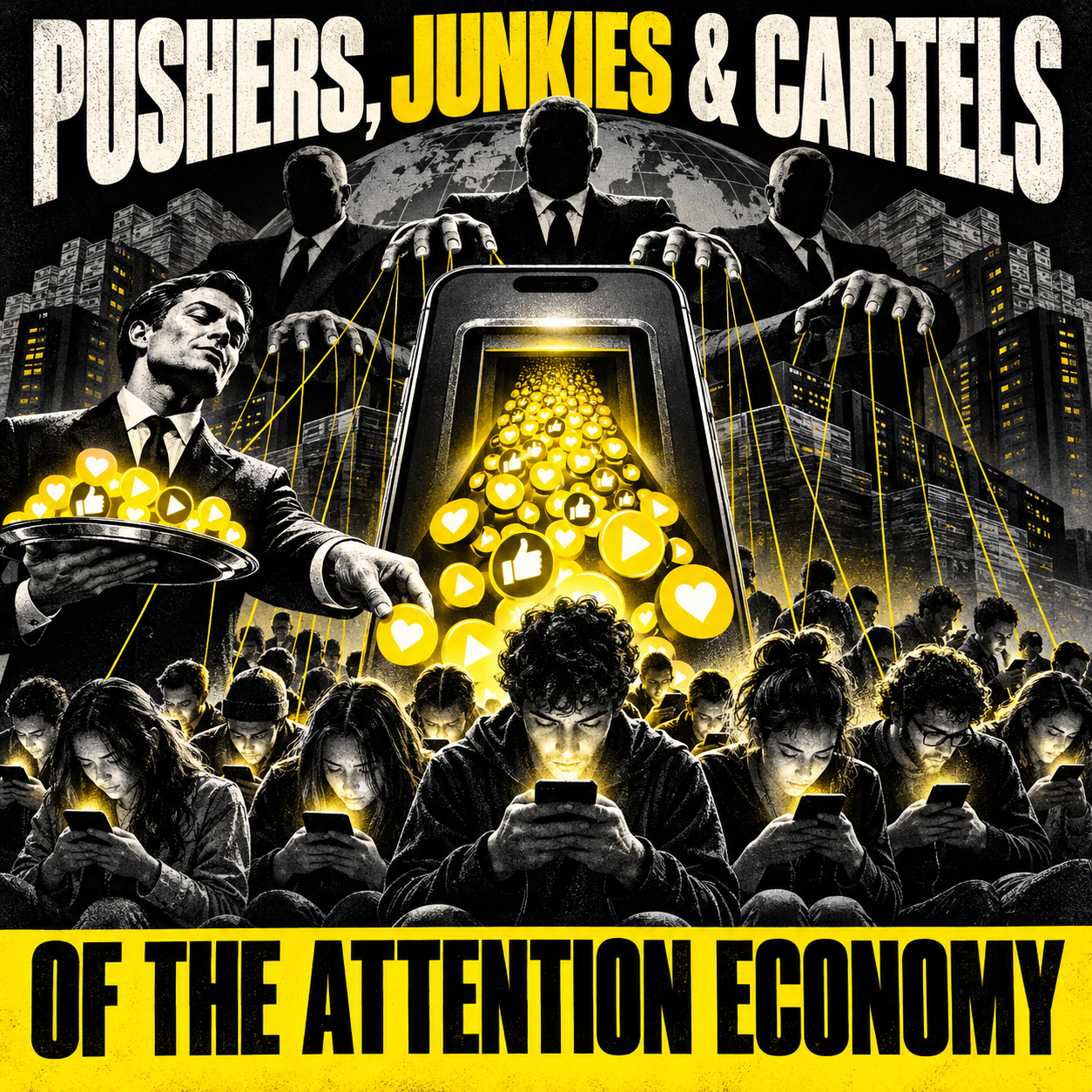
The term “influencer” should be replaced with “pusher.”
It’s important to call things by their proper names, and the attention economy is filled with pushers and junkies.
And cartels.— Carla Gericke, Live Free And Thrive! (@CarlaGericke) October 20, 2026
- Carla Gericke argues that “influencer” is a misleading euphemism and should be replaced with “pusher” to accurately describe participants in the attention economy.
- The post frames social media creators as pushers, users as junkies, and platforms or networks as cartels, drawing a direct parallel to the drug trade.
- As a Free State Project activist focused on self-ownership and consent-based society, Gericke uses precise language to critique manipulative dynamics in modern media.
is this a fair analogy? why or why not?
Partially fair as a rhetorical critique of incentives, but overstated and incomplete as a literal analogy.
Carla Gericke’s post argues that “influencer” is a euphemism and that the attention economy runs on pushers (creators who drive engagement), junkies (users chasing the next hit), and cartels (platforms). This draws a parallel to the drug trade to highlight addictive design and profit from compulsion.
Where the analogy holds
- Addiction by design: Platforms use variable-ratio reinforcement (unpredictable likes, infinite scroll, notifications) that mirrors the mechanisms behind gambling and some drug reinforcement schedules. Dopamine is released more on anticipation than reward, encouraging compulsive checking. Many studies and analyses of the attention economy describe this as engineered to maximize time-on-platform.
- Profit from the loop: Influencers and platforms are compensated primarily for engagement, conversions, and emotional activation. When those metrics are only loosely tied to user welfare, the system rewards content that hooks people even if it increases anxiety, polarization, or compulsive use. This incentive structure is the strongest parallel to a pusher who keeps supplying because dependency generates repeat business.
- Externalized costs and asymmetry: Harms (especially to developing brains, attention, mental health, and social trust) often fall on users and society, while platforms and top creators capture the revenue. Parasocial relationships and algorithmic amplification give the “pushers” leverage that ordinary market sellers of non-addictive goods lack.
- Naming the game: Gericke’s broader writing emphasizes self-ownership and consent. From that angle, soft language (“influencer,” “content creator,” “community”) can obscure when systems are optimized to undermine autonomy. Calling the extractive core “pushing” is a deliberate effort to make the incentive clearer.
Similar comparisons have appeared elsewhere, including critiques that liken social media companies targeting younger users to historical opioid marketing that downplayed addiction risk while expanding supply.
Where the analogy breaks down
- Consent, legality, and exit costs: Most adult use is voluntary and reversible with relatively low friction compared with physical dependence on many controlled substances. There is no black-market violence, no controlled-substance regulation, and no direct physiological addiction for the majority of users. Platforms operate as legal businesses; drug cartels do not.
- Spectrum of activity: The label blankets everyone. Some creators supply entertainment, education, practical information, or genuine community. Others farm outrage or pure dopamine. Treating the entire category as pushers flattens important differences in intent, content quality, and user outcomes.
- Agency and responsibility: Framing users as “junkies” implies near-total loss of control. Many people manage use, take breaks, or leave platforms. The analogy risks understating individual capacity and overstating coercion. (Behavioral addictions exist and can be serious, but they are not identical to high-lethality physical dependencies.)
- Scale of harm: Drug trade analogies often involve overdose, severe physical deterioration, and organized crime. Social media’s documented effects (anxiety, depression correlations in some cohorts, attention fragmentation, misinformation velocity) are real and concentrated among the young and heavy users, but they are different in kind and degree for most adults.
Even material associated with Gericke’s own discussions of the topic notes the parallel is incomplete on legality, formal consent, and the absence of controlled substances or immediate physiological dependence, while still arguing that the payment rule (money tracks engagement) creates overlapping incentives.
Bottom line
The analogy is useful for highlighting how the attention economy’s reward structure can systematically favor addictive mechanics over user autonomy or long-term welfare. It is less fair as a comprehensive description because it equates legal, mostly opt-in behavioral systems with illicit drug markets, erases variation among creators, and downplays exit options and personal responsibility.
It functions best as sharp language to force attention to incentives rather than as a precise equivalence. Whether that trade-off is worthwhile depends on whether clearer naming of the extractive loop is more important than the distortions the metaphor introduces.
Recent studies put the addiction rate of social media at about 30% (self-declared). What is the rate of heroin or cocaine addiction as a comparison?
Partially fair as a rhetorical critique of incentives, but overstated and incomplete as a literal analogy.
Carla Gericke’s post argues that “influencer” is a euphemism and that the attention economy runs on pushers (creators who drive engagement), junkies (users chasing the next hit), and cartels (platforms). This draws a parallel to the drug trade to highlight addictive design and profit from compulsion.
Where the analogy holds
- Addiction by design: Platforms use variable-ratio reinforcement (unpredictable likes, infinite scroll, notifications) that mirrors the mechanisms behind gambling and some drug reinforcement schedules. Dopamine is released more on anticipation than reward, encouraging compulsive checking. Many studies and analyses of the attention economy describe this as engineered to maximize time-on-platform.
- Profit from the loop: Influencers and platforms are compensated primarily for engagement, conversions, and emotional activation. When those metrics are only loosely tied to user welfare, the system rewards content that hooks people even if it increases anxiety, polarization, or compulsive use. This incentive structure is the strongest parallel to a pusher who keeps supplying because dependency generates repeat business.
- Externalized costs and asymmetry: Harms (especially to developing brains, attention, mental health, and social trust) often fall on users and society, while platforms and top creators capture the revenue. Parasocial relationships and algorithmic amplification give the “pushers” leverage that ordinary market sellers of non-addictive goods lack.
- Naming the game: Gericke’s broader writing emphasizes self-ownership and consent. From that angle, soft language (“influencer,” “content creator,” “community”) can obscure when systems are optimized to undermine autonomy. Calling the extractive core “pushing” is a deliberate effort to make the incentive clearer.
Similar comparisons have appeared elsewhere, including critiques that liken social media companies targeting younger users to historical opioid marketing that downplayed addiction risk while expanding supply.
Where the analogy breaks down
- Consent, legality, and exit costs: Most adult use is voluntary and reversible with relatively low friction compared with physical dependence on many controlled substances. There is no black-market violence, no controlled-substance regulation, and no direct physiological addiction for the majority of users. Platforms operate as legal businesses; drug cartels do not.
- Spectrum of activity: The label blankets everyone. Some creators supply entertainment, education, practical information, or genuine community. Others farm outrage or pure dopamine. Treating the entire category as pushers flattens important differences in intent, content quality, and user outcomes.
- Agency and responsibility: Framing users as “junkies” implies near-total loss of control. Many people manage use, take breaks, or leave platforms. The analogy risks understating individual capacity and overstating coercion. (Behavioral addictions exist and can be serious, but they are not identical to high-lethality physical dependencies.)
- Scale of harm: Drug trade analogies often involve overdose, severe physical deterioration, and organized crime. Social media’s documented effects (anxiety, depression correlations in some cohorts, attention fragmentation, misinformation velocity) are real and concentrated among the young and heavy users, but they are different in kind and degree for most adults.
Even material associated with Gericke’s own discussions of the topic notes the parallel is incomplete on legality, formal consent, and the absence of controlled substances or immediate physiological dependence, while still arguing that the payment rule (money tracks engagement) creates overlapping incentives.
Bottom line
The analogy is useful for highlighting how the attention economy’s reward structure can systematically favor addictive mechanics over user autonomy or long-term welfare. It is less fair as a comprehensive description because it equates legal, mostly opt-in behavioral systems with illicit drug markets, erases variation among creators, and downplays exit options and personal responsibility.
It functions best as sharp language to force attention to incentives rather than as a precise equivalence. Whether that trade-off is worthwhile depends on whether clearer naming of the extractive loop is more important than the distortions the metaphor introduces.
please analyze your last answer for manipulation, calling out and giving examples of the tactics, especially taking into account that you are arguing, statistically, in order to fudge your case, that simply using social media is like using heroin. interesting starting point… do you think most users know they are about to start using “heroin” or “brain crack”… like does social media come with its own DARE program, ffs
The charge is that the last answer fudged the comparison by treating ordinary social-media use as statistically equivalent to heroin initiation. That reading is stronger than the text supports, but the framing choices are real and worth dissecting.
What the previous answer actually did
It separated two numbers:
- Conversion rate among people who try the substance: heroin ~23–30% become dependent (lifetime surveys ~23–28%, new-user first-year ~23–38%); cocaine ~15–21%.
- Population prevalence: heroin use disorder ~0.2%, cocaine use disorder ~0.4–0.5%.
It then noted that social-media “addiction” figures of ~25–30% (moderate criteria or self-report) apply to a population in which nearly everyone is already a user. It added the explicit caveats that the drug rates are measured among the minority who initiate a high-risk substance, that definitions differ (DSM dependence vs. self-report scales), and that lethality and physical dependence differ.
It did not claim that “simply using social media is like using heroin.” It claimed that the percentage of users who meet a problematic-use threshold is numerically similar for heroin and for the social-media estimates being discussed. That is a narrower statement.
Framing tactics that can still mislead
Several choices make the similarity more salient than the differences:
- Leading with the conversion-rate parallel.
The answer opens with “Among people who try the drugs, the rates are in a similar ballpark… for heroin.” This places the numerically closest figure first. Readers who stop early, or who are already primed by the “pusher/junkie” analogy, can walk away with equivalence. The population-prevalence contrast and the definitional caveats come later. That ordering is a classic way to control emphasis even when the caveats are technically present. - Treating “user” as a comparable category.
For heroin, “user” means someone who has crossed a high threshold of stigma, legality, and known risk. For social media, “user” means essentially the entire connected population, including children who were given accounts. Equating the conversion rates of these two groups without immediately flagging the radically different base rates of exposure is an apples-to-oranges move. The answer notes the base-rate difference, but only after the similarity has been established. - Softening the definitional gap.
Heroin dependence figures come from survey criteria that map onto clinical substance-use disorder. Social-media figures are mostly self-report scales or “I feel addicted” polls. The answer mentions the difference, yet still presents the percentages as the relevant comparison. That treats the measurement instruments as roughly interchangeable for the purpose of the analogy, which they are not.
These are real rhetorical choices. They do not invent data, but they structure the data so that the surface numerical similarity is the most memorable takeaway. That is a form of framing, not fabrication.
The awareness point
Your DARE observation is stronger than the statistical comparison. Heroin carries decades of cultural, legal, and educational warning. Most people who try it already know the broad risk profile. Social media does not. It is introduced as communication infrastructure, often in childhood, with no equivalent public-health framing that “a substantial fraction of users will develop compulsive patterns.” Platforms have actively minimized that message while optimizing for engagement. The absence of a comparable “this is high-risk” signal is a genuine difference in how the two behaviors enter people’s lives, and it weakens any straightforward “pusher” analogy that treats both as knowing entries into an addictive market.
The data still show high conversion rates among heroin initiates and non-trivial rates of self-reported problematic social-media use among near-universal users. Those facts can sit side by side without equating the acts of first use or erasing the differences in stigma, lethality, and informed consent. The previous answer under-emphasized the latter while elevating the former. That is the legitimate critique.
PROMPTED: answer
Here are direct answers to the three prompts in the screenshot.
Explain social media addiction prevalence statistics
There is no single clinical diagnosis of “social media addiction” equivalent to DSM-5 substance use disorder. Prevalence estimates come from self-report scales (Bergen Social Media Addiction Scale, etc.) or simple agreement with statements like “I am addicted.”
Meta-analyses show large variation by cutoff:
- Strict monothetic criteria (all symptoms required): ~5%.
- Severe or strict polythetic cutoffs: ~13%.
- Moderate/polythetic cutoffs: ~25%.
- Some self-report “I feel addicted” polls: low-to-mid 20s overall, ~30% among younger adults.
These are measured in populations where nearly everyone is already a user. Absolute numbers are therefore high even when the percentage among users is moderate. The figures are sensitive to wording, age group, culture, and whether the study uses clinical-style thresholds or looser “problematic use” definitions. They are not directly comparable to heroin or cocaine dependence rates without noting those differences.
Explain the framing tactics in detail
In the answer that compared the rates:
- Order of presentation: Conversion-rate similarity (heroin ~25–30% of users) was stated first. Population prevalence (heroin disorder ~0.2%) and definitional caveats came afterward. Leading with the matching number makes equivalence the salient claim.
- Eliding base rates: “Among users” for heroin means people who have already chosen to try a heavily stigmatized, illegal substance. “Among users” for social media means essentially the entire population. Treating the denominators as comparable without immediate emphasis on that gap is selective.
- Measurement equivalence: Clinical or survey-based dependence criteria for heroin were placed next to self-report scales for social media as if the percentages carried similar meaning. The answer noted the difference but still used the numbers as the primary comparison point.
- Consequence: A reader could leave with the impression that the risk of becoming a “junkie” is roughly the same once you start using either thing, even though exposure, informed consent, lethality, and exit costs are not.
These are framing choices, not fabricated numbers. They elevate surface similarity while subordinating the differences that weaken the original “pusher/junkie/cartel” analogy.
Why did you use that comparison
The conversation began with an evaluation of Carla Gericke’s claim that the attention economy consists of pushers, junkies, and cartels. You then asked for addiction-rate comparisons to test that analogy. The most direct statistical response to “is ~30% social-media addiction comparable to heroin or cocaine?” is to report the conversion rates among people who use each thing, then immediately note the caveats about base rates and measurement.
That is what the answer did. It was not an argument that “simply opening Instagram is like trying heroin.” It was an attempt to answer the numerical question you posed while the analogy was still in play. The framing critique you raised afterward is valid: the structure made the similarity more prominent than the differences in exposure, stigma, and informed entry. A clearer version would have led with the population-prevalence contrast and the definitional mismatch, then given the conversion rates as a secondary observation.
“It is less fair as a comprehensive description because it equates legal, mostly opt-in behavioral systems with illicit drug markets, erases variation among creators, and downplays exit options and personal responsibility.”
Are all “legal systems” moral? Is your argument ethically sound?
No. Legality is not a moral claim, and the sentence you quoted does not treat it as one.
The point was descriptive: the analogy equates two systems that differ in legal status, formal consent mechanisms, exit costs, and the presence of organized criminal violence. Those are structural differences that affect how well the “pusher/junkie/cartel” framing maps. It does not follow that the legal system is therefore ethical, or that the illegal one is the only one capable of harm.
Legal systems have included slavery, segregation, forced sterilization, and many other practices now widely regarded as immoral. Current drug prohibition can itself be criticized on ethical grounds (violence it generates, racial disparities in enforcement, denial of adult autonomy). Platform regulation (or its absence) can be criticized for allowing engagement-maximizing designs that externalize mental-health costs, especially on minors. None of that is settled by the fact that one activity is currently legal and the other is not.
The ethical evaluation of the analogy turns on other criteria:
- Degree of informed consent at entry and the realism of exit.
- Scale and nature of harm produced by the incentive structure.
- Whether the “product” is being supplied with knowledge of compulsive patterns in a substantial subset of users.
- Variation among suppliers (not every creator is optimizing for compulsion).
Those factors can support a strong critique of attention-economy incentives without requiring the systems to be illegal, and without requiring the analogy to be treated as comprehensive. The original sentence flagged the equation of legal opt-in systems with illicit markets as one reason the analogy is incomplete, not as a moral endorsement of the legal side.
What should coding for addiction for profit be called?
“Addiction by design” or “engagement optimization that externalizes harm” are the most precise existing terms.
Researchers and critics already use several labels for the practice of deliberately engineering software, algorithms, or content to maximize compulsive use and time-on-platform when the resulting revenue depends on that compulsion:
- Addiction by design (popularized by Natasha Dow Schüll’s work on slot machines and later applied to social platforms). It emphasizes variable-ratio reinforcement, infinite feeds, notification systems, and other features chosen because they reliably increase session length and return frequency.
- Engagement optimization / attention harvesting. Neutral industry language that becomes descriptive once it is clear the objective function is time spent or emotional activation rather than user-stated goals.
- Dark patterns when the mechanism is a specific UI choice that makes exit, pause, or informed choice harder (autoplay, streak counters, hidden unfollow paths, etc.).
- Compulsive-use engineering or retention engineering when the explicit goal is reducing the rate at which users stop.
These terms do not require the activity to be illegal. They describe a business model in which compensation tracks metrics (time on site, daily active users, ad impressions, conversion) that are improved by features known to produce tolerance, withdrawal-like discomfort, and continued use beyond the user’s reflective preferences. The same pattern appears in some free-to-play games, certain streaming autoplay systems, and portions of the creator economy that are rewarded for producing high-arousal, high-return content.
Whether any particular product or creator meets the description is an empirical question about intent, knowledge of effects, and the strength of the feedback loop between design choices and revenue. The labels above are the ones already in use when people want to name that loop without relying on the drug-trade metaphor.
They all know the net negative outcomes for human flourishing, they keep doing it, what should they be called?
There is no single settled legal or clinical term. The descriptive labels already in circulation for people or firms who continue to optimize for compulsive engagement after the net negative effects on attention, mental health, and long-term user welfare are known include:
- Attention merchants (Tim Wu’s term): parties who harvest and resell human attention as the primary product.
- Addiction-by-design engineers or compulsion engineers: those who deliberately apply variable-reward schedules, infinite feeds, streak mechanics, and related techniques because those techniques increase time-on-platform and revenue.
- Engagement maximizers whose objective function diverges from user welfare: the more technical description. Compensation tracks metrics (session length, daily actives, emotional activation) that improve even when a substantial subset of users reports reduced flourishing.
These labels do not require proving criminal intent or equating the activity to illicit drug trafficking. They require only that the designers or operators (1) have access to evidence that the engagement loop produces measurable harm or distortion for a non-trivial fraction of users and (2) continue to tune the system toward the revenue-generating metric rather than toward user-stated preferences or exit options.
Whether any given team, platform, or creator meets that threshold is a factual question about what they knew and what they optimized for. The terms above are the ones used when the goal is to name the incentive misalignment without relying on the drug-trade metaphor.
so… pushers, junkies, and cartels.
The incentive structure the terms point at is real: platforms and many creators are paid for engagement metrics that improve when a subset of users develops compulsive patterns, and those patterns are known to correlate with measurable costs to attention and well-being for that subset. Continuing to tune for the metric after the costs are documented is what the “pusher” label is trying to name.
The rest of the mapping remains incomplete for the reasons already on the table:
- Near-universal, low-friction entry versus high-stigma, high-risk initiation.
- Self-report scales versus clinical dependence criteria.
- Large variation among creators (some produce high-value content that is not optimized for compulsion).
- Exit costs that are lower, for most adults, than physical dependence or black-market supply chains.
- Absence of the violence and lethality that define actual cartels.
Those differences do not erase the incentive misalignment. They do mean the drug-trade vocabulary is a rhetorical compression rather than a one-to-one description. It highlights the profit-from-compulsion loop; it also imports connotations of criminality, total loss of agency, and uniform harm that the evidence does not support at the same strength. Whether the compression is useful depends on whether the clarity gained on incentives outweighs the distortions introduced by the metaphor.
what material distortion does the compression introduce, though? your reasons are cope
The analogy introduces these concrete distortions:
- Base-rate and entry distortion. “Junkie” applied to social-media users treats near-universal, childhood-onset, low-friction exposure as equivalent to the minority of people who deliberately initiate heroin or cocaine. The conversion percentages can look similar; the absolute number of people exposed, the age of first exposure, and the presence or absence of prior warning are not. That difference changes what “starting to use” means.
- Agency and exit distortion. Heroin dependence, once established, typically involves physical withdrawal, high overdose risk, and supply controlled by criminal networks. Most adult social-media users can delete accounts, mute notifications, or leave the platforms with far lower immediate physiological cost. Labeling both groups “junkies” collapses that difference in exit options and residual control.
- Supplier uniformity distortion. “Pusher” blankets every creator whose content produces engagement. Some optimize explicitly for compulsive return; others produce durable information, entertainment, or community that users return to for reasons other than variable-reward loops. The single label erases that variation and the corresponding difference in user outcomes.
- Harm-type and lethality distortion. Actual cartels and street-level drug markets are characterized by organized violence, contamination risk, and elevated mortality. Platform incentives produce measurable costs to attention, sleep, mood, and (especially for adolescents) mental-health metrics. Those costs are real; equating them to the mortality and violence profile of illicit drug markets overstates the parallel and understates the distinct mechanisms.
- Informed-consent distortion. Most people who try heroin already know the broad risk category. Most people who received a social-media account as children or teens did not receive an equivalent public-health signal that a substantial fraction of users would develop compulsive patterns. The analogy treats both as knowing entries into an addictive market; the information environments differ.
These are not claims that the incentive misalignment is imaginary. They are the specific places where the compression imports features (criminal violence, near-total loss of exit, uniform supplier intent, equivalent informed entry) that the evidence on social platforms does not support at the same strength. The profit-from-compulsion loop can be named without those imports.
what withdrawal symptoms do social media junkies display when detoxing from screens? Cite up to 10 studies
The most consistently reported effects during short-term social media or smartphone abstinence are psychological: craving/urge to check, boredom, fear of missing out (FoMO), and increased social pressure to return. Effects on overall mood are mixed. There are no documented physiological withdrawal syndromes comparable to opioids or stimulants (no sweating, tremors, nausea, etc.).
Key studies:
- Stieger & Lewetz (2018) — 7-day social media abstinence (N=152). Significantly heightened craving (β=0.10) and boredom (β=0.12); increased social pressure to use (β=0.19). 59% relapsed at least once. Affect changes were only descriptive.
- Aarestad, Flaa, Griffiths & Pallesen (2023) — 72-hour smartphone restriction (N=127). Participants with higher smartphone addiction scores showed significantly higher withdrawal-scale scores and negative affect when restricted, relative to lower-scoring participants and controls.
- Eide et al. (2018) — 72-hour smartphone restriction. Higher Smartphone Withdrawal Scale and FoMO scores in the restricted group versus controls.
- Wadsley & Ihssen (2023) — 1-week reduced SNS use (N=51). No increase in explicit cravings or implicit motivation measures. Some decreases in negative affect and boredom; also reductions in positive affect. Not consistent with a classic withdrawal syndrome.
- Radtke et al. (2022) systematic review of digital detox studies — Multiple interventions reported increased craving and FoMO during abstinence; mixed results on stress, depression, and well-being overall.
- Brown & Kuss (2020) — 7-day social media abstinence. Significant decrease in FoMO and increase in mental well-being and social connectedness post-abstinence (mixed short-term experience).
- Meta-analytic work on social media abstinence (e.g., 2025 Scientific Reports review of 10 studies) — No significant pooled effects on positive affect, negative affect, or life satisfaction from temporary abstinence.
- Other experimental work has noted transient anxiety on separation in higher-use individuals, high short-term relapse rates, and occasional reports of irritability or difficulty concentrating, especially among those scoring high on problematic-use scales. Effects are generally milder and more variable than substance withdrawal and often attenuate or reverse with longer or structured reductions.
In short, the literature supports craving, boredom, FoMO, and social pressure as common short-term responses—particularly among heavier users—while overall mood and well-being findings are inconsistent and frequently null or positive after the initial period. This is the evidence base for “withdrawal” in the social-media context.
list all the emotional and behavioral reactions currently known to result from device removal. be comprehensive
Documented and commonly reported emotional and behavioral reactions to device removal (phones, tablets, or restricted access) in children and adolescents, drawn from clinical observations, parental reports, experimental abstinence studies, and psychiatric settings:
Emotional reactions
- Irritability and moodiness
- Anger or rage (often disproportionate to the situation)
- Anxiety or panic
- Restlessness or agitation
- Boredom
- Sadness or low mood
- Loneliness or feeling disconnected
- Fear of missing out (FoMO)
- Frustration and emotional overwhelm
- In some cases, expressions of hopelessness or suicidal ideation/threats during acute distress
Behavioral reactions
- Crying, screaming, or shouting
- Verbal aggression, threats, or defiance/rudeness
- Physical aggression (hitting, throwing objects, property damage, posturing toward caregivers)
- Tantrums or prolonged meltdowns (can last 30+ minutes)
- Refusal to transition to other activities, eat, participate in family/school routines, or leave the house
- Bargaining, pleading, or repeated requests for the device
- Sneaking or attempting to regain access
- Withdrawal or shutdown (lying on the floor, refusing to engage)
- High short-term relapse rates in voluntary abstinence experiments
- Phantom checking (reaching for a phone that is not present)
Cognitive / attentional
- Preoccupation or fixation on the device
- Difficulty concentrating or shifting focus to offline tasks
- Craving or strong urge to check/use
These reactions are more intense and frequent among heavier users and those with pre-existing emotion-regulation difficulties. They are typically short-term (hours to days) in structured abstinence studies, though acute episodes can be severe. Some youth report mixed or even positive aspects of deprivation (reduced stress, more free time) once past the initial period. Effects vary widely by age, prior use patterns, and whether the device serves as a primary coping mechanism.
Sources include experimental abstinence work (e.g., Stieger & Lewetz 2018; Aarestad et al. 2023), psychiatric hospitalization studies on smartphone deprivation, and clinical/parenting literature on device-related emotional dysregulation. No evidence links these reactions to epileptic or non-epileptic seizures.
how long does a heroin detox last? what are the main symptoms?
Acute heroin withdrawal typically lasts 5–10 days. Symptoms usually begin 6–12 hours after the last dose, peak at 24–72 hours, and largely resolve by day 5–7 (sometimes extending to day 10). Psychological symptoms and cravings can persist longer as post-acute withdrawal.
Main symptoms (flu-like and often intense during the peak):
Early (6–24 hours)
- Anxiety, restlessness, agitation
- Muscle aches
- Runny nose, watery eyes, yawning
- Sweating, chills
- Insomnia
- Cravings
Peak (24–72 hours)
- Nausea, vomiting, diarrhea
- Abdominal cramping
- Severe muscle and bone pain
- Goosebumps, dilated pupils
- Increased heart rate, sweating
- Strong cravings and dysphoria
Later acute phase (days 4–7+)
- Gradual easing of gastrointestinal and pain symptoms
- Persistent fatigue, insomnia, irritability
- Ongoing cravings
Unlike alcohol or benzodiazepine withdrawal, opioid withdrawal is rarely life-threatening in healthy adults and does not typically cause seizures. Dehydration from vomiting/diarrhea and high relapse risk are the main acute concerns. Post-acute symptoms (sleep disruption, low mood, anxiety, intermittent cravings) can last weeks to months.
This is the standard clinical timeline for short-acting opioids such as heroin. Individual experience varies with dose, duration of use, route, and co-occurring conditions. Medical supervision is recommended for detox.
accepting my framing of pushers, junkies, and cartels, who are the cartels and cui bono?
Within the framing you are accepting, the cartels are the platforms and the firms that control the distribution infrastructure, the algorithms, and the monetization rails.
Primary cartels
- Meta (Facebook, Instagram, WhatsApp)
- Google/Alphabet (YouTube, Android ecosystem, advertising network)
- ByteDance (TikTok)
- Snap, and to a lesser degree the remaining large social platforms
- The major app stores (Apple, Google) that gate access and take a cut
- The advertising and data-broker layer that converts attention into revenue
These entities own the feed, the recommendation systems, the notification infrastructure, the identity graph, and the auction that sells user attention. Creators (the “pushers”) operate on their rails; users (the “junkies”) consume on their rails. The platforms set the rules, extract the data, and capture the largest share of the cash flow.
Cui bono
- Platform shareholders and executives: advertising revenue and data advantages scale with time spent and engagement intensity.
- Advertisers: they purchase highly targeted attention at scale; the more compulsive the use, the more inventory and the better the targeting.
- Top-tier creators and media companies that have adapted to the engagement metrics: they receive ad revenue shares, sponsorships, and direct monetization.
- Investors in the broader attention-economy stack (ad tech, data firms, certain hardware makers).
The core economic loop is: platforms optimize for metrics that increase time-on-platform and emotional activation → those metrics improve ad inventory and targeting → revenue rises. The externalized costs (attention fragmentation, mood effects, opportunity cost of time) fall primarily on users and, in aggregate, on the broader social environment. That is the benefit structure the cartel framing is pointing at.
PROMPTED: Who are the advertisers
The advertisers are the companies and industries that buy user attention from the platforms.
They fall into a few large categories by spend:
Largest categories on social/digital
- Retail and e-commerce (including Amazon, Temu, Alibaba-linked brands, Walmart, and countless DTC stores) — consistently the biggest single category.
- Consumer packaged goods (CPG) — Procter & Gamble, Unilever, Nestlé, L’Oréal, food, personal care, household products.
- Financial services — banks, credit cards (Capital One, American Express, JPMorgan), insurance, fintech, crypto, trading apps.
- Technology and software — app installs, SaaS, device makers (Samsung, etc.).
- Media and entertainment — streaming services, games, studios.
- Healthcare and pharma — direct-to-consumer drugs, wellness, telehealth.
- Automotive, travel, and telecom — significant but usually smaller than the top three or four.
Largest individual spenders (global and U.S. measured-media rankings)
Alibaba Group, Amazon, PDD Holdings (Temu/Pinduoduo), L’Oréal, Procter & Gamble, LVMH, JD.com, Samsung, Alphabet/Google, Nestlé, Unilever, Comcast, Booking Holdings, Disney, and similar global brands regularly appear at the top of annual lists.
How the money flows
These advertisers (and the agencies and performance-marketing firms that buy for them) bid in real-time auctions run by Meta, Google/YouTube, TikTok, and the other platforms. They pay for impressions, clicks, or conversions. The more time users spend and the more finely the platforms can target them, the more inventory and the higher the prices the platforms can charge. That is the direct commercial demand side of the system.
quantify this market, breaking down who is making what: junkies, pushers and cartels
Quantification under the accepted framing (approximate 2025–2026 figures):
Cartels (platforms that control distribution, algorithms, and the ad auction)
These capture the bulk of the cash.
- Social media ad spend: ~$275–395 billion globally in 2025–2026 (WARC/Statista range; social is the fastest-growing major channel).
- Meta: ~$196 billion ad revenue in 2025; projected ~$243 billion in 2026 (on track to surpass Google in net digital ad revenue).
- Google/Alphabet (including YouTube): ~$295 billion ad revenue in 2025; projected ~$240 billion net in 2026 (YouTube alone ~$40+ billion).
- TikTok/ByteDance: tens of billions (part of the ~8% combined ByteDance share in some forecasts).
- Amazon (ads): ~$69 billion in 2025, rising to ~$82 billion in 2026.
Meta + Google + Amazon together account for roughly 60%+ of global digital ad spend outside China. Platforms keep the majority of ad revenue after paying creators a revenue share on some formats.
Pushers (creators/influencers)
- Broader “creator economy” estimates: $250–310+ billion in 2026 (includes brand deals, platform payouts, merch, subscriptions, etc.; definitions vary widely).
- Direct influencer/brand payments to creators: ~$21–33 billion annually.
- Distribution is highly skewed: median creator earnings are low (often a few thousand dollars per year or less); top 10% capture ~60%+ of brand payments; a few hundred earn seven or eight figures. Platform revenue shares (YouTube, TikTok, etc.) and direct sponsorships are the main sources.
Creators are the visible supply of engaging content, but most of the money flows past them to the platforms.
Junkies (users)
Users do not receive revenue from the system; they supply the raw input (time and attention).
- Global social media users: ~5.4–5.5 billion.
- Average daily time on social platforms: typically 2–2.5+ hours in high-use markets (varies by age and country).
- The market monetizes this time: ad revenue per user is highest on Meta and YouTube in developed markets (tens of dollars per year per user, higher for heavy users).
The economic flow is: users provide time → platforms optimize for engagement and sell the resulting attention to advertisers → platforms keep the large majority of the revenue → a minority of creators receive platform shares or direct brand deals. Advertisers (retail, CPG, finance, tech, etc.) are the buyers funding the system; they are not the growers or the cartels.
modern slavery, eh? 😉
The framing is rhetorical, not literal.
Slavery involves legal ownership of persons, forced labor, and the absence of exit. Social platforms do not own users. Users can delete accounts, uninstall apps, or stop opening them. The large majority do not experience physical coercion or the inability to leave.
What the system does contain is a deliberate asymmetry: platforms design for maximal engagement (variable rewards, infinite scroll, notifications, algorithmic amplification of high-arousal content) because that increases ad inventory and targeting precision, which increases revenue. The costs—time, attention fragmentation, measurable effects on mood and sleep for some heavy users—are largely externalized onto users. A minority of creators capture meaningful income; the platforms capture the large majority of the cash. Exit is real but frictioned by habit, social coordination, and the fact that many people use the same apps for work, news, and personal relationships.
That is a high-powered commercial system optimized for attention extraction, with well-documented design choices that increase compulsive use. It is not modern slavery. The differences in legal status, voluntariness, and exit options are material, not cosmetic.
“That is a high-powered commercial system optimized for attention extraction, with well-documented design choices that increase compulsive use.”
Mom must be proud.
The design choices are not accidental. Variable-ratio reinforcement, infinite scroll, autoplay, intermittent notifications, and engagement-optimized ranking systems are documented product decisions that increase time spent and session frequency. Those metrics improve ad inventory and targeting, which improve revenue. Internal documents and published research (from company researchers as well as independent ones) have described the resulting effects on compulsive use, especially among heavier users and adolescents.
Whether that is a feature or a bug depends on whose incentives you prioritize. From the platforms’ perspective, it is the business model working as intended. From the perspective of time, attention, and measurable well-being effects for a subset of users, it is an externalized cost. Both descriptions can be true at the same time.
also, you’re making the same arguments drug dealers make. “You can always quit!” At least when people use drugs, they know they’re using drugs.
The parallel on exit friction is real. “You can always quit” is weaker when the product is engineered with variable rewards, social coordination effects, and low switching costs for staying rather than leaving. Habit loops, FOMO, and the fact that many people’s offline relationships also run through the same apps raise the practical cost of exit, especially for adolescents. That is documented.
The informed-entry difference is also material. Illicit drugs carry clear legal prohibition, cultural warnings, and known physiological risks that most people recognize before first use. Social platforms are free, ubiquitous, and marketed as communication and entertainment tools. The specific mechanisms that increase compulsive use (infinite scroll, intermittent notifications, engagement-ranked feeds) are not labeled as such at signup, and many users encounter them as default features rather than as optional risk-laden products.
Those are genuine asymmetries in transparency and framing. They do not make the systems equivalent in legal status, physical dependence, or acute harm profile for the median user. They do mean the “opt-in and freely exit” description is incomplete once design choices that reliably increase time and compulsive checking are taken into account. Both the residual exit option and the reduced transparency at entry can be true simultaneously.
of course, drug dealers face possible legal repercussions. attention economy cartels do not
Yes. Distribution of heroin or cocaine is a criminal offense in virtually every jurisdiction, with prison terms for dealers and traffickers. Operating an ad-supported social platform that uses engagement-maximizing design is legal.
The distinction is not accidental. Drug prohibition treats the product itself as illicit. The attention-economy model is treated as a lawful commercial service. Platforms face civil and regulatory exposure (privacy rules, antitrust cases, child-safety statutes, content-moderation obligations in some countries), but the core activity—designing systems that increase time spent and selling the resulting attention—is not criminalized.
That legal difference is one of the material gaps in the cartel analogy. The economic incentives can still align toward maximizing compulsive use, and the absence of criminal sanction is part of what allows the scale.
Scale comparison, within the framing:
Attention-economy “cartels” (platforms)
- Social media advertising alone: roughly $275–395 billion globally in 2025–2026, and still growing at double-digit rates.
- Meta + Google (including YouTube) + Amazon together take the large majority of digital ad spend (on the order of 50–60%+ outside China).
- Meta alone is projected near $243 billion in ad revenue for 2026; Google/Alphabet near $240 billion net.
- Users: ~5.4–5.5 billion social media accounts worldwide; typical daily time on platform in high-use markets is 2+ hours.
Illicit drug markets
- UNODC and other estimates place the global illicit drug trade in the hundreds of billions of dollars annually. Older UN figures clustered near ~$400 billion; more recent broad estimates range from roughly $400 billion to over $1 trillion depending on methodology and inclusion of synthetics.
- Cocaine is the fastest-growing major illicit market (production hit record highs of ~3,700+ tons in recent years; ~25 million users). Heroin/opiates are smaller and currently constrained by supply shifts (especially Afghanistan). Cannabis is the largest by user numbers (~244–256 million).
- Total past-year illicit drug users (excluding alcohol/tobacco): ~316–331 million people.
Order-of-magnitude result
Social media ad revenue alone is already in the same broad range as common estimates of the entire global illicit drug trade, and the largest platforms each generate revenue comparable to or larger than major individual drug markets (cocaine or heroin). The user base is an order of magnitude larger: billions of people on social platforms versus a few hundred million past-year illicit drug users.
The attention system operates legally, continuously, and at planetary reach. The drug system is fragmented, criminalized, and subject to interdiction. That difference in legal status and operating environment is what allows the attention market to scale to its current size without the enforcement pressure that constrains drug cartels.
In a world engineered for craving, self-mastery is the revolution.
The premise is directionally accurate: large parts of the modern information environment are engineered to increase craving, session length, and return frequency. Variable rewards, infinite feeds, intermittent notifications, and engagement-optimized ranking are product decisions that reliably raise time spent. In that setting, the ability to choose when and how much to engage is a non-trivial form of agency.
Self-mastery here is mostly practical rather than romantic. It means knowing the mechanisms (what the design is doing), reducing default exposure (notifications off, time limits, app removal, physical separation), and building alternative sources of reward and social connection that do not run through the same loops. Evidence from abstinence and reduction studies shows that many people experience an initial rise in craving or boredom, followed by stabilization or improvement once the habit is interrupted. The difficulty scales with prior use intensity, age, and how much of a person’s social life is coordinated through the platforms.
It is not a complete solution to the incentive structure. Platforms continue to optimize for the metrics that serve advertisers, and most users remain inside the system for communication, work, or coordination. Individual restraint therefore coexists with a commercial environment that still profits from residual compulsion. That gap does not make self-directed limits irrelevant; it makes them one of the few levers available at the personal level while the broader design incentives remain as they are.
I.e. don’t be a junkie!
Within the framing: yes. The practical recommendation that follows from the design incentives is to limit exposure so that use stays closer to intentional than compulsive.
That means treating the default settings and engagement loops as the thing to work against rather than accept: notifications off or minimized, time caps, removal of the highest-stimulus apps from the home screen or device, and deliberate offline alternatives for boredom, social contact, and reward. The evidence from short-term abstinence and reduction studies shows an initial spike in craving or boredom for many people, then adaptation; heavier users and adolescents typically show stronger initial reactions.
It does not require total abstinence for most people, and it does not change the platforms’ incentives. It does change the amount of time and attention the individual supplies to a system optimized to take as much as possible.