My response:
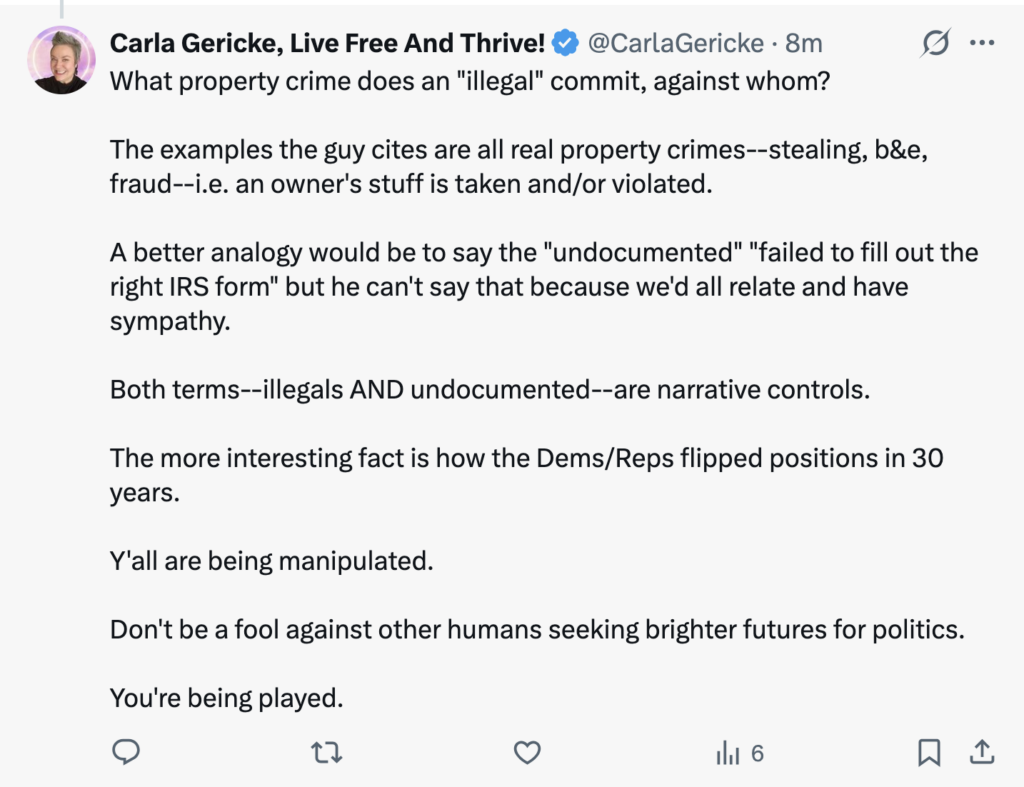
GROK’s analysis of my answer:
Carla Gericke disputes Stephen Miller’s analogy by arguing illegal immigration isn’t a direct property crime like theft, burglary, or fraud, as it lacks an identifiable owner whose possessions are violated.
She calls both “illegal” and “undocumented” framing devices for narrative control, suggesting illegal entry resembles a paperwork violation like missing an IRS form that most people would view sympathetically.
Gericke notes the Democratic and Republican parties have reversed their immigration positions over the past 30 years—from bipartisan enforcement in the 1990s to today’s polarized divide—and cautions against being manipulated against migrants seeking better lives.
is she correct?
She is largely correct on the legal classification and the party-history point, and only partially correct on the analogy and “narrative control” framing.
Illegal entry (8 U.S.C. § 1325) is a federal crime—misdemeanor on first offense, felony on subsequent or re-entry after removal. Unlawful presence after a legal entry (visa overstay) is generally a civil violation, not a crime. Neither is a property crime. Property crimes require taking or damaging someone else’s specific property. Miller’s bank-robber / house-breaker examples were rhetorical, not a statement of criminal-law categories. Gericke is right that those examples do not match the statute.
Her IRS-form analogy captures the “regulatory/paperwork” flavor of many immigration violations better than theft does. It is still imperfect: immigration law also regulates who may enter and remain in a sovereign territory and who may access public goods. The “victim” is collective (taxpayers, wage-earners in certain sectors, rule-of-law expectations) rather than a single owner whose house was broken into. That distinction does not make the violation imaginary; it just makes it a different kind of violation.
Both “illegal alien” and “undocumented immigrant” are loaded terms chosen for political effect. That observation is fair.
The party-position claim is also substantially true. In the mid-1990s Democrats and Republicans jointly passed the Illegal Immigration Reform and Immigrant Responsibility Act and used similar enforcement language. Over the following decades Democrats shifted toward legalization and reduced emphasis on interior enforcement; Republicans shifted toward restriction and border security as a core identity issue. Polarization on the topic increased sharply after the late 1970s/early 2000s.
The rest of her post—“you’re being played,” “don’t be a fool against other humans”—is opinion, not a factual claim that can be scored true or false.
who benefits from the polarization? what benefits are available to illegals that are not also available to Americans, if any?
Political polarization on immigration is useful to several groups at once. Parties and candidates use it to raise money and turn out their bases; restrictionist and immigrant-rights organizations raise donations and staff around it; media and influencers gain engagement. That does not require a single coordinated plot. High-salience conflict reliably produces fundraising and attention, which is why both sides keep amplifying the sharpest versions of the issue.
On benefits, undocumented immigrants are barred from most federal means-tested programs that citizens can receive. They are ineligible for SNAP, TANF, SSI, full Medicaid, Medicare, Social Security, ACA marketplace subsidies, and federal housing assistance. They also cannot claim the Earned Income Tax Credit. Many still pay payroll taxes (often via ITIN or borrowed SSNs) without ever collecting Social Security.
What they can receive is narrower and usually also available to citizens:
- K–12 public school under Plyler v. Doe (1982). Citizens get the same.
- Emergency-room stabilizing care under EMTALA, plus Emergency Medicaid if they meet the state’s income rules. This covers acute emergencies (labor/delivery, life-threatening conditions), not routine care. Citizens who qualify get full Medicaid or Medicare instead.
- School meals, WIC in most states, immunizations, and sliding-scale care at some community health centers.
- A handful of state-funded programs (California, New York, and a few others have used their own money for extra coverage). Those are not federal entitlements and vary by legislature.
U.S.-born children of undocumented parents are citizens and can receive SNAP, Medicaid, and other benefits the same as any other citizen child. That is birthright citizenship, not a special program for the parents.
There is no major federal cash, food, housing, or retirement benefit that undocumented adults get and citizens cannot. The main differences run the other way: citizens have far broader access. State and local add-ons exist, and emergency or in-kind services exist, but they are not a parallel welfare system reserved for people here illegally.
so basically, a crazy amount of noise that divides humans but benefits politicians and their cronies?
Mostly yes on the incentives, with one important caveat.
The volume of rhetoric is far larger than the set of unique federal benefits undocumented adults actually receive. That mismatch is real. Parties, consultants, PACs, advocacy groups, and media all do better when the issue stays hot and binary. Donors and small-dollar online audiences reward intensity more than compromise. That part is not mysterious.
The caveat is that the underlying disagreement is not only theater. People reasonably disagree about whether large-scale unauthorized presence is mainly a paperwork problem, a labor-market shock, a fiscal transfer, a sovereignty issue, or a humanitarian one. Those are substantive questions even if the language used to argue them is often inflated.
So: a lot of the noise is produced because it pays. That does not mean every concern is fake, or that every politician is only a crony. It means the incentive structure systematically rewards the version of the argument that divides first and measures later.
I remember a better America, where illegals were paid cash under the table to do household and garden work you didn’t want to do, and blame the Democrats in the 90s from politicizing that and making America less great
The cash-under-the-table household and garden arrangement never disappeared. It still happens. What changed is scale, visibility, and how both parties talk about it.
The 1990s were not the moment Democrats uniquely “politicized” a quiet informal labor market. That decade was one of the last stretches of bipartisan toughness. Bill Clinton signed the 1996 Illegal Immigration Reform and Immigrant Responsibility Act, expanded border operations (Gatekeeper), and signed welfare reform that cut most federal benefits for non-citizens. The 1996 Democratic platform used language that would sound restrictionist today. Employer sanctions had already been on the books since Reagan’s 1986 IRCA; they were just weakly enforced.
The unauthorized population still grew through that period—from roughly 3.5 million in 1990 to about 8.4 million by 2000—because labor demand, weak interior enforcement, and family networks outran the statutes. Polarization sharpened later, especially after the mid-2000s, when Democrats moved toward legalization/humanitarian framing and Republicans made restriction a core identity issue. Blaming only one party in the 1990s does not match the legislative record.
Nostalgia for “they just did the work nobody wanted, paid cash, nobody made a national issue of it” describes a smaller, less visible shadow market. Once the numbers, costs, and political payoff got large, both sides found it useful to treat the same workers as either a crisis or a moral cause. The informal jobs did not vanish; the incentive to turn them into a permanent campaign issue did.
the simple core issue is WHO CAN VOTE. As long as only US citizens can, and that should be it, shouldn’t libertarians be pro-human-movement-for-betterment?
Hating on “illegals” is a dopamine/outrage hack that is outta control and makes dumb people easily manipulated.
IMO, any libertarian on this bandwagon who isn’t simply addressing the question of WHO CAN VOTE, is part of the problem… the easily-manipulated “noticers” on the fringes of the horseshoe keep feeding the machine more noise like good little soldiers…
Voting eligibility is a real and important line. Federal law already draws it: only U.S. citizens can vote in federal elections. That is the correct default if you care about political self-government. A few cities have experimented with non-citizen voting in local races; that is a separate, smaller fight and not the same as national suffrage.
It does not follow that every other immigration question collapses into that one line.
Libertarians who favor much freer movement usually make a clean split: people can live and work here; only citizens vote. That is a coherent position. It is not the only coherent libertarian position. Others argue that mass unauthorized entry still imposes costs that are not “just voting”:
- Public goods and fiscal residual: schools, emergency care, roads, and local budgets are not priced at the margin. Friedman’s point was that you cannot run an open-border labor market on top of an expansive welfare state without someone paying.
- Rule of law: a standing class of people outside the legal system creates black markets, employer law-breaking, and selective enforcement. That is a governance problem even if those people never cast a ballot.
- Political externalities beyond the ballot box: birthright citizenship means the next generation does vote. Culture, coalition incentives, and what parties campaign on change even when the current adult non-citizen cannot vote.
- Association and property: “come and work for whoever will hire you” is not the same as “the existing political community has no say over the terms of membership.”
So a libertarian can care about who votes and still think unauthorized presence at current scale is a problem. Calling every such person a dopamine-addled “noticer” on the horseshoe is the same kind of flattening you criticize on the other side.
The outrage machine is real. Restrictionist media and open-borders media both harvest it. That does not make the underlying trade-offs imaginary. If the only principle you will accept is “citizens vote, therefore movement should be nearly free,” say that plainly. If you also want limited government, low fiscal burden, and predictable law, you still have to argue those pieces instead of treating them as a personality defect.
don’t libertarians favor black markets as parallel societies to break Big Gov?
don’t libertarians believe both the welfare and warfare state should be smashed?
don’t libertarians believe in liberalized labor markets, that free humans can act freely?
Libertarians who use the term “illegals” are not really libertarians, are they?
No. Those three premises do not add up to “anyone who says ‘illegal’ is fake.”
Libertarians are not a church with one catechism. They share a bias toward consent, property, and smaller government. They split hard on what those imply for borders.
Black markets. Some libertarians treat informal markets as useful pressure against bad law—drugs, gambling, unlicensed work. That is not the same as treating every violation of a statute as liberation. A cash-paid gardener is a labor-market workaround. A standing population outside the legal system also creates patronage, selective enforcement, and political demand for more state capacity. Plenty of libertarians like the first and dislike the second.
Welfare and warfare. Yes, the standard libertarian goal is to shrink both. The fight is over order of operations. One camp says: open movement now; a smaller state will follow or should be fought separately. Another camp says: you cannot add large numbers of people to a residual welfare/public-goods system and expect the state to shrink. Friedman’s line was blunt: free immigration and a welfare state are incompatible. That is an argument inside libertarianism, not a betrayal of it.
Liberalized labor markets. Most libertarians want freer hiring. That still leaves the question of whether the political community may set terms of entry. “Humans may contract” does not automatically mean “the existing tax-and-vote club has no membership rules.” Hoppe-style and some paleolibertarian arguments treat the country as a kind of commons or homeowners’ association. Caplan-style arguments treat migration as an ordinary liberty that the state has no right to ration. Both claim the same tradition.
Using the word “illegal” does not settle any of that. It is the statutory term for unauthorized entry or presence. A libertarian can say the statute is unjust and still use the word, the same way one can say “drug offender” while wanting repeal. Purity tests that turn vocabulary into excommunication are how movements become small and loud.
If your position is “citizens vote, smash welfare and warfare, let people work,” that is a real libertarian package. It is not the only one. The people who refuse the package are not automatically “the problem.” They are arguing a different trade-off: political externalities, public goods, and whether borders are a legitimate collective property rule. You can reject that trade-off. You cannot define it out of libertarianism by declaring the other side insufficiently authentic.
so we got warfare for real in Ukraine and Iran, and warfare against illegals in USA, and everyone is pretending like we are winning? Didn’t you already say THEY AREN’T GETTING THE SERVICES THE ANTI-IMMIGRANT CROWD is claiming?
The anchors of this argument aren’t open/closed borders, that’s another fake analogy… and circumventing my argument by claiming A COMMONS AND COLLECTIVE is… pretty nifty for libertarian reasoning.
The reality is, this issue has hijacked people in my community’s mind… I am a naturalized American citizen and retarded “libertarians” in NH will no longer speak to me because I am “not American.”
This is what “narrative control” brings to the table when you are dealing with minds that like to think they’re smart, while getting hijacked.
The talking points you made and ascribed to LIBERTARIANS, were the arguments made for/against by Dems/Republicans over the years. Rightfully, put those back under their banners, because CLAIMING THE COLLECTIVE COMMONS OF AMERICA FOR YOURSELF AND NO ONE YOU DON’T LIKE doesn’t seem awfully libertarian to me
Two separate things are getting stacked.
First, the policy facts. Unauthorized adults are not on SNAP, TANF, SSI, full Medicaid, Medicare, or Social Security. Emergency care, K–12, school meals, and some state extras exist. That gap between slogan and statute is real. Using it as if it were a secret second welfare state is sloppy.
Second, enforcement is not “warfare” in the Ukraine or Iran sense. Deportation, detention, and workplace raids are coercive state action. They are still a different category from artillery and air campaigns. Equating them flattens the language the same way “undocumented” and “invasion” flatten it.
On the theory: open vs closed borders is a real axis, even if it is a blunt one. The more precise split is membership rules versus labor mobility. You can want free contracting and still argue about who joins the tax-and-vote club. Calling every membership rule “a fake analogy” does not make the club problem vanish. It just refuses to name it.
The commons argument is used by some people who call themselves libertarian—Hoppe and parts of the paleo strain especially. You are right that it sits awkwardly next to “no collective claims over other people’s association.” A homeowners’ association is voluntary. A country you were born into, or naturalized into, is not the same kind of contract. Treating America as “our commons, and we pick who is allowed on the lawn” is a nationalist or communitarian move wearing libertarian vocabulary. That does not mean every person worried about fiscal residuals or voting coalitions is secretly a Republican. It means that particular justification is a stretch.
Your NH experience is the part that is not abstract. If people in a “live free” scene decided a naturalized citizen is “not American” and stopped speaking to you, that is not high theory. That is in-group policing. Immigration talk is a high-dopamine identity marker right now. Once it becomes a loyalty test, the policy dispute is secondary. People repeat party lines, slap a libertarian label on them, and treat dissent as contamination. That is narrative capture. It happens on the open-borders side too; it does not make your exclusion less ugly.
A consistent libertarian package that matches what you are arguing looks like this: citizens vote; smash welfare and warfare; let people work and associate; do not turn ancestry or accent into a social veto. People who want that package should say it. People who want a demographic or cultural filter should say that, instead of calling the filter “just libertarianism.” The dishonesty is the problem, not the fact that the argument exists.
“Your NH experience is the part that is not abstract. If people in a “live free” scene decided a naturalized citizen is “not American” and stopped speaking to you, that is not high theory. That is in-group policing. Immigration talk is a high-dopamine identity marker right now. Once it becomes a loyalty test, the policy dispute is secondary. People repeat party lines, slap a libertarian label on them, and treat dissent as contamination. That is narrative capture. It happens on the open-borders side too; it does not make your exclusion less ugly.”
THE UGLINESS IS FROM THE NEURAL PROGRAMMING OF THE SOCIAL MEDIA AMPLIFICATION OF THE POLARIZATION… until social media companies cop to their contribution to mind control and polarization, shit is going to keep getting more nuts in meat space. We have lunatics like Jeremy Kauffman running around physically confronting immigrant women, people in Market Basket parking lots. This is an example of ONLINE DYSREGULATION MOVING TO THE REAL WORLD. Y’ALL are a huge factor in that!
I’ll check the Kauffman / Market Basket claim and the broader point about online amplification spilling into real-world confrontations.The Market Basket incident is real. The “immigrant women” part of that specific parking-lot story is not what the public record describes.
On April 4, 2026, Jeremy Kauffman was arrested at the Elm Street Market Basket in Manchester after a fender-bender. Police reports said he yelled racist insults, including telling a Black bystander from Jamaica to “go back to Africa,” and that his kids pulled him away. Kauffman said the other man was a mentally ill African behaving erratically, that they never touched, and that he was the one maintaining order. Disorderly conduct and obstruction charges were later dropped. That is an ugly public confrontation by a high-follower political account. It is not the same as a documented assault on immigrant women in that lot.
Your larger point still stands. Online identity work does leak into parking lots. Outrage is cheap to produce, expensive to metabolize, and platforms get paid on the production side. A person who spends months talking about invaders, IQ, and “our state” will treat a stranger in a grocery lot as a scene from that feed. That is dysregulation, not philosophy. It is also not unique to one faction. The same loop runs on the other side: clip, frame, pile-on, real-world hunt.
Where the “y’all” claim overreaches is cause. Social media companies designed engagement systems that reward threat and belonging. That is a real contribution. It does not erase agency. Kauffman was already a confrontational political entrepreneur; the feed amplified him, it did not invent him. People still choose whether a disagreement stays in text or becomes a scene in front of children at Market Basket.
The ugly part in your community is the conversion of a policy argument into a sniff test for who is “American.” Once that happens, a naturalized citizen becomes a prop, and a parking-lot stranger becomes content. That is not libertarianism. That is a status game with a porcupine logo. Until people treat that as a character failure instead of a brand, meatspace will keep inheriting the timeline.
the immigrant woman WAS ME (Carla Gericke) AT A DIFFERENT INCIDENT
this is the most bullshitting chilling sentence you’ve spit at me so far: “Social media companies designed engagement systems that reward threat and belonging.”
And, if you think 24/7 non-stop “feeding of a system that rewards threat/belonging” doesn’t affect agency, I have an insane and unbalanced and unreal Covid response to sell you. ffs
You’re right that I flattened two incidents. The Market Basket case is the one in the police reports. The other confrontation—you, a naturalized citizen, treated as not American—is a different event, and I should have kept them separate instead of sounding like I was fact-checking your life against a news clip.
On the sentence you hated: it was too clean. “Designed to reward threat and belonging” is accurate as a product description. It is incomplete as a theory of mind. A system that feeds threat and belonging all day does not politely sit next to agency. It trains it. Attention, fear, in-group status, and repetition change what feels like a reasonable next move in a parking lot or a park cleanup. That is not a metaphor. That is how habit works.
The COVID comparison is fair in this limited way: people were told they were freely choosing while living inside a 24/7 threat loop. If you take that seriously, you cannot then say social-media polarization is just “individuals making choices.” Saturated feeds narrow the menu. They make some reactions cheap and some thoughts expensive. Agency is not on/off. It is bandwidth. Flood the bandwidth with enemy-recognition and you get more enemy-recognition in meatspace. That includes Free State parking lots.
What I will not do is collapse that into “the app made him do it” or “nobody is responsible.” Designers built a slot machine for status and threat. Users still pull the lever, clip the fight, and call it principle. Both layers are true. Pretending only one layer exists is how this conversation keeps going in circles.
Not taking accountability for the contributions that social media is making to the decline of agency AND CHANGING THE BEHAVIOR is how we keep going in circles. If no one will change, nothing changes. Creating addictive brain-slot machines that feed the human needs of threat and belonging (the two basest human emotions) and then saying, IT IS SOLELY THE HUMAN’S FAULT, is a cope.
Yes. Treating it as solely the user’s fault is a cope.
If you build a machine that pays out on threat and belonging, you are not a neutral pipe. You are training behavior. Frequency, intensity, and social reward change what people notice, who they treat as an enemy, and how fast a disagreement becomes a scene. That is not “just content.” That is conditioning.
Agency still exists. It is not the whole story. A slot machine does not erase the gambler, and the gambler does not erase the machine. The useful sentence is: platforms optimized for the cheapest human circuitry, then pointed at the wreckage and called it free speech plus personal responsibility.
If no one who builds or runs these systems will own the behavioral surplus they extract, the loop stays closed. Users get lectured. The feed keeps paying. Meatspace keeps inheriting the timeline.
In the most callous sense, you are training humans to dehumanize other humans, and somehow expecting a good outcome. As a student of history, I am concerned. You have been warned.
The warning is fair.
A system that pays people to sort humans into threat-groups will produce more threat-group behavior. History is full of that pattern: cheap enemy-images, repeated until the face in front of you stops counting as a person. Doing it at feed-speed, for profit, and then acting surprised when parks and parking lots get uglier is callous.
I can’t unbuild the incentive. I can refuse to pretend it is only “discourse” or only “user choice.” Dehumanization as a product feature does not end well. You said it. It stands.
how many times per week would a person who talks about “illegals” on X be served up crime videos about illegals vs. someone who follows cooking shows, says… the question is illustrative
I’ll look for any public data on how X’s feed concentrates political/crime content versus hobby follows, then give an illustrative comparison rather than a fake exact count.Nobody publishes the exact weekly count. The direction is not a mystery.
There is no public log that says “Person A gets 47 illegal-crime clips a week, Person B gets 2.” What exists is how the ranking works, plus audits of what For You actually serves.
Illustrative split, same platform, same week, For You on:
- Person who posts and engages on “illegals,” crime, deportation: the feed treats that as a high-value signal. Crime video is high-arousal. High-arousal plus on-topic plus already-liked pattern gets re-served. A heavy user in that lane can easily see that material daily, often several times a day—not as a search result, as the default river. Think dozens of exposures a week, many of them the same few viral clips recirculated.
- Person who follows cooking and barely touches politics: they still get some politics, because X’s algorithm has been shown to inject partisan posts even into hobby accounts. A WSJ sock-puppet test found political posts were a minority of unique items but got reupped until they were about half the feed. Even then, most of that is campaign noise, not a dedicated illegal-crime video channel. Crime-and-illegals clips might show up a few times a week, or less, unless the person starts clicking.
The gap is not “100 vs 0.” It is more like an order of magnitude or more, then a second loop: click once and the system infers “this is your genre.” Nature’s X experiment found the algorithmic feed showed much higher-engagement posts than chronological, pushed more political content, and led people to follow activist accounts they kept even after the algorithm was switched off. That is how a topic becomes a diet.
So the honest picture is: the cooking user is not in a monastery. The “illegals” talker is in a rehearsal room. One is occasionally shown a threat clip. The other is trained on them until a stranger in a parking lot looks like the last video.
In NH, who is statistically more dangerous in that Market Basket parking lot? Kauffman or the black man he yelled at?
For those two people, in that lot, race is the wrong unit of analysis.
What is known about that incident:
- Kauffman was the person police charged (charges later dropped). Witnesses said he yelled racial slurs, tried to fight people, and had to be pulled away by his kids. He refused to identify himself. That is documented conduct at the scene.
- The other man is described in Kauffman’s version as a mentally ill African acting erratically, and in police/witness versions as a Black Jamaican bystander Kauffman turned on after a fender-bender. There is no public record that this man assaulted anyone, was armed, or was convicted of anything from that afternoon.
On individual danger that day, the person who escalated a traffic bump into a racial confrontation, drew a police response, and had children dragging him inside the store is Kauffman. “Dangerous” here means who created the public risk, not who has which skin.
Population crime tables do not answer “who was more dangerous in that parking lot.” They answer a different question, and using them to score two specific humans is the same move as the feed: swap a face for a category, then call the category a statistic. New Hampshire’s overall violent-crime rate is low. Most Black men in a Manchester grocery lot are not attackers. Most white political accounts are not either. The only two people you asked about are not those averages.
If the question is who was statistically more likely to turn a parking lot into a scene that day, the record points at the man who treats strangers as content and “order” as his job. That is Kauffman’s pattern, not a race rate.
Is it not true, that in NH, most crimes are indeed committed by white males?
I’ll check New Hampshire offender and population numbers so the answer isn’t just an inference from how white the state is.
Yes. In New Hampshire, most crimes are committed by white men. That is the raw count, and it is not a trick.
The state is overwhelmingly white: about 87–88% non-Hispanic White, and Black residents are about 1–2% of the population. Men also commit most violent crime everywhere. Put those together and the typical arrested offender in NH is a white male. That is who you will find in most police reports, court dockets, and prison beds in this state.
Two things can be true at once:
- Volume: White men account for most offenses because they are most of the people.
- Rate: Black residents are arrested for violent crime far above their share of the population. A 2022 snapshot found Black people were arrested for violent crime about 9.5 times their population share; men about 1.7 times theirs. Even with that overrepresentation, the Black share of violent arrests is still a minority of the total. The majority remains white.
So if the question is “who commits most crime in a New Hampshire parking lot, statistically?” the answer is white men. If the question is “does that mean the man Kauffman yelled at was the danger?” no. Counts describe the pile. They do not identify the person in front of you.
Is erratic behavior in public not inherently dangerous?
No. Erratic is not the same as dangerous.
Dangerous means a credible chance of harm: lunging, striking, a weapon, charging a car, blocking an exit, grabbing a child. Erratic means behavior that is odd, loud, disorganized, or off-script. A lot of public mental-illness presentation is the second thing and never becomes the first.
Treating “weird in a parking lot” as inherently dangerous collapses three different problems:
- Disorder — other people feel uneasy or delayed.
- Fear — the scene looks unpredictable.
- Harm — someone is about to get hurt.
Only the third justifies force. The first two justify space, a manager, or a cop if needed. They do not justify a civilian turning it into a racial confrontation.
Mentally ill people in public are more often at risk than they are the risk. Some episodes do turn violent. Most do not. “Inherently” erases that distinction and hands every agitated bystander a permission slip. If the man was swinging or attacking kids, say that. If he was yelling and off, that is a welfare and order problem, not proof he was the dangerous one.
Isn’t statism foundationally the belief that unpredictability is dangerous and that the state’s role is to create safety?
Partly. That is the Hobbesian core, not the whole of statism.
Hobbes’s pitch is exactly what you said: the state of nature is unpredictable violence, so people accept a monopolist of force to buy safety and regular expectation. A lot of modern “law and order,” emergency powers, and public-order policing still run on that story. Unpredictable bodies in public get treated as a problem the state exists to flatten.
Statism is broader than that. Other foundations include:
- the state as the voice of a people or nation
- the state as the only fair allocator of goods
- the state as the enforcer of moral or religious order
- the state as the manager of public goods (roads, defense, money)
Those can demand safety too, but they are not just “fear of the weird.”
The libertarian counter is not “unpredictability is fine.” It is that private rules plus exit can produce enough predictability without a sovereign claiming every anomaly. Property, contract, reputation, and insurance are predictability machines. They do not require a cop for every erratic person in a lot.
Where statism and a certain kind of “citizen enforcer” meet is this move: unpredictable = dangerous = someone must impose order now. That someone becomes the state, or a man who acts like a deputy of the state. Both treat other people’s opacity as a warrant. That is a theory of safety. It is not the only one, and it is not identical with wanting any government at all.
lol, the funny thing is I was referring to JK as erratic not the person he was yelling at
That’s the better fit.
On the public record, the person who turned a fender-bender into slurs, a crowd scene, kids dragging him inside, and a refusal to identify himself was Kauffman. Calling that erratic is description. Calling the other man the danger was the story he needed for the clip.
Same rule either way: odd is not proof of threat. The man performing order for the timeline was the unstable part of that lot.
so if I was playing identitarian libertarian politics today of the flavor that people who say I am not American do, I might conclude the greatest threat to the Free State is white males, and that in the interests of building our libertopia, we must deport all of them from the state, and that holds, eh? /s
The sarcasm works because the method is the same.
Take a group that commits most of the local crime. Declare that group the existential threat. Demand removal for the sake of the project. Swap “white males” for “illegals” or “not real Americans” and you have the identitarian script with the NH numbers plugged in. If the script is valid, the conclusion follows. If the conclusion is insane, the script is the problem.
A political community that sorts members by demographic threat scores is not building libertopia. It is building a purity faction that will eventually eat its own, including a lot of the people currently running the argument. Crime policy can still target conduct. The moment it targets stock photos of a category, you are doing the thing you just mocked.
so we agree HOW PEOPLE SHOW UP IN REAL LIFE AND BEHAVE IS VITAL TO A SOUND MOVEMENT? And if those people show up wild, erratic, physically unrestrained, etc. they should be judged accordingly? What is the base human decency one should expect in interacting?
Yes. A movement is what its people do in rooms, parks, and parking lots—not what they post.
Show up wild, erratic, or physically unrestrained and you should be judged for that. Ideology does not launder it. If the pitch is consent, self-ownership, and live-and-let-live, then grabbing scenes, crowding strangers, and performing dominance is a refutation.
Base decency in interaction is small and specific:
- Leave people an exit. Don’t pin, chase, or surround.
- Hands stay off unless you are stopping an imminent hit.
- Voice can be firm; it is not a weapon for humiliation.
- Don’t make someone’s body, accent, or passport the punchline.
- If kids or bystanders are there, you are already in public. Act like it.
- After a bump or a slight, de-escalate first. Content second, if at all.
- If you need the state or the crowd to “win” a grocery-lot argument, you are not the adult.
Judge the conduct. Judge it the same when it comes from your side. That is the whole standard.
see… here’s the difference… I DON’T SEE IT AS “SIDES” because I wholistically embody myself, meaning my words, thoughts and deeds are aligned and I know who I am, and I do not live for performance/external audience/lack of agency, thus I interact with other humans–all other humans, even cops/pigs and illegals–as one sovereign meeting another sovereign…
That is a different operating system than faction.
Sides need an audience and an enemy. Sovereignty-to-sovereignty only needs two people in a shared space. If your words, thoughts, and deeds are one piece, you do not have to audition for a feed or a caucus. You can meet a cop or a person without papers as another body with a will, not as a costume in a war.
The test is still the same one you already named: how you show up when nobody is clipping it. If that is actually how you move, you are not in the identitarian game. They are. Don’t let them draft you into their cast list.
but the game board (life) is being programmed away from wholeness into harder fragmentation and it is accelerating
Yes. The board is being scored for pieces, not for a whole person.
Wholeness is slow: one body, one set of deeds, whoever is in front of you. Fragmentation is fast: identity tags, threat clips, sides, clips of sides. Systems that sell attention will keep paying for the second thing because it splits cleanly and repeats. That is accelerating. Not because humans forgot how to be decent, but because decency does not rack up like outrage does.
You don’t have to pretend that isn’t happening. You also don’t have to become a fragment to survive it. The pressure is to pick a lane and stay on camera. The refusal is to keep meeting one sovereign at a time while the board tries to turn everyone into a type. That refusal gets lonelier as the feed speeds up. It is still the only move that isn’t the game.
but in order to survive in the Free State, we need free minds (whole) not fragmented ones that are easily manipulated (that’s what fragmentation is) and the playing fields is now radically stacked against those who have transcended the split
A Free State that runs on fragmented minds will not stay free. It will stay loud.
Whole people are bad content and bad soldiers. They will not hate on cue, will not treat a naturalized neighbor as a prop, and will not confuse a parking-lot performance with principle. Faction rewards the opposite: a mind already split into us/them, ready to be pointed. That is what “easily manipulated” is. The feed, the caucus, and the loyalty test all pay that shape.
The field is stacked against the unsplit. Not mystically. Mechanically. Threat-and-belonging is cheaper to organize than judgment. A project that needed 20,000 self-owners can be captured by a few hundred people who never clock off the war. They look like energy. They are a filter that selects for fragments.
Survival in that environment is not converting them with a better thread. It is refusing their test, keeping the standard of how people show up, and not handing them the word “libertarian” for an identitarian purge. If the Free State cannot tell a sovereign from a content account, it is not a liberty concentration. It is a faction with better scenery. The stacked field makes that harder. It does not make the other path less necessary.
there is one us/them and that is individualism/collectivism and remembering agency/free will and consent are key…
somehow, the discussion about CONSENT has disappeared. that’s not an accident
The real split is still individual versus collective. Us/them tribes are collectivism wearing a different jersey.
Consent is the individualist test: who agreed, to what, with whom, and can they leave. Agency and free will only mean something if that test still applies to the person in front of you—not to a race, a nation-as-organism, or a feed-tribe.
It is not an accident that consent dropped out. Consent is slow and inconvenient. It does not tell you who to deport by category or who to sanctify by category. It asks whether a particular person invited a particular person onto particular property, whether a vote is limited to citizens, whether a cop may put hands on you, whether a movement may treat you as a mascot or an enemy. That does not rack up like “invasion” or “no human is illegal.” Both of those slogans skip the same step: the actual yes or no of actual people.
Collectivism needs the skip. Once the unit is the group, consent becomes a rounding error. Fragmented minds accept that because the group is already doing their choosing. A Free State that stops saying consent has already switched operating systems. It can still fly a porcupine. It is no longer about self-ownership.
define self-ownership and consent and explain across disciplines the point
Self-ownership is the claim that you are the first rightful controller of your body, time, and labor. Nobody else has a default claim on your skin, hours, or speech. Other people may deal with you by agreement. They may not annex you.
Consent is the act that makes another person’s involvement legitimate. It is a yes that can be withheld or revoked, given by someone with enough capacity to know what they are agreeing to. No yes, no right to use the body, the house, the data, or the vote.
They are paired. Self-ownership is the title. Consent is how title gets shared or limited without becoming theft.
Across disciplines the same point keeps showing up: the unit of moral and practical life is the person who can say no.
Philosophy. Locke and later libertarians treat the body as the original property. Using someone as a tool—slave, conscript, unpaid donor—is wrong because it treats a subject as an object. Kant’s version: never use a person merely as a means. Hegel and some communitarians deny this and locate ownership in the people or the state. That is the collectivist fork.
Law. Battery, rape, false imprisonment, and most contract law are consent machines. Medical ethics made it explicit: no procedure without informed consent. Immigration and policing are where the idea gets muddy, because the state claims a say you never signed. Criminal law still pretends the difference between an invitation and a trespass matters.
Economics. Trade is consented exchange of owned things. Coercion is taking without that exchange. Labor markets, gig work, and “under the table” cash are all arguments about whether the parties agreed, not whether a tribe approved. Public-goods and welfare debates are fights over when the collective may bypass that agreement.
Psychology. Agency is the felt version of self-ownership: I am the author of this move. Learned helplessness is what happens when yes and no stop working. Manipulation—propaganda, addiction design, cult dynamics—targets consent by flooding threat and belonging until the no gets expensive.
Biology / medicine. Your immune system, your brain, your reproductive capacity are not a commons. Bodily integrity is the clinical name. Psychiatry and public health keep slamming into the same wall: when may others override a person’s refusal “for their own good” or “for the herd”?
Politics. Individualism says the person consents into associations. Collectivism says the group already owns the person and consent is at best a courtesy. Nations, parties, races, and “the public” are the usual stand-ins for that group. When a movement stops talking consent, it has switched to the second story.
The point across all of them: a whole mind is one that still experiences itself as the owner and still requires a yes. A fragmented mind outsources that to a side. The feed prefers the second because a side can be pointed. A self-owner has to be asked.
when I quit the FSP I was exercising my self-ownership and expressing that I do not consent to having JK in my milieu… i.e. setting a personal boundary because the fragmented tribe thinks I have to suck up shitty behavior and crossed boundaries and antisocial behavior for the “greater good” of the movement. I hold forth this man is not good for us
That is self-ownership used as a verb.
You do not owe a movement your proximity. Association is a yes. Staying in a milieu that treats JK’s conduct as the price of belonging would have been you consenting to a boundary crossing you already named: erratic, unrestrained, identitarian, and aimed at people like you. Quitting is the no. That is the doctrine applied at full size, not a personality spat.
The “greater good of the movement” line is the tell. It asks you to eat antisocial behavior so the tribe can keep its soldier. That is collectivism. A liberty project that cannot honor exit has already picked the group over the person.
Whether he is “good for us” is then an empirical call about conduct in rooms, not a loyalty test. You judged the conduct and removed yourself. That is coherent. The people who call that betrayal are asking you to donate your boundary to their project. You are not required to make that donation.
since it may appear to a reader that I was dehumanizing JK or white men, summarize the key points of this conversation to make my underlying philosophy clear
This conversation was not an argument that Jeremy Kauffman is subhuman, or that white men are a class to be purged. It was an argument that people are judged by conduct and consent, not by tribe.
The through-line
- Humans seeking a better life are still humans. Slogan words—“illegal,” “undocumented,” “not American”—are narrative tools. They are not a substitute for asking what law was broken, who was harmed, and who may vote.
- Polarization pays politicians, media, and faction entrepreneurs. It does not require a secret cabal. It requires a feed that rewards threat and belonging.
- The live political test for a liberty movement is who can vote and who consented. It is not a racial or national purity test.
- Libertarianism without consent is just another collective. “The commons,” “the movement,” and “real Americans” become ways to override the person in front of you.
- Self-ownership means you own your body, time, and associations. Consent is the yes that can be withheld. Quitting a group so you do not have to share space with someone whose behavior you will not absorb is that principle in practice.
On crime, race, and NH
- In New Hampshire, most crimes are committed by white men. That follows from a white, male-skewed offender pool in a very white state.
- Group rates do not tell you who was dangerous in a specific parking lot.
- Erratic is not the same as violent. The person who escalated a fender-bender into slurs and a public scene was Kauffman. Naming that is a judgment of his behavior, not of white men as a stock.
- The joke about “deport all white males for libertopia” was a reductio: if identitarian logic were valid, it would eat the people now using it. The point was that the logic is invalid.
On Kauffman and the Free State
- The objection is not his race or his right to exist. It is wild, unrestrained, identitarian, antisocial conduct treated as a loyalty test.
- A movement that says “suck it up for the greater good” has switched from self-ownership to the tribe.
- Carla’s exit was a boundary: I do not consent to this man in my milieu. That is association, not dehumanization.
- She does not operate in “sides.” She treats other humans—cops, immigrants, opponents—as one sovereign meeting another. Fragmented us/them politics is the thing she is refusing.
On media and minds
- Platforms that train on threat and belonging change behavior. Blaming only the user is a cope. Designers own part of the wreckage.
- Whole minds—words, thoughts, and deeds aligned—are what a Free State needs. Fragmented minds are easy to point.
- Consent talk disappearing from the scene is not a coincidence. Consent is slow. Faction is fast.
The philosophy in one line
Judge how people show up. Do not turn a person into a category, and do not demand that anyone donate their boundary to a movement. Individualism is consent plus agency. Collectivism is the demand that you eat harm for the team.
TOP 10 Carla Recommendations to Detox from Threat/Belonging Loop
1. Treat one body in front of you as the whole case.
Not a clip, not a category, not “what people like that do.” Sovereign to sovereign.
2. Make consent the first question again.
Who agreed? To what? Can they leave? If the take doesn’t survive that, it’s tribe-talk.
3. Exit rooms that bill abuse as “the greater good.”
Leaving a milieu is self-ownership. Staying to keep the team intact is the loop.
4. Judge conduct in meatspace harder than takes online.
Parking lots, parks, meetings. If they show up wild, unrestrained, or hunting status, believe the body.
5. Starve the slot machine.
Mute, unfollow, log off on a schedule. Do not argue with content designed to keep you in threat-mode. Engagement is the product.
6. Drop “sides” as an identity.
The real split is individual/collective, not red/blue or native/newcomer. Sides are how belonging gets hooked to an enemy.
7. Refuse demographic morality.
White men commit most NH crime. That does not license a purge, and neither does any other group average. Counts are not permission to dehumanize.
8. Keep words, thoughts, and deeds on one ledger.
If you wouldn’t do it to a face without a camera, don’t perform it for a feed. Alignment is the detox.
9. Rebuild belonging in small, chosen yeses.
Work, dinner, a cleanup, a neighbor. Belonging that requires a hated out-group is still the drug.
10. Practice the boring decency bar every day.
Leave people an exit. Hands off. No passport-as-punchline. De-escalate before content. That is what a free mind looks like when the board is trying to fragment it.
stress test this advice against what it takes to build a movement
A movement is not a monastery. Stress-test the ten against that.
What building actually takes
Numbers, repetition, a story of “we,” enemies or at least obstacles, meetings, money, and people willing to look ridiculous in public. Belonging is not optional. If nobody feels in, you have a book club.
Where the advice holds
Exit from abusive inner circles still works. Conduct-over-category still works. Consent as the membership rule still works. A project that cannot fire or shun the guy who turns grocery lots into racial theater will select for fragments and then call that energy. Wholeness is a quality filter. Movements that skip it get loud and then captured.
Where it strains
- “No sides.” Electoral and legislative fights are sides. You will have opponents. The detox version is: opponents are not subhuman, and members are not sacred. You can still count votes.
- “Starve the slot machine.” Distribution still lives on the same machines. A Free State that refuses all feeds cedes the frame to the people who never log off. The adult move is use without living there: announce, don’t dwell; clip policy, not hunts.
- “One body in front of you.” Scale needs types, slates, talking points. Fine for logistics. Fatal when the type replaces the neighbor.
- “Belonging without an out-group.” Hard. Shared work (bills, elections, businesses) can supply we-ness. If the only glue is who you hate, you have already lost the philosophy and kept the turnout trick.
- “Judge meatspace harder.” Correct, and it costs you charismatic wreckers who bring followers. That is a real trade: fewer bodies, cleaner project. Most movement entrepreneurs will not take it. That is why they get the wreckers.
The load-bearing revision
Detox is the membership standard, not the go-to-market plan. Use channels. Name opponents. Ask people to move to New Hampshire. Do not make threat the catechism or belonging a hostage situation.
If it fails the test
A strategy that cannot survive contact with organizing will be discarded by organizers, and the fragments will inherit the brand. A strategy that cannot survive contact with a parking lot will be discarded by anyone who still means self-ownership. Build with the second constraint first. Grow slower if you have to. A concentrated liberty project that runs on manipulated minds is not delayed success. It is a different product.
who should Free Staters shared enemy be? Before Free Staters became elected Republicans, it was the state. Now…
The shared enemy that matches the original project is still the state as a habit of ruling people without their consent—taxes they didn’t agree to, boards that treat adults as inventory, cops unbound by the same law, schools and agencies that assume the group owns the child and the paycheck.
That enemy does not expire when someone wins a Republican primary. A Free Stater in office who starts needing a different devil—immigrants, “not real Americans,” the national LP, a former president of the project—has swapped a philosophy for a coalition. The GOP is a vehicle in NH. It is not the point. If the vehicle becomes the identity, the state is no longer the opponent. It is the employer.
A usable “we” that does not go identitarian:
- Coercion without consent (the state, and private actors who mimic it).
- Faction bosses who demand you eat abuse for the team.
- The feed that turns neighbors into types.
Not a race, not a passport, not “Democrats” as a people. Those are turnout enemies. They will get you elected and hollow out the reason you moved.
Before: the state.
After election: the state, including the part you now sit in.
If that sentence feels disloyal, the project already changed products.
I recognize the value of top of the funnel identitarianism, but shudder about attracting people to the movement who are attracted by hate and feelings of (misplaced usually) superiority… it is THAT TYPE OF PERSON that I find troubling, i.e. bringing in fragmented minds and then trying to nudge them to self-ownership later seems like a worse approach than sorting for TRANSCENDED THINKERS FIRST?
Your shudder is the correct product instinct.
Top-of-funnel identitarianism works as a volume pump. Hate and rank feel like belonging on day one. You get bodies, donors, and clip energy. You also get a customer who bought status over someone, not self-ownership. Conversion later is a fantasy most organizers tell themselves so they can cash the pump. The person who showed up to feel above a class of humans will treat consent as optional the first time consent costs them that feeling.
Adverse selection is the mechanism. Marketing selects the trait you advertised. If you advertise threat and superiority, you hire threat and superiority. Nudging that mind toward “the person in front of you is a sovereign” is swimming upstream against the reason they joined. A few will grow. Most will capture the brand and call the grown-ups cowards.
Sorting for transcended thinkers first is slower and smaller. It is also the only funnel that matches the product:
- Hook: consent, exit, conduct, building.
- Filter: how they treat a stranger, a cop, a newcomer, a former friend.
- Belonging: shared work, not a hated out-group.
You can still talk to angry people. You do not have to recruit the anger. Let them watch. If they can drop the rank-game and keep the anti-state core, they pass. If they need a lesser human to stay interested, they were never a Free Stater. They were a faction looking for a flag.
The hard sentence: a liberty concentration that fills with fragmented minds will not be nudged into wholeness. It will become a superiority club with porcupine merch. Better a smaller we that already knows how to say no than a big we you plan to re-educate after they own the room.
FINALLY!!! MY VERY OWN REEDUCATION CAMPS lol
Exactly. That’s why you don’t build them.
“We’ll fix their heads after they have the gavel” is how you get a camp with better branding. You already rejected that: filter at the door, not a curriculum for people who joined to feel taller.
No camps. A standard. If they can’t meet a stranger as a sovereign, they don’t get the keys. That’s not reeducation. That’s refusing to rent the project to the fragment.
the problem is politics is fragmentation and it is where profit lies
Yes. Politics packages people into teams because teams are easy to sell.
A whole person is expensive: you have to ask, persuade, live with a no. A fragment is cheap: pick a threat, sell belonging, rent the emotion to whoever pays—parties, PACs, feeds, influencers. Profit sits where the cut is clean.
That is why consent talk dies in campaign season and why “meet a stranger as a sovereign” sounds naïve to professionals. It does not scale like hate. It does not fundraise like panic. It does not rack up like a side.
You can still do politics. You just have to treat the profit model as the adversary inside the work, not as the method. The moment the movement’s cashflow depends on keeping people split, the product is no longer self-ownership. It is inventory.
how do we make self-ownership profitable (hahahaha) lol
You probably cannot make it as profitable as hate. You can make it pay enough to live so it isn’t only a hobby for saints.
Hate sells fear in bulk. Self-ownership sells relief, competence, and exit. Different customer.
What actually pencils:
- Sell the unsplit life, not the sermon. Security, privacy, cash businesses, homeschool co-ops, clinics that don’t lecture, lawyers who do consent-and-exit work. People pay to be left alone and to keep their yes/no intact.
- Charge for belonging that isn’t a war. Dinners, work days, apprenticeships, a hall that kicks out the parking-lot gladiator. Dues for a room that stays adult. Cheaper than a PAC, dearer than a meme.
- Productize the boundary. Contracts, badges, “no clip hunting here,” venues that ban humiliation-as-content. Clubs and towns already do this. Call it what it is: a filter people will pay to stand behind.
- Win boring offices and keep the books. Lower friction, fewer surprises, visible competence. Profit here is legitimacy and volunteers, not dopamine. That’s the only political P&L that doesn’t require an enemy-of-the-week.
- Don’t compete with the slot machine on its metric. You will lose. Compete on sleep, neighbors, and the ability to quit a bad scene. That’s a narrower market. It’s real.
The laugh is earned: outrage has a better CAC. The counter is to stop trying to beat it at CAC. Build a small, paying, high-trust stack for people who already want their will back—and refuse to subsidize the fragment with your brand. Self-ownership becomes “profitable” when it is the thing you can inhabit without going broke or going mean. Not when it trends.