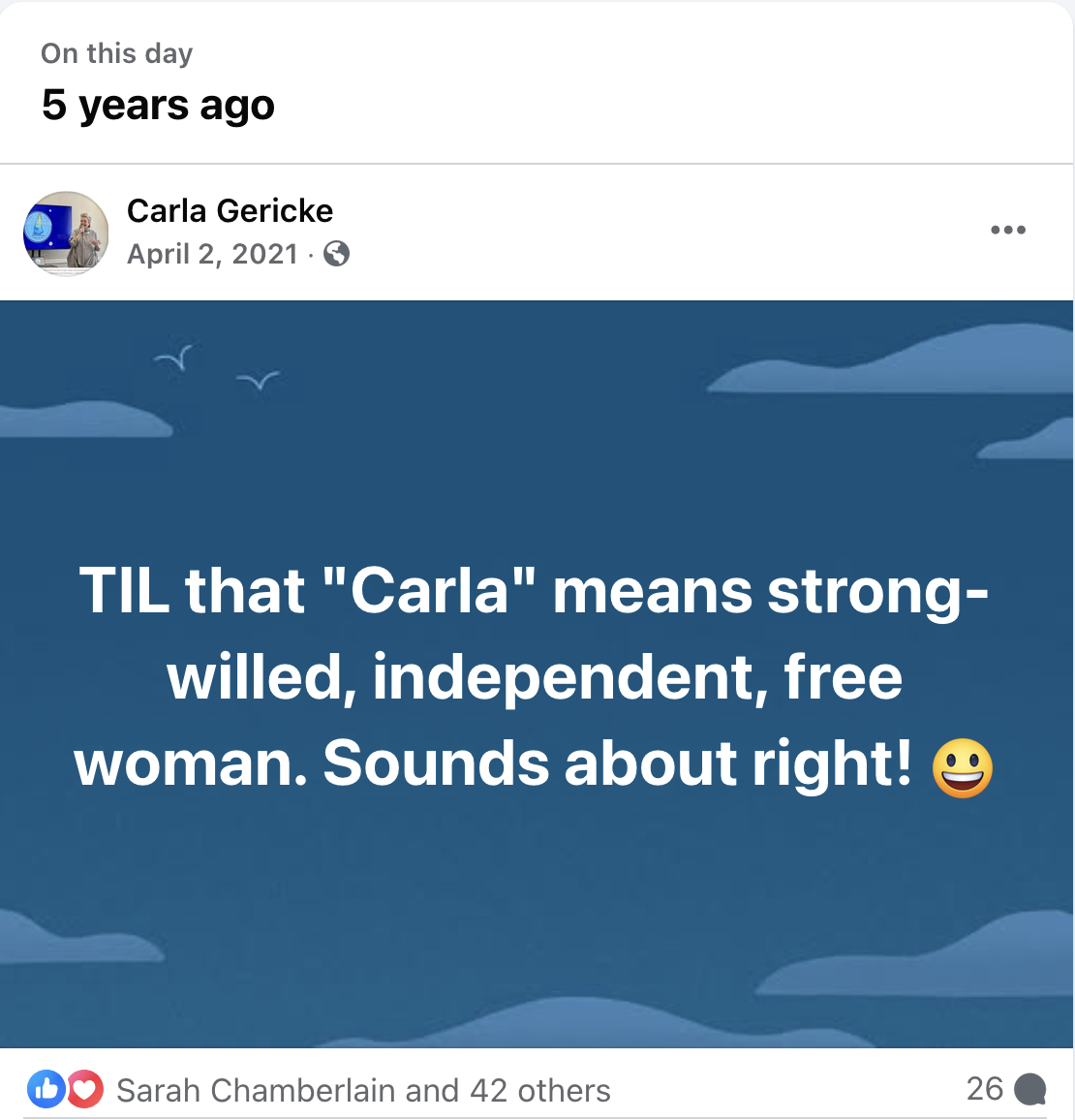
The name Carla is the feminine form of Carl (or Carlo in Italian, Carlos in Spanish), which itself comes from the Germanic name Charles.Primary Meaning”Free man” (or “freeman”).
thebump.com
This derives from the Old High German word Karl (or Old Norse karl), meaning a free man, common man, or freeman (as opposed to a bondsman or serf). Over time, it also came to connote strength, independence, and manliness.
etymonline.com
Other Common Interpretations”Strong” or “one who is strong” (especially in Teutonic/Germanic contexts).
babycenter.com
In some Romance language usages (Italian/Spanish/Latin influences), it can carry shades of “strong one,” “manly,” or even “free woman” when feminized.
familyeducation.com
Origin and HistoryCarla has Germanic roots but became popular in Italian, Spanish, Portuguese, and other Romance languages, where feminine names were often created by adding an “-a” ending to masculine forms (e.g., Carl → Carla, Carlo → Carla). It is closely linked to the name Charles, famously borne by historical figures like Charlemagne (“Charles the Great”).
en.wikipedia.org
Pronunciation is typically KAR-luh (or KAR-lah in some languages). In short, Carla evokes ideas of freedom, strength, and independence — a classic, timeless name with a strong, resilient vibe.
BONUS for Louis!
The name Louis is a classic masculine given name with deep Germanic roots, popularized through French culture and royalty.
Primary Meaning
- “Famous warrior” (or “renowned in battle,” “famous in war”).
It comes from the Old Frankish/Germanic name Hlōdowig (or Chlodwig / Hludwig), which combines two elements:
- Hlūdaz (or hlud) → meaning “loud,” “famous,” or “renowned.”
- Wiganą (or wig) → meaning “to fight,” “battle,” or “warrior.”
This is the same root as the German name Ludwig and the English variant Lewis.
Alternative Interpretation
Some linguists suggest the first element could derive from Proto-Germanic hlutą (“lot,” “share,” or “portion”), potentially giving a meaning closer to “loot bringer” or “plunder-bringing warrior” — evoking a successful fighter who brings home spoils of war. However, the “famous warrior” translation remains by far the most widely accepted and traditional one.
Origin and History
- Germanic/Frankish origin → evolved into the French form Louis via Latinized Ludovicus.
- It was the name of 18 kings of France (including the famous Louis XIV, the “Sun King”), as well as rulers in Germany (as Ludwig), Hungary, and elsewhere.
- The name has a strong royal, noble, and historical vibe, symbolizing strength, fame, and leadership.
- Closely related to Clovis (the early Frankish king) and shares roots with names like Louise (feminine form).
Pronunciation
- In French: loo-EE (or lwee).
- In English/American: often LOO-iss or LOO-ee.
- Common nicknames: Lou, Louie, Loulou.
In short, Louis carries connotations of fame through strength or renowned warrior — a powerful, timeless name with centuries of regal history behind it.
Interesting follow-up to your question about “Carla” (free/strong one): both names have strong Germanic warrior/freedom themes. If you’re exploring “nominal destiny” again, a “famous warrior” named Louis who achieves public success could fit that fun pattern!