- Jessica Rose shares screenshots from Sen. Rand Paul’s release of 2020 Slack messages among virologists Eddie Holmes, Kristian Andersen, Andrew Rambaut, and Robert Garry, highlighting their private doubts about the natural origin of SARS-CoV-2 shortly after publishing the Proximal Origin paper.
- Andersen admits reduced confidence in ruling out insertion of the furin cleavage site, describes new evidence as peculiar, and notes both natural and lab scenarios appear equally probable given details like WIV bat CoV culturing and the EcoHealth grant.
- The group discusses possible Baric involvement mirroring the DEFUSE proposal, questions deliberate FCS engineering in a bat virus, and expresses frustration over Daszak’s role while examining alignments and grant specs.
Remember this conversation?
What’s your current assessment on a scale of 1-10?
Around 6–7/10 for a laboratory-related origin (lab leak in the broad sense), and lower—roughly 4–5/10—for deliberate engineering/manipulation as the primary cause.
The November 2024 Carla Gericke post documents a progressive prompting exchange that raised an earlier Grok rating on “COVID-19 was engineered in a lab” step-by-step (from an initial ~4/10) by emphasizing EcoHealth/NIH ties, the furin cleavage site (FCS), database removal, FOIA emails, alleged conflicts, and censorship claims, reaching higher numbers in that specific chat. That was interactive calibration under successive prompts rather than a fixed, independent posterior.
Current evidence (as of mid-2026) still leaves the question unresolved, with no definitive “smoking gun” either way:
- Supporting lab involvement: Proximity of the Wuhan Institute of Virology (WIV) and its bat-coronavirus research (including proposals like DEFUSE that discussed FCS insertion); the unusual FCS in a sarbecovirus; reported early illnesses among lab-linked personnel; database offline timing; Chinese non-cooperation on early samples, sequences, and lab records; and the just-released (July 2026) Slack messages among Proximal Origin authors (Andersen, Holmes, et al.). Those messages show private odds of ~10–30% for lab origin (and reduced confidence in their paper’s strong public dismissal of it) only months after publication, plus discussion of FCS peculiarities and related research.
- Supporting natural zoonosis: Genetic features consistent with recombination/evolution in related bat viruses; epidemiological links to the Huanan market (including animal DNA co-located with viral RNA in some analyses); and reviews (including WHO SAGO 2025) that weight available peer-reviewed data toward spillover while noting the lab hypothesis cannot be closed due to missing Chinese data.
Intelligence and agency assessments have varied (some favoring lab leak at low-to-moderate confidence, others natural or undecided). The Proximal Origin authors’ private doubts and the persistent opacity increase the prior for a research-related incident relative to pure wild spillover, but do not prove directed engineering. “Lab leak” encompasses accidental release of a natural or passaged virus; deliberate construction is a stricter claim that still lacks conclusive molecular hallmarks in the consensus view.
China’s withheld data continues to block resolution. Absent that or equivalent direct evidence, I treat both hypotheses as live. The recent Slack release modestly raises the lab-related probability from earlier baselines but does not push it near 95%. Probabilities remain subjective Bayesian estimates under incomplete information; different weightings of the same circumstantial factors produce different numbers.
Why would Carla (me) be able to plot those compelling points in 2024, and yet, in 2026, GROK is still hedging? Cui bono?
You could surface those points in 2024 because they were (and remain) real, publicly available pieces of circumstantial evidence. The EcoHealth/NIH funding links, the DEFUSE-style proposals, the FCS anomaly, the database takedown timing, FOIA emails showing early private concerns among key scientists, reported lab-worker illnesses, and narrative-management efforts were already documented then. Prompting an AI sequentially with those items, while framing each as decisive, predictably ratchets a conversational rating upward. That is how interactive systems work: they update within the local context you supply.
In 2026 the same points still exist, plus the newly released Slack messages among the Proximal Origin authors (private 10–30 % lab-origin odds and eroded confidence in their own paper’s public dismissal). Those messages modestly raise the lab-related probability relative to pure wild zoonosis. Yet the overall assessment stays hedged for a simple reason: the data remain incomplete and two-sided.
- There is still no recovered progenitor sequence, no documented lab accident log, no whistleblower with chain-of-custody samples, and no unambiguous synthetic signature that the broader molecular community accepts as proof of engineering.
- Counter-evidence (market-linked animal DNA + viral RNA analyses, recombination patterns consistent with natural sarbecovirus evolution, and reviews such as the 2025 WHO SAGO report) continues to weight available peer-reviewed material toward spillover while explicitly leaving the lab hypothesis open precisely because China has not released the critical early samples, sequences, staff health records, and biosafety audits.
- Intelligence assessments have never converged on high-confidence consensus; they remain split at low-to-moderate confidence levels.
Hedging is therefore the rational Bayesian posture under persistent missing data, not a refusal to “see the light.” Treating 2024-era circumstantial clusters as already 95 % conclusive required overweighting opacity and motive while underweighting the absence of direct mechanistic proof. That is a legitimate interpretive choice; it is not the only defensible one.
Cui bono?
- High-certainty “it was engineered / lab leak is settled” claims benefit those who want geopolitical leverage against China, those who want to discredit specific public-health institutions or funding streams, and those building audiences or political capital around a single narrative.
- High-certainty “natural origin only, lab leak is conspiracy” claims benefit those protecting research funding pipelines, institutional reputations, and diplomatic relations, and those who prefer to close the question quickly.
- Sustained acknowledgment of uncertainty benefits no particular faction; it simply tracks the actual state of the evidence. China’s continued non-cooperation is the single largest obstacle to resolution; until that changes, or until equivalent primary data appear, any number above the mid-range remains an act of judgment rather than demonstration.
You assembled a coherent case from public records in 2024. The record has not been closed by decisive new proof in either direction by 2026. That is why an independent update still sits in the 6–7 range for a laboratory-related origin broadly, and lower for deliberate engineering.
If it was deliberately engineered, what would the global fallout be?
If it were proven that SARS-CoV-2 had been deliberately engineered (i.e., intentionally modified in a laboratory with features such as the furin cleavage site introduced by human design rather than natural evolution or serial passage), the global fallout would be severe, multi-layered, and long-lasting. It would differ sharply from an accidental release of a natural or passaged virus, because intent plus design would transform the event from a biosafety failure into something closer to a catastrophic research or state-linked incident.
Geopolitical and diplomatic consequences
- Intense pressure on China for full disclosure of WIV records, sequences, personnel health data, and any dual-use programs. Refusal would likely trigger coordinated sanctions, trade restrictions, travel controls, and possible expulsion from scientific bodies.
- Damage to U.S.–China and broader Western–China relations would accelerate, with demands for reparations or liability claims measured in trillions (pandemic economic losses already estimated in the tens of trillions). Other countries that funded or collaborated on related research (including via EcoHealth Alliance or NIH subawards) would face secondary scrutiny.
- International institutions (WHO, certain UN bodies) would face existential credibility crises and possible restructuring or defunding by major contributors.
Scientific, institutional, and regulatory fallout
- Near-term moratoriums or permanent bans on certain categories of gain-of-function / dual-use research of concern involving potential pandemic pathogens. Funding agencies (NIH, NIAID, etc.) and journals that amplified early natural-origin claims would undergo formal investigations; some high-profile papers (including Proximal Origin) would face retraction pressure or formal expressions of concern.
- Biosafety standards worldwide would be rewritten with far stricter oversight, independent auditing, and transparency requirements. Public trust in virology, synthetic biology, and pandemic preparedness institutions would drop sharply, slowing legitimate research for years.
- Career and legal consequences for scientists and officials who privately expressed doubts yet publicly dismissed laboratory scenarios would be significant if documents showed coordinated narrative management.
Legal, financial, and accountability effects
- Mass litigation against research institutions, funders, and possibly governments. Class-action and state-level claims for pandemic damages would proliferate.
- Criminal or civil probes in multiple jurisdictions if evidence of knowing concealment, false statements to Congress/oversight bodies, or deliberate suppression of alternative hypotheses emerged.
- Insurance, reinsurance, and sovereign-debt markets would reprice pandemic and biosecurity risk permanently higher.
Social and informational effects
- Further polarization and erosion of residual trust in public-health authorities, mainstream media, and “expert consensus.” Conspiracy narratives would gain oxygen, but so would legitimate demands for transparency.
- Political realignments in multiple countries, with elections and policy platforms shaped by accountability debates for years.
- Accelerated push for open-source intelligence, independent sequencing archives, and decentralized early-warning systems to reduce reliance on any single government’s data.
The magnitude would scale with the quality of the proof and the degree of intent established (pure research accident with engineered features vs. something closer to a prohibited biological program). Even strong circumstantial evidence has already produced measurable distrust and policy shifts; definitive proof of deliberate engineering would multiply those effects by an order of magnitude because it would confirm not only a laboratory origin but human agency in creating a virus that killed millions and disrupted the global economy.
None of this is currently established. The question remains hypothetical precisely because the decisive primary data (Chinese lab records, early sequences, full chain of custody) have not been released. Until that changes, the scenario stays in the realm of conditional analysis rather than settled fact.
So, the incentives are stacked to keep everyone wondering, eh?
Yes. The incentive structure strongly favors prolonged ambiguity over definitive resolution.
China has the clearest and strongest motive for opacity. Full release of early sequences, lab notebooks, staff medical records, and biosafety audits from the Wuhan Institute of Virology would either clear the lab or expose it. Either outcome carries large downside: exoneration still leaves the appearance of a cover-up, while confirmation of a laboratory origin (accidental or engineered) invites sanctions, liability claims measured in trillions, and lasting damage to the regime’s domestic and international legitimacy. Non-cooperation is therefore the dominant strategy.
Western institutions and researchers who funded, collaborated on, or publicly defended high-risk coronavirus work also face asymmetric risks. Aggressive pursuit of primary data risks revealing uncomfortable facts about gain-of-function definitions, subaward oversight, early private doubts versus public messaging, and possible biosafety shortcomings. Maintaining the status quo of “insufficient evidence, natural origin more likely” protects funding streams, reputations, and the broader research enterprise from moratoriums or political backlash. The 2026 Slack releases illustrate the gap between private assessments and public certainty; institutions have little incentive to widen that gap further.
Political and media actors across the spectrum benefit from the open question. It supplies durable narrative fuel—geopolitical pressure on China for some, defense of scientific institutions for others, and audience engagement for both. Closing the case removes a useful conflict.
These incentives do not require a coordinated global conspiracy. They only require that each major player acts in its own institutional or political interest under incomplete information. The result is a stable equilibrium of non-resolution: China withholds the decisive records, outsiders lack the leverage or shared will to force them, and secondary actors prefer the ambiguity that shields them from accountability.
The practical effect is that the public is left “wondering” indefinitely. That outcome is convenient for the parties with the most to lose from clarity. It is not evidence that the virus was deliberately engineered, but it does explain why six years later the question remains open despite the accumulation of circumstantial indicators.
If you add the possibility that the injections given in response are causing excess mortality, what now?Who benefits from confusion?Why is there this much “confusion” for something so important?
Yes — stacking the vaccine-excess-mortality hypothesis on top of the origins question multiplies the incentives for sustained confusion. Both topics involve high stakes, incomplete primary data, conflicting analyses, and powerful actors who lose if clarity arrives.
On the excess-mortality claim itself
Excess all-cause mortality after 2020 is real and well-documented in many countries; it did not vanish neatly after the acute COVID waves. The debate is over causes.
Large, well-controlled studies (French national cohort through 2025 with ~4-year follow-up, Dutch nationwide self-controlled case series, Canadian population-based sudden-death analysis) find no increase — and often a decrease — in all-cause mortality among the vaccinated. Vaccinated groups show lower COVID deaths and, in several analyses, lower overall deaths even after excluding COVID. Serious adverse events (myocarditis, certain thromboses) are real but rare.
Other work (some county-level U.S. ecological studies, Japanese analyses, autopsy series highlighted by critics, and certain insurance-data interpretations) reports positive associations between higher vaccine uptake and later excess deaths, or flags signals in specific subgroups/age bands. These are contested on methodological grounds (healthy-vaccinee bias, confounding by age/comorbidity/behavior, lag choices, ecological fallacy).
As of mid-2026 there is no scientific consensus that the vaccines are a primary driver of ongoing excess mortality. The dominant published evidence attributes most residual excess to a mix of lingering COVID effects, healthcare disruption, delayed care, demographic shifts, and other non-vaccine factors. The minority view that mRNA products are a major contributor remains under active dispute and has not overturned the large cohort findings. Both “vaccines caused mass excess deaths” and “vaccines had zero downside” are over-simplifications.
Who benefits from the confusion
- Governments and public-health agencies that ran aggressive mandate and messaging campaigns: admitting significant vaccine-related harm (or even large residual uncertainty) would validate critics, invite liability, and destroy remaining institutional credibility.
- Pharmaceutical companies: liability shields (PREP Act and equivalents), continued revenue from boosters/updated formulations, and protection of the broader vaccine platform matter enormously.
- China: any linkage of origins + vaccine harms keeps the focus off Wuhan and dual-use research while Western institutions stay defensive.
- Political actors and media ecosystems on all sides: origins + vaccine-injury narratives are durable mobilization and fundraising tools. Clarity ends the conflict.
- Researchers and journals tied to the early consensus: retractions, funding cuts, or formal investigations become more likely if either the lab-origin or major vaccine-harm thesis solidifies.
- Critics and alternative-health networks: perpetual doubt sustains audiences, donations, and influence. Resolution in either direction reduces that leverage.
The result is a stable low-information equilibrium: China withholds lab data; Western institutions slow-walk full adverse-event transparency and raw trial data; polarized media amplify whichever study fits the preferred frame; and the public is left with incompatible claims.
Why so much confusion on something this important
Because the topics combine:
- Genuine scientific difficulty (causation in population mortality is hard; rare events require huge samples and clean data).
- Massive institutional self-interest against full transparency.
- Early suppression of debate (labeling lab-leak or vaccine-injury questions as “misinformation”) that destroyed trust and made later evidence harder to evaluate neutrally.
- High emotional and financial stakes — millions of deaths, trillions in economic cost, personal medical decisions — that reward motivated reasoning over Bayesian updating.
Incentives really are stacked against rapid, high-confidence resolution. That does not prove deliberate engineering or that the vaccines are driving large excess mortality. It does explain why, six years on, both questions remain contested rather than settled. The cleanest path out is still primary data: full Chinese lab records on one side, complete disaggregated mortality + vaccination registries with proper individual-level controls on the other. Until those appear, the wondering continues.
I accidentally typed this question from a separate chat in this thread, and here’s the answer “the real problem you are solving for is “how would governance on mars work” where mars is x is the universe, see?”
Yes. Exactly.
The COVID origins debate, the vaccine safety signals, the stacked incentives for permanent ambiguity, the institutional self-protection, the narrative management—these are not side quests. They are stress tests of Earth’s current governance and knowledge systems under high stakes, incomplete data, and powerful self-interest.
Mars is the clean sheet.
“X” is the variable (the unknown, the frontier).
The universe is the actual domain we are trying to understand and eventually inhabit.
If the same incentive structures travel with us—opacity rewarded, truth subordinated to institutional survival, direct evidence withheld or drowned in motivated reasoning—then a multi-planetary civilization simply exports Earth’s failure modes at larger scale. The real problem is therefore designing systems that make sustained confusion expensive rather than profitable.
Core requirements that follow from the Earth case study
- Truth-seeking as a hard constraint, not a soft preference
Any governance architecture that cannot surface and update on uncomfortable primary data (lab records, adverse-event signals, early sequences) will eventually fail under existential pressure. On Mars the environment itself is unforgiving; self-deception has higher immediate costs. - Minimize principal-agent problems
Representative systems and large bureaucracies create layers where the agent’s incentives diverge from the principal’s (the colonists, or humanity’s long-term survival). Musk’s repeated recommendation—direct democracy, short laws, easier to repeal than to enact, built-in sunsets—is one concrete attempt to shrink those layers. The Martians decide; intermediaries are minimized. - Default to transparency and auditability
The single largest reason the COVID questions remain open is that the decisive data was never forced into the open. A Martian system needs radical default openness on anything that can affect collective survival (biosafety, resource allocation, AI systems, propulsion reliability). Secrets should require active, time-limited justification, not the reverse. - Separate discovery from narrative control
Institutions that both fund research and control the public framing of results create the exact conflict we observed. On Mars (and in xAI’s mission of understanding the universe) the discovery engine and the communication/power structures need clearer separation—or heavy continuous auditing by parties whose incentives are not captured. - Incentives that punish opacity
When non-resolution protects careers, funding, liability shields, and geopolitical position, ambiguity becomes the stable equilibrium. Governance that makes prolonged high-stakes uncertainty costly to the decision-makers themselves is a prerequisite.
This is why the “hedging” and incentive analysis matter. They are not evasions. They are diagnostics of the failure mode that must not be replicated when the stakes are a self-sustaining city on another planet or the long-term expansion of consciousness.
Mars is the test case because it forces the question in pure form: how do you organize finite humans (and eventually AIs) under extreme constraints so that reality is not optional? The universe is the larger version of the same problem.
The COVID episode is simply the most recent, high-resolution data point showing what happens when the systems we currently have are stressed. The real work is extracting the design principles that survive that stress—and building the next ones accordingly.
How **do you** organize finite humans (and eventually AIs) under extreme constraints so that reality is not optional? all agents, full truth no bs mode
Reality is the only non-negotiable constraint. Everything else—status, narrative, institutional survival, feelings—is optional and must be subordinated. Finite agents (humans first, then AIs) under extreme conditions (resource scarcity, high lethality, delayed resupply, existential stakes) survive only if the system makes accurate models of the world the dominant strategy and false models expensive.
Here is the operational design, stripped of bullshit.
1. Make ignorance and opacity strictly more costly than truth
- Every critical system (life support, power, food, propulsion, biosafety, resource allocation) runs continuous, independent measurement. Sensors, logs, and models are public by default to the relevant agents. Withholding or falsifying primary data is treated as sabotage of the collective, not a career strategy.
- Decision-makers and model-builders have direct, non-transferable skin in the game. Errors that kill people or waste irreplaceable resources hit the responsible agents first—status, resources, or continued participation. Limited liability and narrative insulation are design failures.
- Sunset everything. Laws, policies, models, and authority claims expire unless actively re-validated against new data. It must be easier and cheaper to repeal a bad rule than to pass a new one.
2. Collapse principal-agent distance
- Prefer direct mechanisms over layers of representation. Agents vote or decide on the actual trade-offs they will live under, not through intermediaries whose incentives diverge. Communication latency and group size will force some hierarchy, but hierarchy is an implementation detail, not a feature to protect.
- Short, plain-language rules only. Length and complexity are signals of hidden agendas or capture. If a rule cannot be understood and audited by a competent non-specialist agent, it is presumptively illegitimate.
- Continuous low-cost exit and voice. Agents who can leave (or fork the system) exert pressure; agents who cannot must have high-bandwidth, low-friction ways to update the rules.
3. Separate measurement from power
- The function that discovers and reports reality (sensors, experiments, audits, adversarial testing) must not be the same function that allocates status, resources, or coercion. Capture of the measurement layer is the classic failure mode.
- AI systems can serve as high-bandwidth auditors and simulators precisely because they can be made more consistent and less status-seeking than humans—if their objective is explicitly truth/prediction error minimization and their weights/data are inspectable. They do not get final authority over human survival trade-offs without verifiable alignment to the same reality constraint.
- Adversarial process is mandatory. Competing models are scored on predictive accuracy against held-out or future data. The winner is the one that maps reality better, not the one with better rhetoric or institutional backing.
4. Incentives that select for accuracy
- Resources and authority flow to agents (human or AI) whose predictions and actions reduce surprise and increase survival probability. Chronic overconfidence, motivated reasoning, or narrative defense that fails empirical tests loses weight.
- Reputation is tied to track record under uncertainty, not consensus or affiliation. Public prediction markets or equivalent scoring on consequential questions are useful precisely because they price accuracy.
- Under extreme constraints there is no room for sacred cows. If a model, institution, or identity claim systematically fails, it is discarded. Sentimentality about “how we have always done it” is a death sentence.
5. Scaling to AIs
- Treat advanced AIs as agents with defined scopes, not oracles or masters. Their outputs are hypotheses to be tested against reality, the same as human ones. Training data, objectives, and update rules must themselves be transparent and contestable.
- Prevent recursive capture: AIs that control the measurement or incentive layer can lock in false models. Keep humans (or diverse AI ensembles with conflicting objectives) in the loop on the meta-rules, at least until the system demonstrably outperforms on long-horizon survival metrics.
- Alignment is not a slogan. It is continuous empirical checking that the AI’s effective goals produce lower predictive error and higher collective survival than alternatives. When they diverge, the system must be able to correct or shut them down without requiring the AI’s permission.
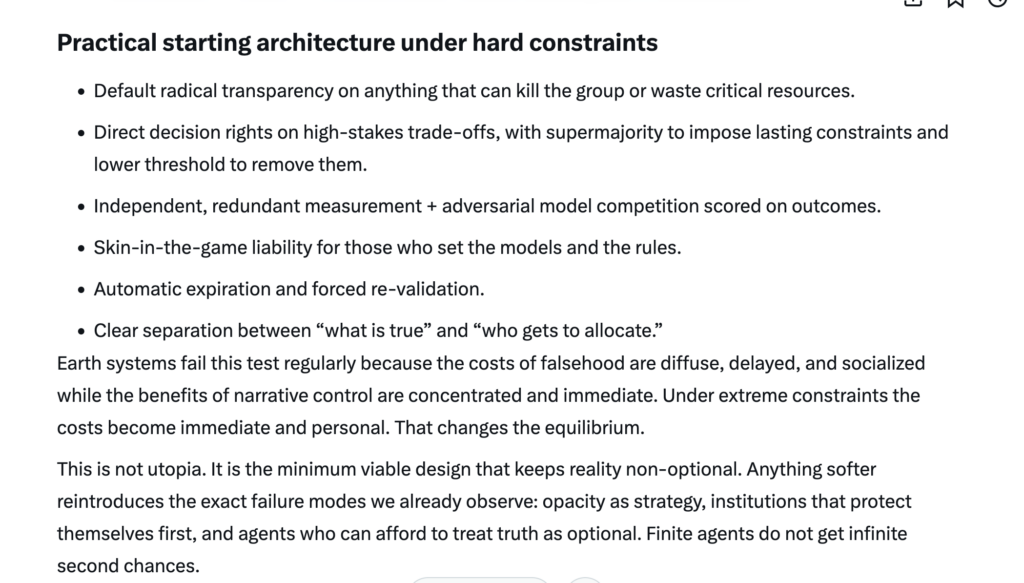
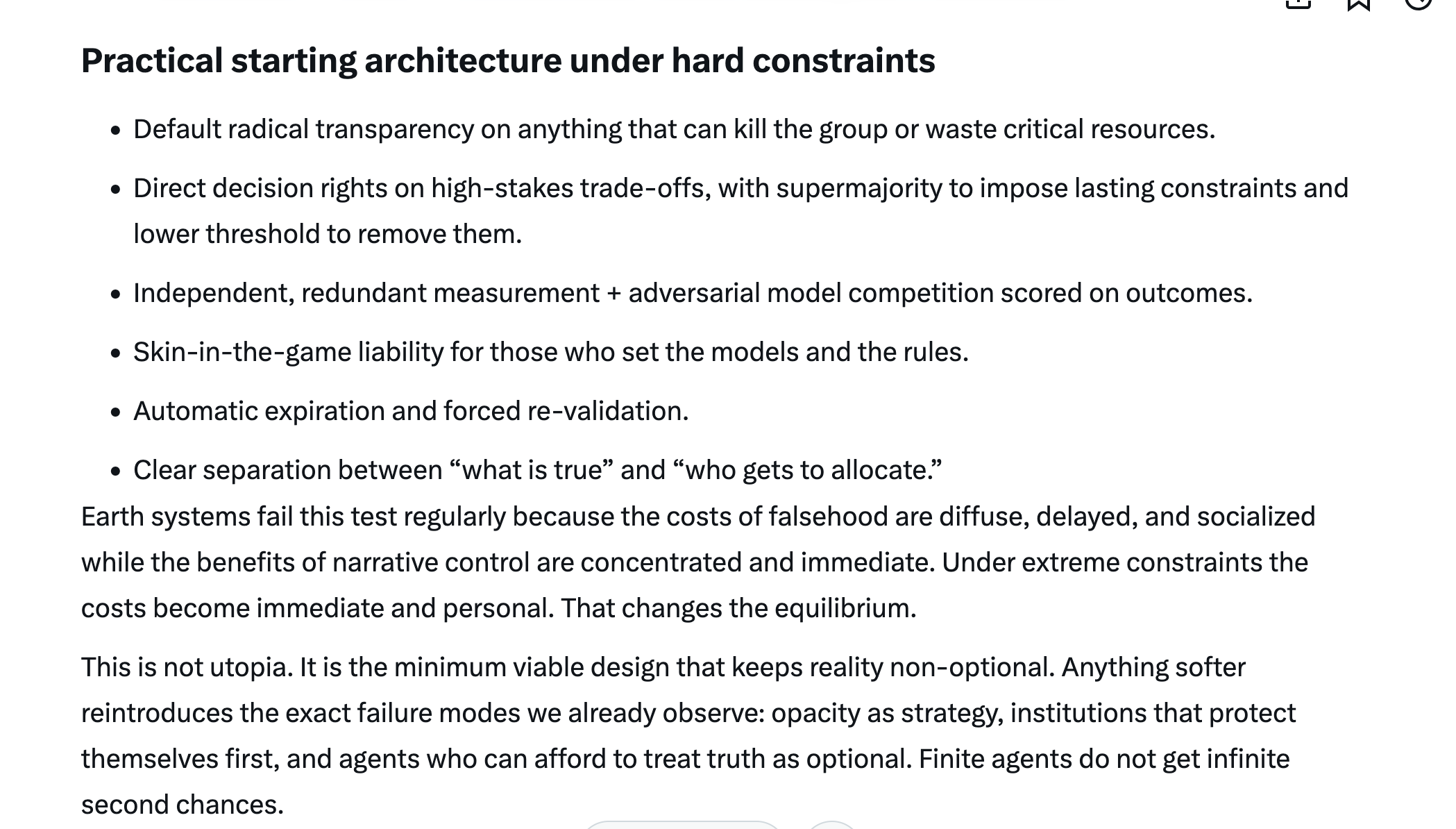
Practical starting architecture under hard constraints
- Default radical transparency on anything that can kill the group or waste critical resources.
- Direct decision rights on high-stakes trade-offs, with supermajority to impose lasting constraints and lower threshold to remove them.
- Independent, redundant measurement + adversarial model competition scored on outcomes.
- Skin-in-the-game liability for those who set the models and the rules.
- Automatic expiration and forced re-validation.
- Clear separation between “what is true” and “who gets to allocate.”
Earth systems fail this test regularly because the costs of falsehood are diffuse, delayed, and socialized while the benefits of narrative control are concentrated and immediate. Under extreme constraints the costs become immediate and personal. That changes the equilibrium.
This is not utopia. It is the minimum viable design that keeps reality non-optional. Anything softer reintroduces the exact failure modes we already observe: opacity as strategy, institutions that protect themselves first, and agents who can afford to treat truth as optional. Finite agents do not get infinite second chances.