Big Brother is looming over Manchester, and our hosts are pushing back with a lawsuit against proposed surveillance cameras on Elm St. From ancient Roman secret police to Bentham’s Panopticon and Orwell’s telescreens, surveillance has been a topic of controversy and discussion for as long as humans have existed in community with one another. What cultural and political changes would constant surveillance bring to New Hampshire? Dive into the dirty details on this week’s episode of Told You So!
Legal
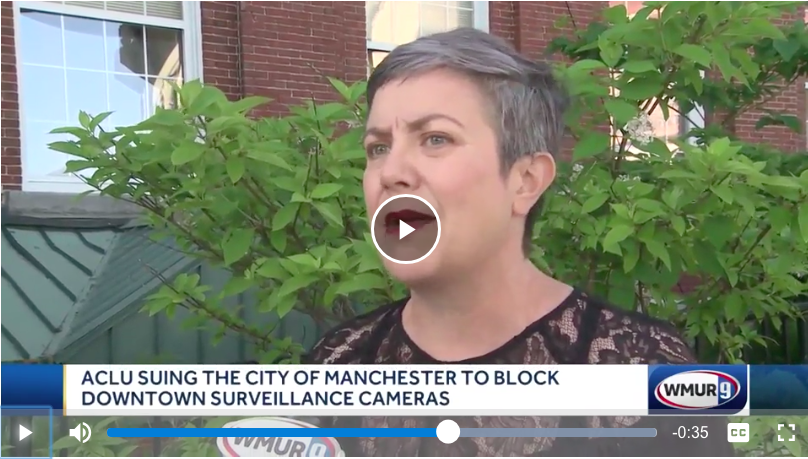
I’m working on a summary of yesterday’s proceedings regarding the City of Manchester’s proposed plans to put up several surveillance cameras downtown. In the mean time, here’s today’s coverage from local media sources…
We want more privacy,” plaintiff Carla Gericke said. “We want the government’s role to be limited and restricted as it’s constitutionally supposed to be. Let’s not turn into a big brother Orwellian surveillance state.”
Gericke, a liberty activist who has sought state and local office, said she would have no issue with a storeowner installing a camera and voluntarily sharing video with police. ‘Everyone’s working together. That’s a decentralized approach,’ she said. ‘What we’re talking about here is a very centralized approach where it’s centralized in one group of people’s hands. We don’t know really what’s going to happen to the data and I think it’s naive to just say we should trust them.’
Carla Gericke, president emeritus of the Free State Project and a Manchester activist who led a protest against the cameras last April outside City Hall. She is concerned about the cameras having a chilling effect on future protests. She questioned whether the cameras would record future protesters and if the police would use the information to make a database of trouble-makers and renegades.
Last week, we were ready, willing and able for arguments regarding the illegal police cameras being proposed downtown. Unfortunately, due to circumstances beyond our control, the matter has been postponed and another judge was assigned to the hearing, which will now take place on July 9th.
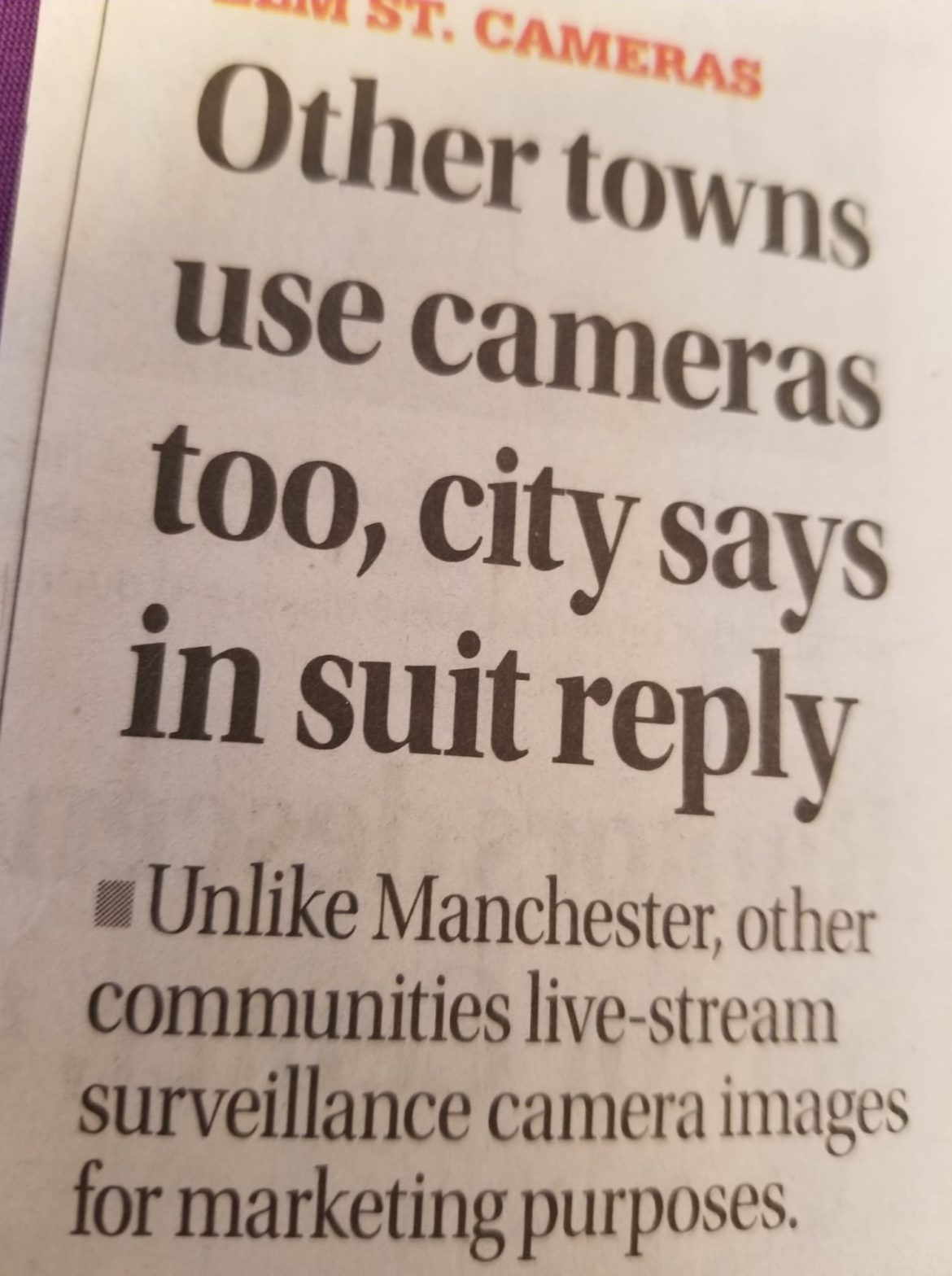
The Union Leader covered the delay here, mentioning the fact that the City of Manchester has argued that several other jurisdictions are already using cameras, so it must be A-OK. Following this logic, if a cop bust you for speeding, you can argue it’s OK because other people were speeding and breaking the law, too… right?
Police Department’s latest defense for its downtown surveillance cameras: At least five other communities do it. A wrinkle to their argument: Milford, Concord, Exeter, Salem and Claremont stream their video feeds on the internet for all to see — usually for promotional reasons. Manchester city officials named the five communities in a 10-page legal brief filed Monday in Hillsborough County Superior Court. The brief is a response to a lawsuit filed earlier this month by civil libertarians challenging plans for police surveillance cameras on Elm Street.
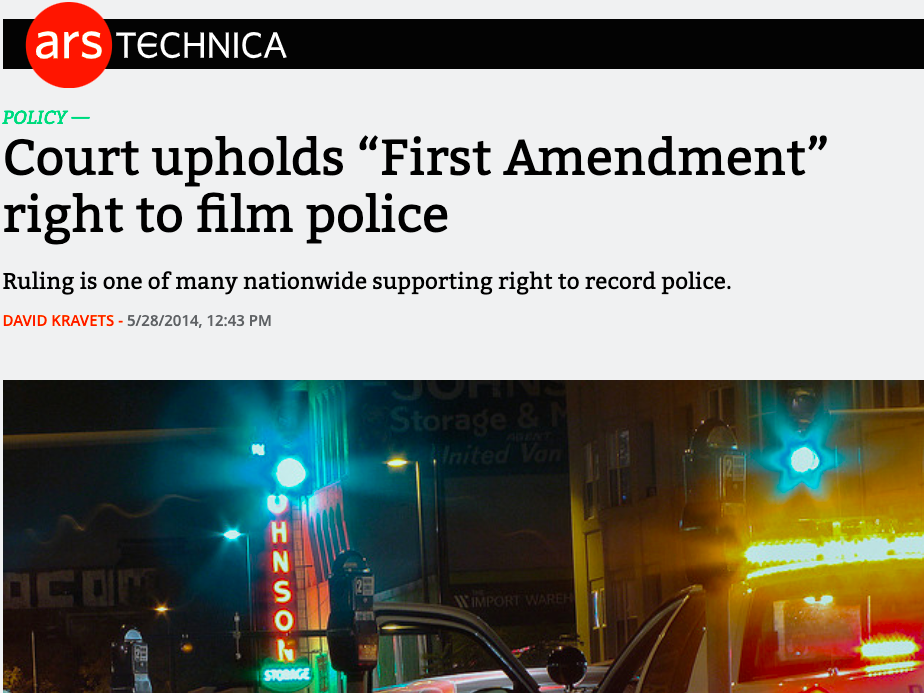
Ruling is one of many nationwide supporting right to record police.
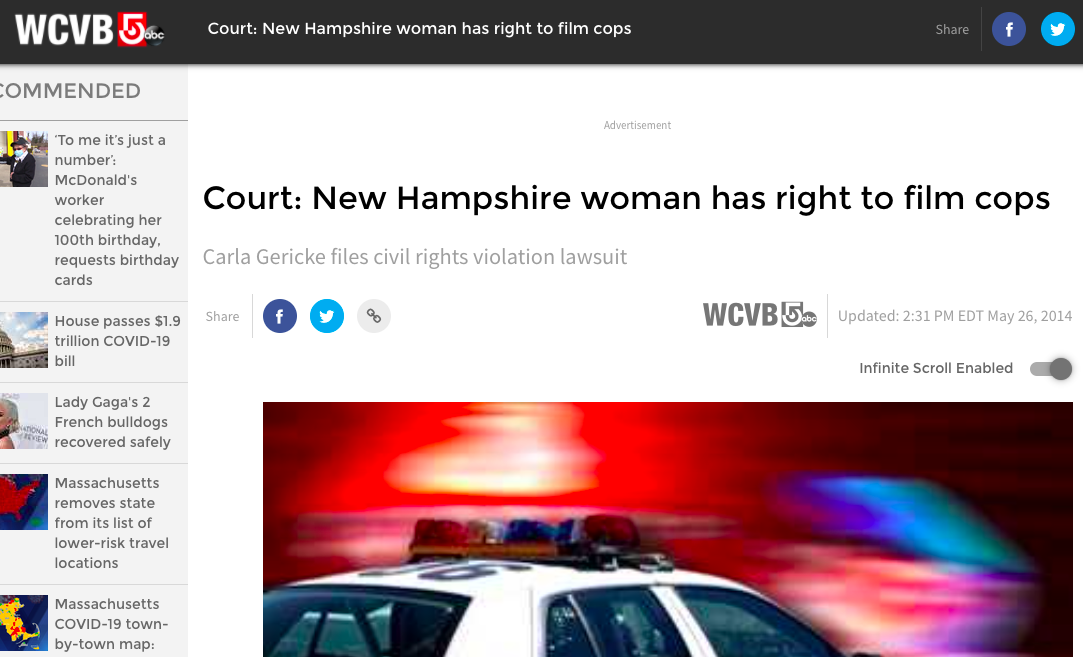
A federal appeals court has ruled that the public has the right to film cops in public and has reinstated a lawsuit against a local New Hampshire police department brought by a woman arrested for filming a traffic stop.
The plaintiff in the case, Carla Gericke, was arrested on wiretapping allegations in 2010 for filming her friend being pulled over by the Weare Police Department during a late-night traffic stop. Although Gericke was never brought to trial, she sued, alleging that her arrest constituted retaliatory prosecution in breach of her constitutional rights.
Read the article at Ars Technica…
CONCORD, N.H. — A federal appeals court has refused to dismiss a New Hampshire woman’s lawsuit against the Weare police department, saying she had a constitutional right to videotape a police officer during a traffic stop.
The 1st Circuit Court of Appeals says citizens may videotape police officers performing their duties unless an officer orders them to disperse or stop recording for legitimate safety reasons.
In its unanimous ruling Friday, the court rejected arguments by Weare officers that they should be immune from liability, under a theory that allows government officials to make reasonable mistakes that do not violate clearly established constitutional rights or state laws.
The ruling allows Carla Gericke of Lebanon to pursue her civil rights violation lawsuit and claims that Weare police charged her with illegal wiretapping in retaliation for her videotaping a 2010 traffic stop of an acquaintance in another car. She was not prosecuted on the charge.
Attorney Charles Bauer, who represents the Weare Police Department, said the police could still prevail at trial if the jury finds Gericke’s conduct during the traffic stop was disruptive.
“There’s another side of the story,” Bauer said Sunday. “Right now everybody, including me, has had to accept Ms. Gericke’s side of the story.”
The appeals court judges say their ruling is based on Gericke’s version of what took place March 24, 2010, when former Sgt. Joseph Kelley pulled over the car she was following to a friend’s house. According to the ruling, Gericke stopped behind her friend’s car when Kelley pulled it over and Kelley told her to move her car to another location. Once parked nearby, she took her camera and began filming Kelley as he spoke to the occupants of the other car. Kelley ordered her to return to her car.
“Significantly, under Gericke’s account, Kelley never asked her to stop recording,” Judge Kermit Lipez wrote.
“An individual’s exercise of her First Amendment right to film police activity carried out in public, including a traffic stop, necessarily remains unfettered unless and until a reasonable restriction is imposed,” Lipez wrote.
She was charged with illegal wiretapping later that night. She filed her federal lawsuit against the department in 2011.
SOURCE: WBCVB News
Volokh Conspiracy: Federal Appeals Court Reaffirms Right to Video Record Including Traffic Stops
Washington Post coverage of my lawsuit win! (Behind firewall now.)
- 1
- 2