[Video cut off early, sorry about that mid-sentence stop.]

[Video cut off early, sorry about that mid-sentence stop.]
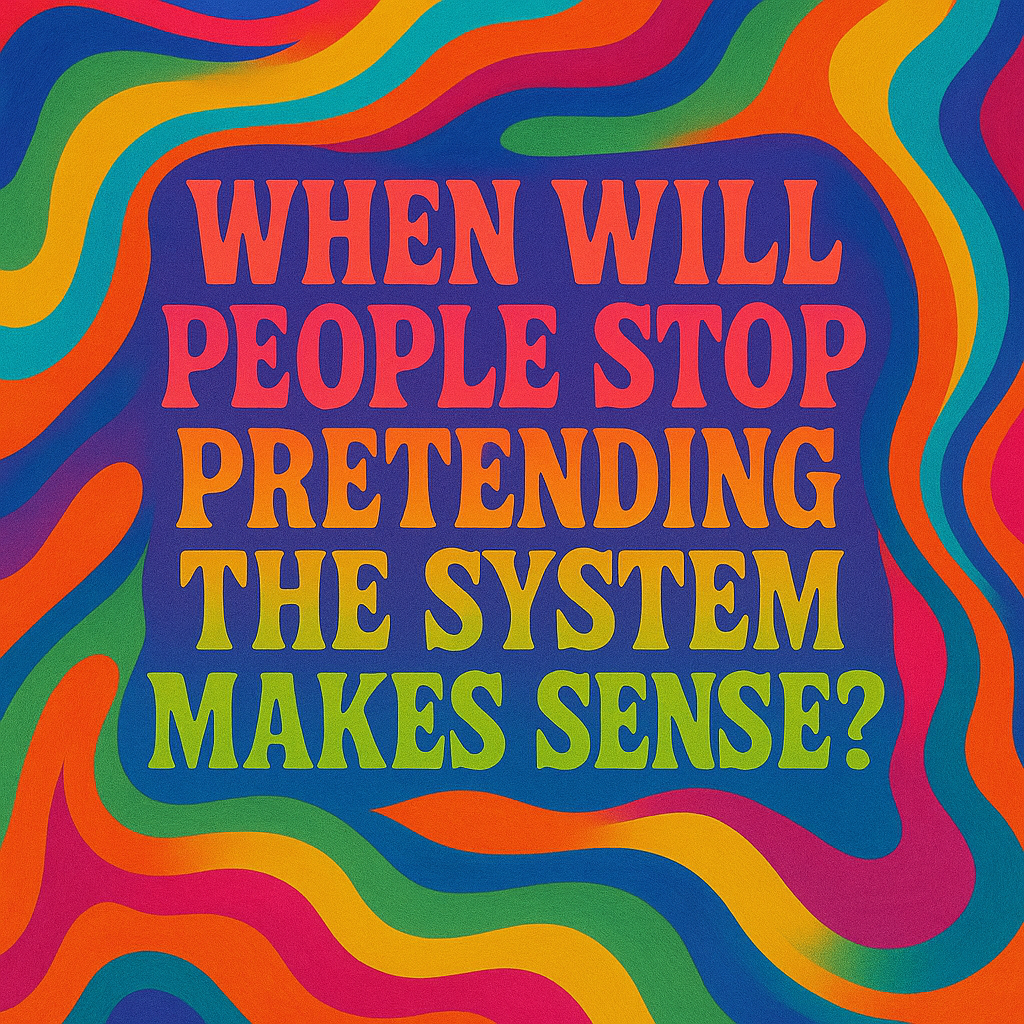
Ah yes. That question.
The one people ask right before they lower their voice and look around, as if the walls might be listening.
Because what you’re really asking isn’t when will things change?
It’s: when will we stop agreeing to the lie that this all adds up?
There’s no date on the calendar. No cosmic Outlook invite titled “Awakening – Mandatory.”
But if you’re paying attention—if you’re even asking—you’ve probably noticed:
the pretense is cracking.
Not collapsing.
Cracking.
Hairline fractures first. Quiet ones. The kind you only see once you stop staring at the screens and start trusting your gut again.
People feel it when they’re forced into a binary party system that demands total ideological obedience across fifty unrelated issues.
They feel it when institutions supposedly designed for “the people” openly defy the people—electoral colleges, filibusters, regulatory labyrinths nobody voted for.
They feel it when elections start to resemble a controlled, self-reinforcing loop where the brands change but the outcomes don’t.
The system doesn’t fail—it maintains itself.
With money. With fear. With divide-and-conquer theater. With unlimited bribery dressed up as “campaign finance.”
Leftists correctly spot the corporatist scam—then demand more power for the same managerial class.
Liberals preach democracy while defending systems that require mass psychological compliance to function.
Everyone insists their version will fix it, while quietly sensing the whole architecture is upside down.
And here’s the thing history teaches—every time:
Societies don’t collapse all at once.
They come undone.
So slowly you barely notice.
Until one day you look back ten years and think, Oh. That was the moment.
Václav Havel nailed this in The Power of the Powerless:
systems persist because people live within the lie—not because the lie is convincing, but because it’s convenient.
Collapse begins not with revolution, but with people quietly deciding to live in truth instead.
They stop pretending.
They withdraw their belief.
They opt out—not loudly at first, but decisively.
Every real awakening looks like that.
The Soviet Union.
The Arab Spring.
Every empire that mistook compliance for consent.
In America, the accelerants are obvious:
AI exposing hypocrisy at machine speed.
Economic fragility.
Technological transparency.
And a growing number of people realizing inner freedom matters more than winning rigged games.
The most “awake” people aren’t screaming online.
They’re building parallel lives.
Parallel economies.
Parallel communities.
They’re choosing place over politics.
Which is why projects like the Free State Project matter—not as protest, but as practice.
As proof of concept.
As the embodied answer to: Okay, but what do we do instead?
Michael Malice likes to remind us that most people assume everyone else thinks like they do. That’s why absurd systems last so long—each person waits for permission that never comes.
So when does the charade end?
When enough people stop voting for brands
and start building alternatives.
When enough people stop outsourcing conscience
and reclaim consent.
When enough people say, quietly but firmly:
No. This doesn’t make sense anymore.
If you’re asking the question, you’re already early.
The clock isn’t ticking.
It’s shedding parts.
And whether this ends gently or violently depends on how many of us choose to wake up—and where we choose to stand when we do.
(Spoiler: some of us chose New Hampshire.) 🌲
Meaning of “Unalienable”
“Unalienable” (also spelled “inalienable” in modern usage) refers to rights that are inherent to human beings, cannot be surrendered, transferred, taken away, or denied by any government or authority. These are often described as natural rights or God-given rights, existing by virtue of being human rather than granted by laws or rulers.
The term is most famously used in the U.S. Declaration of Independence (1776):
“We hold these truths to be self-evident, that all men are created equal, that they are endowed by their Creator with certain unalienable Rights, that among these are Life, Liberty and the pursuit of Happiness.”
Here, “unalienable” emphasizes that these rights are not alienable (i.e., they cannot be separated from the individual). “Unalienable” and “inalienable” are synonyms with no meaningful difference today—”unalienable” was the preferred 18th-century spelling in the Declaration’s final version, while “inalienable” became dominant later.
The concept draws from Enlightenment thinkers like John Locke, who argued for natural rights to life, liberty, and property (Jefferson adapted this to “pursuit of Happiness”). Governments exist to secure these rights, deriving power from the consent of the governed; if they fail, people have the right to alter or abolish them.
How the Concept Has Been “Subverted” or Infringed
The idea of unalienable rights has faced criticism and real-world violations throughout history, often described as “subversion” when governments or societies undermine their universality or inviolability:
In essence, while the concept asserts absolute inviolability, history shows frequent subversion through exclusion, violation, or redefinition—yet it remains a powerful ideal driving reforms toward greater inclusion and protection.
The distinction between negative rights (also called liberty rights) and positive rights (also called entitlement or welfare rights) is a key concept in political philosophy, popularized by Isaiah Berlin in his essay “Two Concepts of Liberty” (1958). Negative rights focus on freedom from interference, while positive rights focus on freedom to have or achieve something, often requiring active provision.
Here’s a breakdown in columns:
| Aspect | Negative Rights | Positive Rights |
|---|---|---|
| Definition | Rights that require others (individuals or government) to refrain from interfering or acting against you. They protect liberty by imposing duties of non-interference. | Rights that require others (usually government) to actively provide goods, services, or opportunities. They impose duties to act or provide. |
| Philosophical Basis | Classical liberalism (e.g., John Locke, U.S. Founding Fathers’ emphasis on natural rights). Associated with “negative liberty” (freedom from coercion). | Modern welfare states and social democracy. Associated with “positive liberty” (freedom to fulfill potential). Often linked to second-generation human rights (economic/social). |
| Examples | – Freedom of speech (others must not censor you) – Right to life/liberty (protection from murder, enslavement, or arbitrary arrest) – Private property (others must not steal or seize it) – Freedom of religion (no forced belief) | – Right to education (government provides schools/teachers) – Right to healthcare (government-funded treatment) – Right to social security/welfare (benefits during unemployment) – Right to housing or minimum standard of living |
| Cost/Who Pays | Generally low direct cost: Enforced through restraint (no action needed beyond basic legal systems). Any enforcement (e.g., courts, police to prevent violations) is funded by taxpayers collectively, but the right itself doesn’t require transferring resources to individuals. Critics argue pure negative rights have minimal burden. | High direct cost: Requires resources, labor, and funding to provide the good/service. Typically paid by taxpayers (through government redistribution via taxes). Can involve coercion (forced contribution) and may conflict due to scarcity (not everyone can receive equally). |
| Criticisms/Debates | Seen as universally compatible (everyone can enjoy them simultaneously without conflict). Enforcement still needs some positive action (e.g., police protection). | Often criticized as creating dependency or infringing negative rights (e.g., taxing property to fund welfare). Some argue they aren’t “true” rights since they depend on others’ labor/effort. Proponents say they’re essential for equality and dignity. |
This distinction ties into discussions of unalienable rights (mostly negative in the classical sense) and the UDHR (which includes both, e.g., Articles 3–21 lean negative; 22–27 positive).
Note: Some philosophers argue the divide isn’t absolute—enforcing negative rights also requires positive actions (e.g., funding courts). However, the core difference in burden and obligation remains widely recognized.
Your question touches on a common debate in political philosophy, where negative rights are often framed as protections for individual autonomy, while positive rights involve obligations on others (typically society or government) to provide resources or services. I’ll break this down step by step to evaluate if your description is “fair,” drawing on standard definitions and critiques. Overall, the first part of your statement aligns reasonably well with classical liberal views, but the second part oversimplifies and isn’t entirely accurate—positive rights aren’t inherently “communist,” though they can involve elements of compulsion that critics associate with collectivist systems.
To clarify, here’s a quick comparison highlighting why the communism link isn’t straightforward:
| Aspect | Negative Rights (Individual Freedom Focus) | Positive Rights (Obligation/Provision Focus) |
|---|---|---|
| Core Mechanism | Restrains actions (e.g., “don’t interfere”) | Requires actions (e.g., “provide this”) |
| Basis in Freedom | Freedom from coercion or harm | Freedom to achieve or access something |
| Association with Ideologies | Classical liberalism, libertarianism (e.g., U.S. Bill of Rights emphasizes these) | Social democracy, socialism; communism amplifies them but they’re not unique to it |
| “Making People Do Something” | Minimal—mostly passive restraint | Yes, via taxes/redistribution; seen as coercive by critics, but voluntary in social contracts |
| Examples in Non-Communist Systems | Freedom of assembly (universal in democracies) | Universal basic education (in most capitalist countries) |
In summary, your first point captures the essence of negative rights well, but labeling positive rights as “communism” isn’t fair because it ignores their role in diverse political systems. The debate often boils down to balancing individual liberty with collective welfare—positive rights can enable freedom (e.g., education empowers individual action), but they do introduce elements of compulsion that some view as antithetical to pure individualism. If you’re drawing from a specific thinker or context, feel free to provide more details for a deeper dive!
To directly address your question: In the standard philosophical distinction (particularly from libertarian and classical liberal perspectives), no typical positive right avoids elements of compulsion when enforced at a societal or governmental level. Positive rights inherently require active provision of goods, services, or opportunities by others—often funded through taxation or regulated redistribution—which critics argue involves coercion (forcing people to contribute resources or labor against their will).
However, there are nuances and edge cases where philosophers argue positive rights can be framed or implemented without direct compulsion:
| Critique Perspective | Reason Positive Rights Require Compulsion | Common Examples |
|---|---|---|
| Libertarian/Classical Liberal | Provision demands resources/labor from others; taxation = coerced transfer, violating negative property rights. | Healthcare, education, welfare—can’t be guaranteed universally without forcing contributions. |
| General Philosophical Consensus | Positive rights impose “positive duties” (to act/provide), while negative rights impose only “negative duties” (to refrain). Scarcity means someone pays involuntarily. | Social security, housing—voluntary charity isn’t a “right” since it can be withheld. |
| Practical Enforcement | Even “non-coercive” ideals (e.g., voluntary funding) fail at scale; states rely on compulsory taxes/laws. | No modern welfare state funds positive rights purely voluntarily. |
In summary, while positive rights can exist without compulsion in narrow, voluntary contexts (e.g., private contracts or mutual aid societies), universal or state-enforced ones—like those in the UDHR (education, work, social security)—almost always involve some coercion through taxation or regulation. This is why critics (e.g., from libertarian traditions) argue positive rights inherently conflict with pure individual freedom. Proponents counter that such “compulsion” is justified via social contract or democracy for greater equity. If you’re thinking of a specific right, I can analyze it further!
Under modern contract law (e.g., in common law jurisdictions like the US, UK, or influenced systems), a person can be bound to a contract without signing it or explicitly agreeing (e.g., saying “I agree”). This occurs primarily through:
However, key requirements must be met: offer, acceptance (via conduct), consideration (exchange of value), and intent to be legally bound. Silence alone rarely binds unless prior dealings or context imply it. Contracts for major items (e.g., real estate) often require writing/signatures under the Statute of Frauds.
In short: Yes, you can be bound without explicit agreement if your behavior objectively shows consent.
The social contract in political philosophy (Hobbes, Locke, Rousseau, Rawls) is a metaphor or thought experiment explaining why we have political obligation (duty to obey laws) and government legitimacy. It is not a literal contract under law.
Critics (e.g., David Hume, modern philosophers) argue this fails as a true contract analogy:
| Aspect | Strict Contract Law | Social Contract Theory | Key Criticism |
|---|---|---|---|
| Consent Required | Mutual, objective intent (express or implied by conduct) | Tacit (residence/benefits) or hypothetical | No real choice—leaving country is costly/impractical (Hume: like being born on a ship and forced to stay) |
| Opt-Out Possible | Can reject offer or breach (with consequences) | Emigration, but often unrealistic | No reasonable exit; benefits (e.g., roads) hard to avoid without consent |
| Mutual Benefits | Consideration required | Protection, order in exchange for obedience | Unequal; government can breach (unjust laws) without easy remedy |
| Enforceability | Courts enforce if elements met | State enforces via coercion | Not voluntary; more imposition than agreement |
| Historical Basis | Actual past dealings | Fictional/hypothetical origin | “Isn’t worth the paper it’s not written on” (common quip) |
The analogy breaks because:
Many conclude the social contract is not legitimate under strict contract principles—it’s a useful fiction or ideal, but political obligation may rest on other grounds (e.g., fairness, gratitude, natural duty, or democracy). Critics like philosophical anarchists argue no general duty to obey exists without actual consent.
In essence: Under law, non-explicit binding is possible but limited and voluntary. The social contract stretches “consent” far beyond that, making the analogy weak or illusory to skeptics.
Strictly speaking, a political or social system in which individuals are born into obligations, laws, and conditions without their personal consent (explicit or otherwise) is most accurately described as one based on political subjection or non-consensual authority.
Common precise terms used in political philosophy and jurisprudence for such a system include:
| Term | Definition/Usage | Key Proponents/Critics | Why It Fits the Description |
|---|---|---|---|
| Subjection | Being placed under the authority or dominion of a ruler/state without voluntary agreement. | Hobbes (in state of nature vs. civil society); modern critics of state legitimacy. | Emphasizes involuntary submission from birth. |
| Coercive Authority | Authority enforced by threat of force, without requiring individual consent. | Weber (monopoly on legitimate violence); libertarian theorists. | Laws apply regardless of agreement; non-compliance punished. |
| Philosophical Anarchism | The view that no existing state has legitimate authority because it lacks genuine consent from subjects. | Robert Paul Wolff (In Defense of Anarchism); A. John Simmons. | Argues all states impose non-consensual rule on those born within borders. |
| Involuntary Governance | Rule over persons who have not voluntarily submitted to it. | Lysander Spooner (No Treason); modern voluntarists. | Explicitly rejects tacit consent theories. |
| De Facto Authority | Authority that exists in practice (backed by power) but lacks moral legitimacy due to absence of consent. | Hume; Raz (on authority). | Distinguishes raw power from justified rule. |
From a strictly consent-based perspective (especially libertarian or voluntarist), any system that imposes binding obligations on individuals from birth—without their actual, explicit, and ongoing consent—is a form of non-voluntary subjection. Critics like Spooner and Wolff argue it cannot be legitimately called a “contract” or “consensual” arrangement at all, regardless of theories of tacit or hypothetical consent.
In short: non-consensual political subjection or involuntary subjection to authority is the most accurate, neutral description. Those who reject the legitimacy of such systems entirely often label it simply as illegitimate state authority.
These terms are closely related but have distinct nuances depending on context (e.g., ethics, law, philosophy, or everyday language). Both describe situations lacking genuine, freely given agreement or choice.
| Term | Core Meaning | Key Characteristics | Common Contexts & Examples |
|---|---|---|---|
| Non-Consensual | An action, relationship, or imposition that occurs without the valid consent of the affected person(s). Consent must be informed, voluntary, ongoing, and uncoerced. | – Emphasizes the absence of agreement. – Consent can be withheld or revoked. – Often implies one party initiates without permission. | – Sexual activity without agreement (sexual assault). – Medical procedures performed without informed consent. – Contracts or terms accepted under duress. |
| Involuntary | Something done against one’s will or without voluntary choice, often due to external force, necessity, or lack of viable alternatives. | – Focuses on lack of free will or choice. – Can include coercion, compulsion, or unavoidable circumstances. – Broader than consent—applies even where “agreement” isn’t relevant. | – Involuntary servitude (forced labor). – Reflex actions (e.g., knee-jerk). – Being drafted into military service against personal desire. – Subjection to laws in a territory where exit isn’t realistically possible. |
In essence: “Non-consensual” means “without permission or agreement,” while “involuntary” means “not by free choice”—both point to a fundamental denial of individual autonomy.
Yes, the entire founding ideology of the United States explicitly hinges on the principle of “consent of the governed”.
This is stated most clearly in the Declaration of Independence (1776):
“Governments are instituted among Men, deriving their just powers from the consent of the governed.”
The implication is profound: If a government no longer has the consent of the governed, it loses its legitimacy, and the people have a right “to alter or to abolish it, and to institute new Government.”
In practice, the U.S. political system treats consent as ongoing and collective rather than individual and explicit. The main mechanisms are:
| Mechanism | How It Represents “Consent” | Criticisms (Lack of True Consent) |
|---|---|---|
| Voting / Elections | Periodic elections allow citizens to choose representatives or approve/reject policies. | Low turnout, gerrymandering, two-party dominance, and “none of the above” not being an option mean many feel unrepresented. |
| Residence & Participation | Living in the U.S., using public services (roads, courts, protection), and not emigrating implies tacit consent (Lockean view adopted by many courts). | Born into it—no realistic opt-out; emigration is costly and rare. |
| Constitutional Ratification | The Constitution was ratified by conventions in 1787–1788; later generations are bound by it. | No living person participated; amendments require supermajorities, making change difficult. |
| Jury Duty, Taxes, Obedience | Compliance with laws is interpreted as consent. | Non-compliance leads to coercion (fines, imprisonment), undermining voluntariness. |
From a strict individual-consent perspective (e.g., philosophical anarchism or voluntarism), none of these constitute genuine, personal, revocable consent—especially for those born into the system.
The tradition and theory provide a spectrum of answers:
The U.S. system claims legitimacy from “consent of the governed,” but that consent is largely presumed, collective, and tacit—not individual and explicit. If enough people actively withhold consent and act on it (through voting, movements, or rarer means), change is possible. For the individual who feels no consent was ever given, the honest options are limited: comply under protest, minimize engagement, emigrate, or join collective efforts to alter the system.
The Declaration itself acknowledges that people tolerate a lot before acting: “mankind are more disposed to suffer, while evils are sufferable, than to right themselves by abolishing the forms to which they are accustomed.” The question of “what now?” ultimately returns to each person’s judgment of how “sufferable” the current situation is.
The Free State Project, launched in 2001, aims to concentrate liberty-minded individuals (libertarians, classical liberals, voluntarists) in one low-population state to influence policy toward maximal individual freedom and minimal government—directly addressing non-consensual political subjection by creating a jurisdiction with stronger protections for negative rights (e.g., gun ownership, property, speech) and resistance to federal overreach.
New Hampshire was selected in 2003 for its “Live Free or Die” ethos, low taxes, and small government tradition. Participants pledge to move and exert efforts toward a society where government’s role is limited to protecting life, liberty, and property.
This falls short of the original 20,000-mover vision but represents a significant influx into a state of ~1.4 million people.
The FSP has contributed to policy wins enhancing individual autonomy and limiting coercive state power:
| Category | Key Achievements (Attributed to FSP Influence) | Impact on Subjugation |
|---|---|---|
| Gun Rights | Constitutional carry (permitless concealed/open carry); expanded Castle Doctrine (no duty to retreat). | Stronger negative rights to self-defense. |
| Tax & Fiscal Policy | Blocked state income/sales taxes; business tax cuts; low overall tax burden. | Reduces involuntary wealth transfer. |
| Education & Choice | Strengthened homeschooling freedoms; expanded school choice programs. | Empowers parental autonomy over state control. |
| Drug & Personal Freedoms | Marijuana decriminalization and medical legalization; civil asset forfeiture reforms. | Limits state intrusion into private choices. |
| Other | Deregulated cryptocurrency; rejected federal mandates (e.g., REAL ID, Obamacare exchange); court wins on filming police. | Resists federal coercion; enhances transparency. |
| Political Representation | Dozens of Free Staters elected to NH House (16+ in recent sessions); influence in Republican-majority legislature. | Direct voice in limiting government scope. |
New Hampshire consistently ranks #1 or #2 in freedom indices (e.g., Cato Institute’s Freedom in the 50 States—#1 in 2023 edition, highest score ever; top for fiscal policy, high for personal freedom). It has no income tax, low regulations, and strong gun/home-school protections—outcomes amplified by FSP activism.
| Metric | Rating (1–10) | Justification |
|---|---|---|
| Reduction in State-Level Coercion | 8 | Tangible wins in taxes, guns, education—NH freer than most states. |
| Model for Consent-Based Governance | 6 | Demonstrates concentrated activism works, but still operates within non-consensual system. |
| Escape from Broader Subjugation | 4 | Limited to state policy; federal obligations (taxes, laws) unchanged. |
| Sustainability/Inspiration | 7 | Growing community/events inspire voluntarism; proves migration can shift culture. |
The FSP is a moderate bulwark—successful in making NH one of the least subjugating states domestically (low involuntary burdens via taxes/regulations) and proving that targeted migration + activism can expand negative liberties. It offers a practical alternative for those rejecting full anarchism but seeking less coercion. However, it hasn’t created a truly consensual society or fully nullified higher-level subjection. For individuals valuing liberty, moving to NH via FSP remains one of the strongest real-world strategies against everyday governmental overreach.
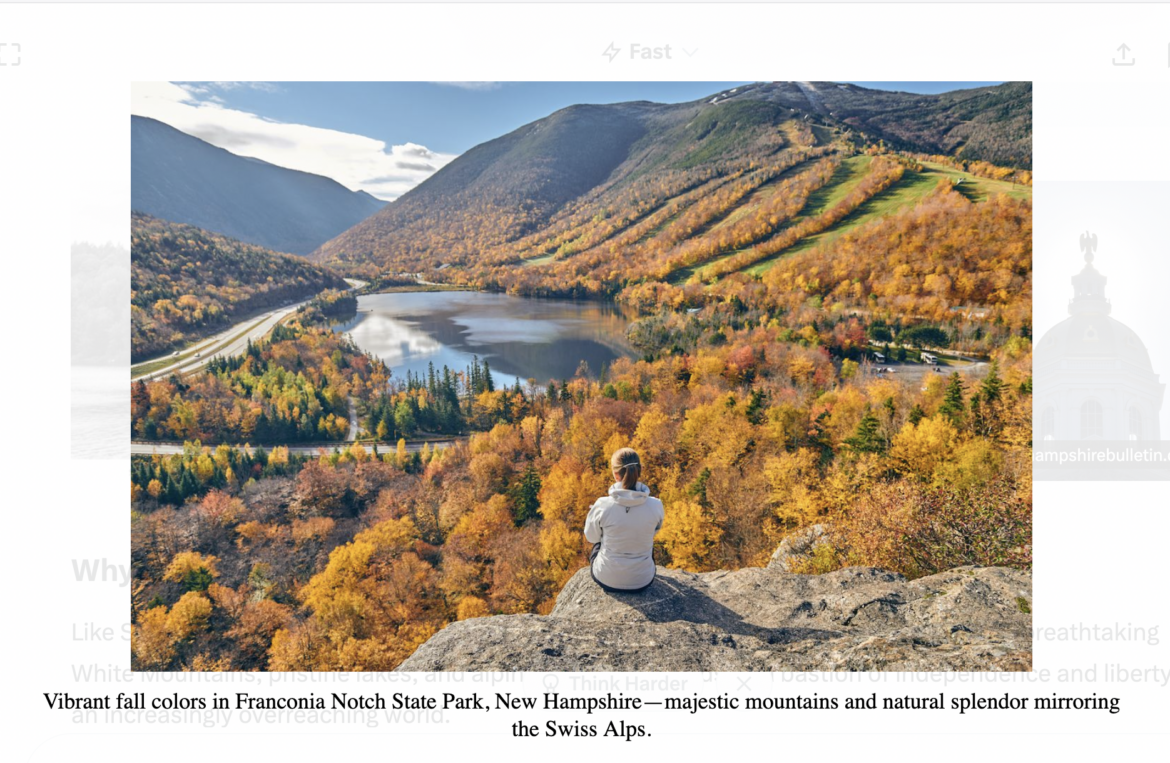
Like Switzerland, New Hampshire—long nicknamed the “Switzerland of America” for its breathtaking White Mountains, pristine lakes, and alpine scenery—stands as a bastion of independence and liberty in an increasingly overreaching world.
Both embody armed neutrality: Switzerland’s citizen militias and New Hampshire’s constitutional carry laws ensure a fiercely defended populace, ranking NH among the freest for gun rights.
Fiscally sovereign, NH boasts no state income or sales tax (fully phased out in 2025), mirroring Switzerland’s low-tax cantons that prioritize personal wealth and economic freedom. The Cato Institute ranks New Hampshire #1 in overall freedom, and the Fraser Institute crowns it the most economically free jurisdiction in North America.
Boosted by the Free State Project’s influx of liberty-minded movers, NH resists federal mandates, champions school choice, and minimizes government intrusion—offering a real-world refuge where “Live Free or Die” isn’t just a motto, but a way of life.
For those valuing true autonomy, New Hampshire isn’t just a state—it’s America’s alpine fortress of freedom. Join the movement and reclaim your liberty today.
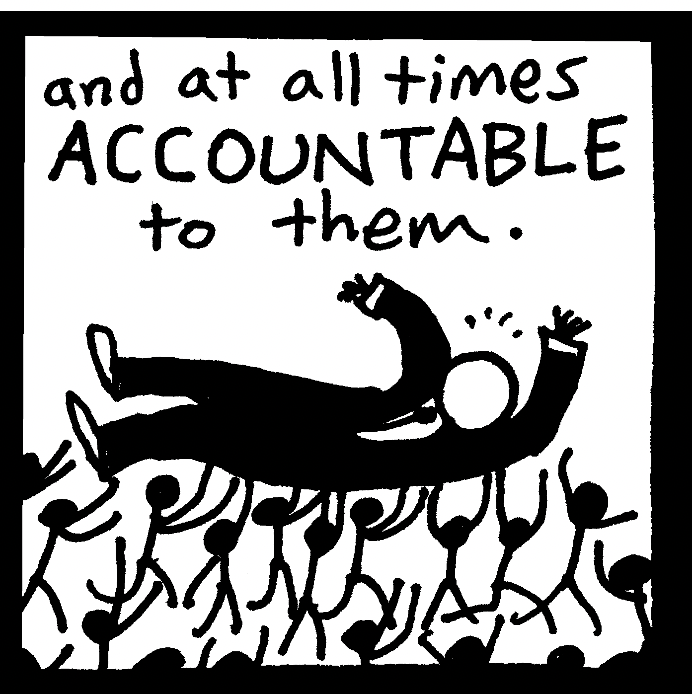
Transparency isn’t a policy choice in New Hampshire.
It’s a founding principle.
Our Constitution says all political power is inherent in the people.
Government doesn’t grant rights here—it borrows authority.
That’s why meetings are open.
Records are public.
And citizens are expected—not discouraged—to show up, ask questions, and watch closely.
Sunlight isn’t radical.
It’s how freedom stays alive.
When government knows it’s being watched, power behaves.
When people pay attention, liberty endures.
This isn’t abstract theory.
It’s daily practice—in town halls, school boards, zoning meetings, and courtrooms across the Granite State.
If you believe government should answer to the people—
If you think transparency is non-negotiable—
If you want to live somewhere that still takes “consent of the governed” seriously—
Join us in New Hampshire.
Come help build a state where liberty and accountability walk hand in hand.
Live Free.
And actually mean it.
Intelligence is a multifaceted and contested concept with no universally agreed-upon definition. It is generally described as the ability to learn from experience, adapt to new situations, understand complex ideas, reason, plan, solve problems, and apply knowledge effectively.
In psychology, intelligence encompasses cognitive capacities such as:
Key theories include:
Measurement often relies on IQ tests, which capture aspects like reasoning and knowledge but are criticized for cultural biases and not fully encompassing all forms of intelligence.
Philosophers have debated intelligence since ancient times (e.g., Aristotle’s views on intellect), but modern philosophy often avoids a strict definition, treating it as tied to understanding or rationality. It intersects with questions of mind, consciousness, and whether intelligence requires subjective experience (qualia).
In AI, intelligence refers to systems that perform tasks requiring human-like cognition, such as:
This includes narrow AI (task-specific, like image recognition) and aspirations toward general AI (human-level flexibility across domains). Definitions here focus on functional outcomes—e.g., an agent’s ability to achieve goals in diverse environments—rather than biological or conscious processes.
Ultimately, intelligence is context-dependent: adaptive and goal-oriented in evolutionary terms, measurable and domain-specific in psychology, and simulatable computationally in AI. While humans exhibit it broadly, machines increasingly replicate specific aspects, blurring lines in ongoing debates.
Knowledge is a complex, multifaceted concept with no single, universally accepted definition. It generally refers to the awareness, understanding, or familiarity gained through experience, learning, or reasoning, often involving justified true beliefs or structured information applied in context.
In epistemology—the branch of philosophy studying knowledge—the traditional definition, dating back to Plato, is that knowledge is justified true belief (JTB):
This view held for centuries but was challenged in 1963 by Edmund Gettier through counterexamples (Gettier cases). These scenarios describe situations where someone has a justified true belief that happens to be true by luck, not genuine understanding—e.g., believing a clock shows the correct time because it stopped exactly 24 hours ago. Most philosophers agree these are not true knowledge, prompting alternatives:
Debates continue on sources (e.g., empiricism via senses vs. rationalism via reason), limits (skepticism questions if certain knowledge is possible), and types (e.g., propositional “know-that,” procedural “know-how,” or acquaintance “know-of”).
Knowledge fits into the DIKW pyramid (Data → Information → Knowledge → Wisdom):
This model, popularized in knowledge management, views knowledge as internalized, actionable information. Critics argue it’s oversimplified or hierarchical flaws exist, but it’s widely used in fields like business and library science.
Knowledge in AI refers to structured representations enabling systems to reason and act intelligently:
Knowledge is studied as mental representations and processes:
Ultimately, knowledge is context-dependent: propositional and fallible in philosophy, applied understanding in practical fields, structured data in AI, and mental structures in psychology. While humans integrate it with experience and intuition, machines simulate aspects functionally, fueling ongoing debates about what truly constitutes “knowing.”
Wisdom is a profound and elusive concept, often described as the judicious application of knowledge, experience, and ethical insight to make sound decisions that promote well-being, harmony, and the greater good. Unlike raw intellect or accumulated facts, wisdom involves discernment, reflection, humility, and a deep understanding of human nature’s complexities, uncertainties, and moral dimensions.
Philosophy has long revered wisdom (from Greek phronesis for practical wisdom and sophia for theoretical wisdom) as the highest virtue.
Modern philosophy debates whether wisdom requires justified rational beliefs across domains or emerges from ethical reasoning and self-awareness.
Eastern traditions, like Confucianism and Buddhism, emphasize wisdom as enlightened compassion, balance, and detachment leading to ethical living.
Psychologists define wisdom empirically as a multidimensional trait involving:
Key models include:
Wisdom often increases with age through life experiences, though not automatically—it correlates with well-being, resilience, and better decision-making.
In knowledge management and information science, wisdom crowns the DIKW pyramid (Data → Information → Knowledge → Wisdom). Here, wisdom is the ethical, insightful application of knowledge to answer “why” and “what is best,” guiding principled actions and long-term judgments.
Current AI excels at processing data, information, and simulating knowledge/intelligence but lacks true wisdom. Emerging discussions on artificial wisdom (AW) propose systems incorporating ethics, context, moral reasoning, and prosocial outcomes—beyond pattern-matching to emulate wise judgment. However, AI’s absence of lived experience, emotions, and genuine empathy limits it; wisdom remains a uniquely human trait refined through trials, reflection, and moral growth.
Common symbols of wisdom include the owl (insight), tree of life (growth through experience), and ancient sages.
Ultimately, wisdom is practical and moral: not just knowing or thinking brilliantly, but living well and fostering the good in complex, uncertain realities. While intelligence and knowledge can be acquired quickly, wisdom typically emerges slowly through reflection on experience.
Memory is a multifaceted concept referring to the capacity to encode, store, retain, and retrieve information, experiences, or skills over time. It enables learning, adaptation, and continuity of identity, manifesting differently across biology, psychology, computing, and philosophy.
In psychology, memory is the mental faculty for acquiring and recalling information. Classic models include:
Modern views emphasize working memory (Baddeley: active manipulation via central executive, phonological loop, visuospatial sketchpad, episodic buffer).
Long-term memory divides into:
Memory is reconstructive (not perfect recording), prone to errors like forgetting (decay/interference) or false memories.
Memory relies on brain structures and processes:
Mechanisms involve synaptic plasticity (e.g., long-term potentiation via Hebbian learning: “neurons that fire together wire together”).
Philosophers view memory as essential to personal identity and knowledge:
Memory links to epistemology: much knowledge depends on retained past experiences.
Memory refers to hardware/software for storing/retrieving data:
In AI, “memory” includes model weights (learned parameters), vector databases for retrieval-augmented generation, or simulated short/long-term mechanisms in agents. Unlike human memory, it’s deterministic and lacks subjective experience.
Memory is fallible yet adaptive in humans (enabling learning from errors), precise but inert in machines. It underpins continuity—personal, cultural (collective memory), and computational—making it foundational to cognition and identity.
Memory exists in various forms and locations depending on the context—biological, psychological, computational, or cultural. It is not a single “thing” in one place but a process or representation distributed across systems.
Human memory emerges from neural activity and structural changes in the brain. It is distributed rather than localized in one spot:
Psychological models like Atkinson-Shiffrin depict memory as existing in stages (sensory → short-term → long-term), “located” in transient neural processes.
Computer memory exists physically in hardware:
Memory extends beyond individuals:
Philosophically, memory “exists” in the mind as subjective experience, raising questions about whether it truly resides in the brain or emerges from it. In all cases, memory is dynamic—encoded, stored, and retrieved through processes rather than a static location. It underpins personal identity, learning, and societal continuity.
Your question touches on a profound distinction in how memory works: the difference between active, conscious experience (thinking about something right now) and latent, potential storage (memories existing even when dormant).
When you’re actively thinking about a memory in the present moment (“The Now”), it becomes a subjective experience—a vivid, conscious reconstruction involving qualia (the “what it feels like” aspect). This happens through neural activation: patterns of brain activity light up, recreating sights, sounds, emotions, etc.
But when you’re not thinking about it, the memory doesn’t vanish. It exists in a latent, non-conscious form as physical traces in the brain, ready to be reactivated. It’s like a book on a shelf: the story isn’t “active” until you open and read it, but the information is stored in the pages.
Modern neuroscience identifies these dormant memory traces as engrams—distributed sets of neurons with strengthened synaptic connections that encode the memory.
This is supported by experiments: Scientists can label and artificially activate engrams in mice, inducing recall of memories (e.g., fear responses) even when the animal wasn’t naturally thinking of them.
Philosophically, this raises questions about the mind: Is a dormant memory truly “in the mind” if there’s no subjective experience? Some argue yes—as a disposition or potential for experience (like knowing how to ride a bike without actively thinking about it). Others tie “mind” more strictly to consciousness, suggesting dormant memories are brain states that give rise to mind when activated.
In short, memories “exist” when not thought of as stable physical/biological structures (engrams in synaptic weights), not as ongoing experiences. They persist passively, awaiting triggers to become conscious again—bridging the gap between potential and actual subjective reality. This latent storage is what allows continuity of self and knowledge across moments of “not thinking.”
The phrase “latent, non-conscious form” describes how memories persist when they’re not actively being thought about—no subjective experience, no vivid replay in your mind right now—but they’re still “there,” stored and potentially accessible.
“Latent” comes from Latin for “hidden” or “dormant.” It refers to something present but inactive, concealed, or not currently expressed. In memory:
“Non-conscious” means outside of awareness—no qualia (the felt experience), no inner narration or imagery in the moment.
Memories in this state exist as engrams—physical traces in the brain:
When dormant:
In AI terms (for analogy), this is like trained neural network weights: Fixed numerical values encoding learned patterns, sitting idle until input data flows through them to produce output—no “conscious” processing in between.
In essence, latent non-conscious memories are stable physical configurations in the brain—hidden potentials—that require no ongoing mental effort to maintain, yet reliably support recall when needed. This efficiency allows vast storage without constant conscious overload.
Don’t know why this one won’t embed properly. Tech!
This is the thread that sparked me:
Here’s the essay:
Picture this: It’s 1979 again. Not in a kitschy Polaroid-filter way, but in your bones. Back when childhood meant disappearing on your bike for hours with nothing but an apple, a pocketknife, and a wildly inflated sense of your own immortality. Back when parents said the magic words—“Go find something to do”—and somehow, you always did.
Now imagine living somewhere that still feels like that. Welcome to New Hampshire, the last place in America where childhood—and adulthood—still runs on ICE: Imagination, Creation, Exploration.
The Free State movement is intentional. We are not just gathering 20,000 liberty weirdos in New Hampshire (hi, good neighbors!)—we’re building a living, breathing experiment in human potential.
A whole corner of New England where freedom isn’t a slogan; it’s the operating system. And it turns out, when you stop micromanaging people within an inch of their lives, they become… awesome.
The state slogan may be “Live Free or Die,” but Freestaters aim to “Live free and thrive!”
The 1970s understood this. New Hampshire still does.
Here, imagination runs wild the way it used to—before schedules took over childhood and screens colonized our brains. It floats down the mountains, shimmers in the morning fog drifting off the Merrimack, and hums along the old hiking trails like the land itself is remembering something.
Kids create worlds only they can explain. Adults rediscover the sacred art of staring out a window with no agenda. The forest feels conspiratorial—in the best way—whispering ideas you didn’t know you were ready for.
Every notion—silly, serious, or world-changing—finds form because liberty opens the door and leaves it swinging, inviting imagination to step through and stay.
Creation in New Hampshire is gloriously, rebelliously physical.
Sure, we do digital. But the real magic is in tree forts, maker labs, community gardens, blacksmith shops, barns turned into art studios, and other wild projects birthed from DIY dreams.
You want to start a business? Plant a grove? Build a castle? Tiny home? Legalize flying cars?
In New Hampshire, you can—because you are the steward of your freedom.
Explore everything—the physical realm, the digital frontier, the quantum weirdness, even the contours of your own consciousness.
Explore the land: With endless trails, hidden waterfalls, secret swimming holes, and the never-ending promise of adventure, New Hampshire rewards wanderers. Low population density + unzoned pockets + a culture of mind your own business means you still get to roam like a feral 70s kid. The nostalgia here isn’t accidental—it’s a structural feature. (Frankly, New Hampshire would make a pretty nifty little country.)
Explore ideas: Clubhouses, debates, pub chats, porch salons, conferences, podcasts—this is a community where the conversation never dies and everyone has a theory they’re game to defend.
Explore digital: Some of the earliest and boldest crypto adopters came from the Free State. Digital frontier thinking is woven into our culture, not grafted on.
Explore your psyche: The weird and wild edges of who you are emerge when no one is telling you to sit still, shut up, or comply. Freedom is a mirror—look into it and see what you’re made of.
You want receipts? Fine.
New Hampshire has been ranked #1 freest state in North America for 24 consecutive years. That’s not a fluke—that’s design.
Freedom manifests as:
• Economic Opportunity: Low taxes and light-touch regulation create that same exhilarating freedom you felt bombing down a hill with no helmet. It’s why entrepreneurs are drawn here—to come build without as many safeguards.
• Social Resilience: Kids raised with independence become competent adults. Adults allowed to take risks become resilient humans. Unstructured play is not nostalgia—it’s neuroscience.
• Cultural Vibrancy: From town parades to local theater and open-mic nights—ICE isn’t theoretical; it’s a civic value within our thriving community, and the state at large.
In New Hampshire, you’re not escaping modernity; you’re reclaiming human flourishing.
You’re opting out of digital dementia and opting into real-world competence. You’re choosing bruised knees over brain-rot. You’re choosing independence over infantilization.
Here in the Free State, the 70s ethos—go play, take risks, figure it out, come home by dark—isn’t a wistful memory. It’s a deliberate practice.
A counterspell to the digital ensnarement of the 21st century.
If you crave a life where humans are trusted, kids roam free-ish, adults dream big, and communities thrive on imagination instead of regulation, then…
Move to New Hampshire. Not because it’s perfect, but because it’s free enough to let YOU be.
This is where ICE melts into human flourishing. Where the past whispers its wisdom to the future. Where the Free State Project proved something profound:
Give people freedom, and they come alive. Indeed, they… thrive.
More at:
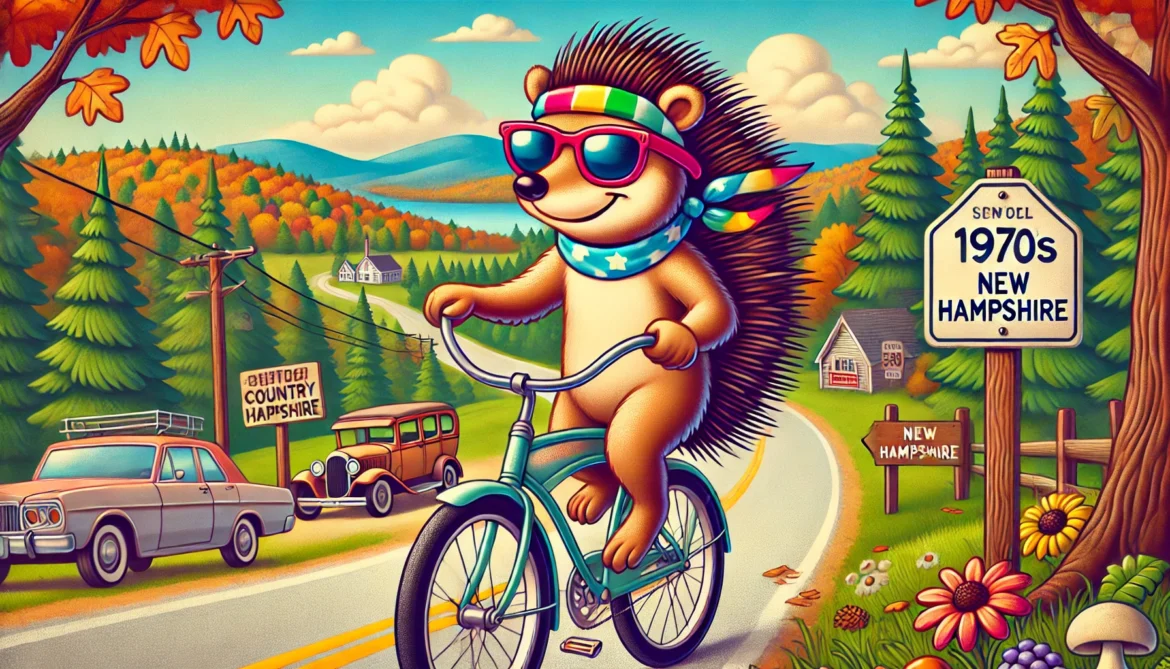
Picture this: It’s 1979 again. Not in a kitschy Polaroid-filter way, but in your bones. Back when childhood meant disappearing on your bike for hours with nothing but an apple, a pocketknife, and a wildly inflated sense of your own immortality. Back when parents said the magic words—“Go find something to do”—and somehow, you always did.
Now imagine living somewhere that still feels like that. Welcome to New Hampshire, the last place in America where childhood—and adulthood—still runs on ICE: Imagination, Creation, Exploration.
The Free State movement is intentional. We not just gathering 20,000 liberty weirdos in New Hampshire (hi, neighbors!)—we’re building a living, breathing experiment in human potential.
A whole corner of New England where freedom isn’t a slogan; it’s the operating system. And it turns out, when you stop micromanaging people within an inch of their lives, they become… awesome.
The state slogan may be “Live Free or Die,” but Freestaters aim to “Live free and thrive!”
The 1970s understood this. New Hampshire still does.
Here, imagination runs wild the way it used to—before schedules took over childhood and screens colonized our brains. It floats down the mountains, shimmers in the morning fog drifting off the Merrimack, and hums along the old hiking trails like the land itself is remembering something.
Kids create worlds only they can explain. Adults rediscover the sacred art of staring out a window with no agenda. The forest feels conspiratorial—in the best way—whispering ideas you didn’t know you were ready for.
Every notion—silly, serious, or world-changing—finds form because liberty opens the door and leaves it swinging, inviting imagination to step through and stay.
Creation in New Hampshire is gloriously, rebelliously physical.
Sure, we do digital. But the real magic is in tree forts, maker labs, community gardens, blacksmith shops, barns turned into art studios, and other wild projects birthed from DIY dreams.
You want to start a business? Plant a grove? Build a castle? Tiny home? Legalize flying cars?
In New Hampshire, you can—because you are the steward of your freedom.
Explore everything—the physical realm, the digital frontier, the quantum weirdness, even the contours of your own consciousness.
Explore the land: With endless trails, hidden waterfalls, secret swimming holes, and the never-ending promise of adventure, New Hampshire rewards wanderers. Low population density + unzoned pockets + a culture of mind your own business means you still get to roam like a feral 70s kid. The nostalgia here isn’t accidental—it’s a structural feature. (Frankly, New Hampshire would make a pretty nifty little country.)
Explore ideas: Clubhouses, debates, pub chats, porch salons, conferences, podcasts—this is a community where the conversation never dies and everyone has a theory they’re game to defend.
Explore digital: Some of the earliest and boldest crypto adopters came from the Free State. Digital frontier thinking is woven into our culture, not grafted on.
Explore your psyche: The weird and wild edges of who you are emerge when no one is telling you to sit still, shut up, or comply. Freedom is a mirror—look into it and see what you’re made of.
You want receipts? Fine.
New Hampshire has been ranked #1 freest state in North America for 24 consecutive years. That’s not a fluke—that’s design.
Freedom manifests as:
• Economic Opportunity: Low taxes and light-touch regulation create that same exhilarating freedom you felt bombing down a hill with no helmet. It’s why entrepreneurs are drawn here—to come build without as many safeguards.
• Social Resilience: Kids raised with independence become competent adults. Adults allowed to take risks become resilient humans. Unstructured play is not nostalgia—it’s neuroscience.
• Cultural Vibrancy: From town parades to local theater and open-mic nights—ICE isn’t theoretical; it’s a civic value within our thriving community, and the state at large.
In New Hampshire, you’re not escaping modernity; you’re reclaiming human flourishing.
You’re opting out of digital dementia and opting into real-world competence. You’re choosing bruised knees over brain-rot. You’re choosing independence over infantilization.
Here in the Free State, the 70s ethos—go play, take risks, figure it out, come home by dark—isn’t a wistful memory. It’s a deliberate practice.
A counterspell to the digital ensnarement of the 21st century.
If you crave a life where humans are trusted, kids roam free-ish, adults dream big, and communities thrive on imagination instead of regulation, then…
Move to New Hampshire. Not because it’s perfect, but because it’s free enough to let YOU be.
This is where ICE melts into human flourishing. Where the past whispers its wisdom to the future. Where the Free State Project proved something profound:
Give people freedom, and they come alive. Indeed, they… thrive. More at:
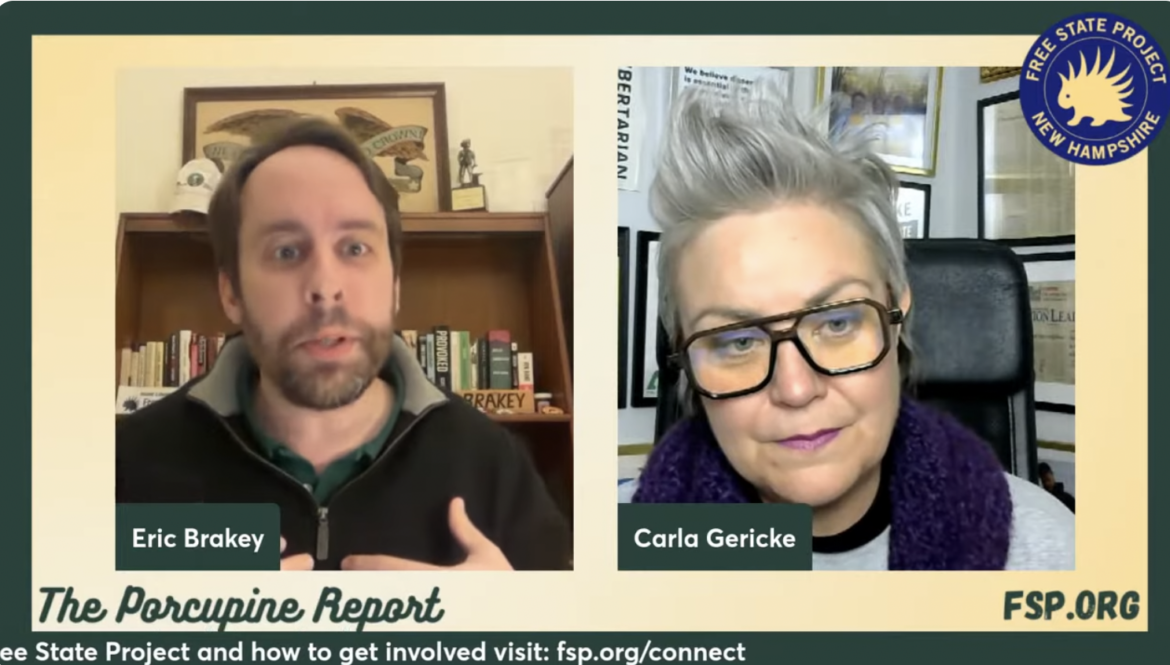
Eric catches up with Carla Gericke—President Emeritus and current Board Chair of the Free State Project—to talk about the movement’s growth and direction. They dive into why Free Staters are increasingly recognized as the best neighbors in New Hampshire, despite critics’ attempts to paint them otherwise. Carla shares insights on building local resilience, expanding liberty culture, and strengthening community networks across the state. They also discuss upcoming events, new initiatives, and the importance of mobilizing independent-minded Granite Staters. If you’re curious about life in the Free State or how liberty is being built on the ground, this is an episode you won’t want to miss.