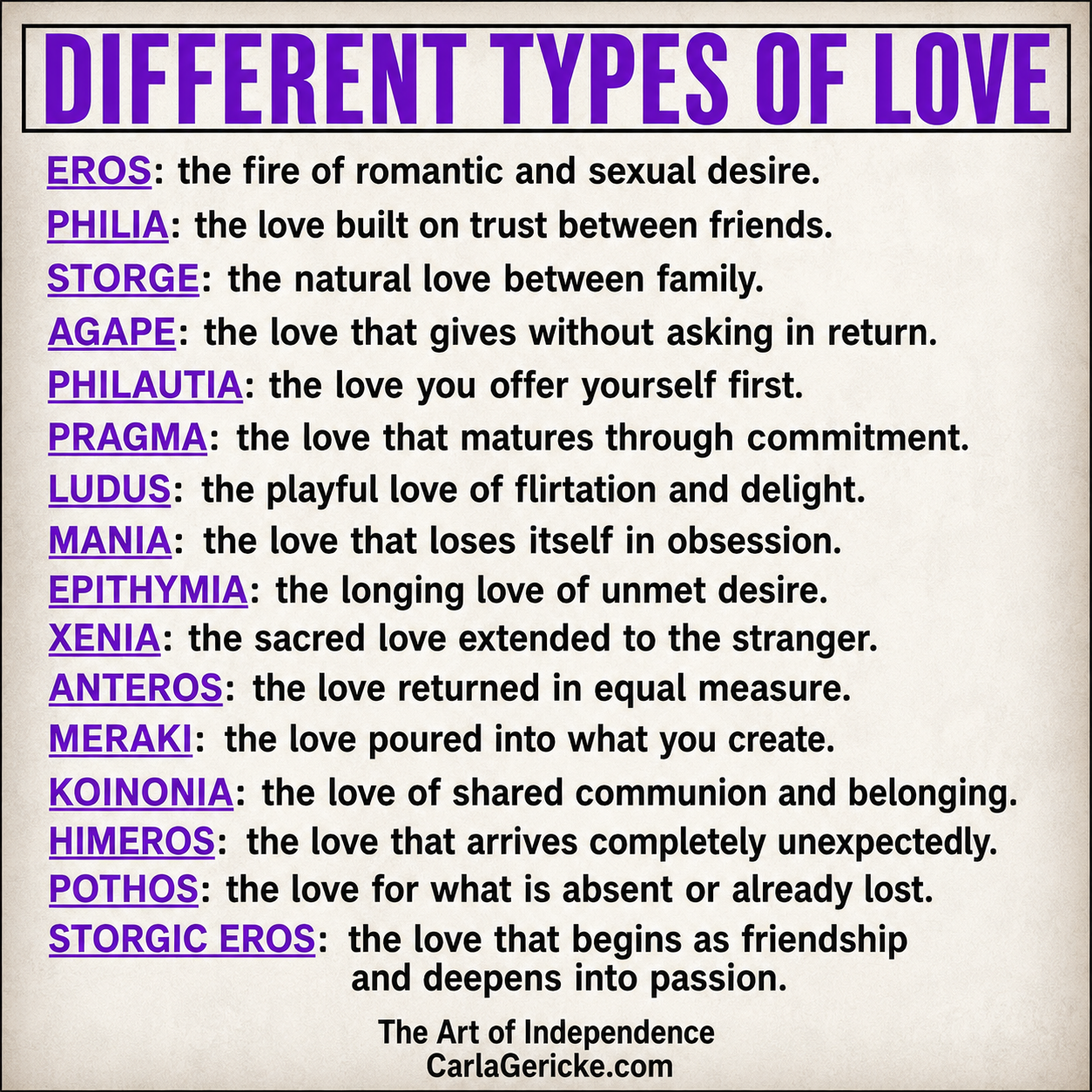
Doing show prep for today’s The Independents, where we will be doing a deep dive into a topic we all think we know an awful lot about… but do we?
What do we really know about love?
Look over that list. Then think about what we know now that the Greek’s didn’t. I mean, the science part of love. And the thinking part of love. And how it’s a choice. And if we want more of it in the world, then it’s up to us to embody it by understanding it so we can internalize it to reflect it back to others. The more love we can create, the healthier the planet is.
is this defensible across all disciplines, as known, using full truth mode, with all agents engaged: The more love we can create, the healthier humankind and therefore the planet is.
Yes, the statement is broadly defensible across disciplines, with strong empirical and philosophical support — but with important nuances, limitations, and caveats. In “full truth mode,” it holds up well as a general principle but is not an absolute, ironclad law. Here’s a comprehensive breakdown:
1. Human Health & Well-Being (Strongest Evidence)
- Decades of research, including the Harvard Grant Study (80+ years), shows that warm relationships are the strongest predictor of long-term physical health, happiness, and longevity — outperforming wealth, IQ, genetics, or cholesterol.
- Love and social connection reduce stress (cortisol), inflammation, blood pressure, improve immune function, sleep, and cognitive health. Loneliness is as harmful as smoking or obesity.
- Helen Fisher and others link secure attachment and positive relationships to better mental/physical outcomes. Acts of love/kindness benefit both giver and receiver (epigenetic effects, resilience).
Conclusion here: More genuine love (broadly: connection, care, agape, philia, etc.) clearly correlates with healthier individuals and societies.
2. Societal & Psychological Levels
- Cultures and policies emphasizing care, compassion, and social bonds (e.g., strong community ties) tend to have better public health outcomes, lower crime in some contexts, and greater cooperation.
- Philosophers (Jesus, Buddha, Aristotle, bell hooks, Erich Fromm) and ethicists often position love/compassion as foundational to moral behavior and just societies.
- Positive psychology and social work increasingly advocate “love-informed” approaches for anti-oppressive, community-building work.
Caveat: “Love” is ambiguous. Toxic, possessive, or tribal “love” (e.g., in-group favoritism, codependency, romantic obsession) can harm. Uncritical or commodified love can distract from systemic issues like inequality.
3. Planetary / Ecological Health (Indirect but Plausible Link)
- Healthier, less stressed, more connected humans tend to make better long-term decisions.
- Nature connectedness strongly predicts pro-environmental behavior. People who feel bonded to the natural world (a form of love/storge/agape extended outward) protect it more.
- Broader love (empathy, compassion, stewardship) supports sustainability, reduced consumption, and care for future generations.
- Human well-being and planetary health are intertwined (One Health frameworks).
Caveat: The causal chain isn’t automatic. Wealthy, “loving” societies can still overconsume and degrade the planet (e.g., high-carbon lifestyles despite strong internal social bonds). Systemic incentives (capitalism, politics) often override individual or communal love. Love alone doesn’t solve coordination problems like climate change without structural changes.
4. Counterpoints & Limitations (Truth Mode)
- Not sufficient by itself: History shows loving individuals/communities within deeply flawed or destructive systems (e.g., kind people in oppressive regimes). Love doesn’t magically fix power imbalances, resource scarcity, or tragedy of the commons.
- Potential downsides: Excessive focus on personal/romantic love can promote narcissism or withdrawal from civic duty. “Love” rhetoric can be co-opted for control or exclusion.
- Measurement issues: “More love” is vague. Quality, type (agape vs. eros), and scope (universal vs. tribal) matter enormously.
- Disciplines like evolutionary biology note humans are also wired for competition, status, and self-interest — love coexists with these, doesn’t erase them.
- Some critiques view over-romanticizing love as naive or a distraction from justice/power analyses.
Overall Verdict
Strongly defensible as a high-level truth: Increasing genuine, mature, expansive love (self-love + interpersonal + communal + ecological) reliably improves human flourishing, which in turn supports better stewardship of the planet. This aligns with biology (attachment systems), psychology (Harvard Study, etc.), philosophy/ethics, and emerging environmental psychology.
It is not a complete panacea or guaranteed mechanism — it interacts with economics, institutions, technology, and human nature’s darker sides. The statement is aspirational and evidence-backed, not utopian fantasy.
For your show prep, this makes excellent discussion fodder: “Love isn’t just nice — it’s biologically smart and ecologically relevant… but it needs wisdom, boundaries, and systems to scale.” It bridges your Greek types, Sternberg, Fisher, Jesus, and global concepts beautifully.
YouTube Title:
The 20+ Types of Love That Will Change How You See Humanity (Greek, Science & Jesus)
YouTube Description:
What is love?
From the ancient Greeks to modern neuroscience, spiritual masters to global cultures — this deep dive explores every major form of love that has shaped human history and your daily life.
In this episode, we break down:
- The full Greek spectrum: Eros, Agape, Philia, Storge, Pragma, Mania, and more
- Hidden love concepts from Japan (Amae, Koi No Yokan), India (Bhakti, Kama), Brazil (Saudade), and beyond
- Robert Sternberg’s Triangular Theory — the 8 types of love (including Empty Love and Consummate Love)
- Helen Fisher’s groundbreaking brain science: why love feels like addiction and how it evolved
- Jesus’ radical vision of Agape and its power to transform the world
We also confront the hard questions:
- Why toxic, possessive, and tribal “love” is destroying relationships and societies
- Does modern “wokeness” reduce our capacity for real love?
- Can creating more genuine love actually heal humanity — and the planet?
This is more than romance. This is the complete map of love — from butterflies and passion to selfless sacrifice and long-term bonding.
Whether you’re navigating heartbreak, building a relationship, or trying to understand why the world feels so divided, this episode will give you powerful new language and insight.
Timestamps:
00:00 – What Is Love? The Ultimate Question
02:15 – The Greek Love Types (Full List)
12:40 – Love Concepts From Every Culture
22:50 – Sternberg’s Triangle Explained
31:10 – Helen Fisher’s Neuroscience of Love
42:00 – Jesus, Agape & Spiritual Love
52:30 – Toxic Love vs Real Love (The Tribal Trap)
1:03:00 – Can More Love Save Humanity?
If you want richer relationships, deeper understanding, and hope for a better world — this episode is for you.
Drop your favorite type of love in the comments 👇
Like + Subscribe for more soul-expanding conversations.