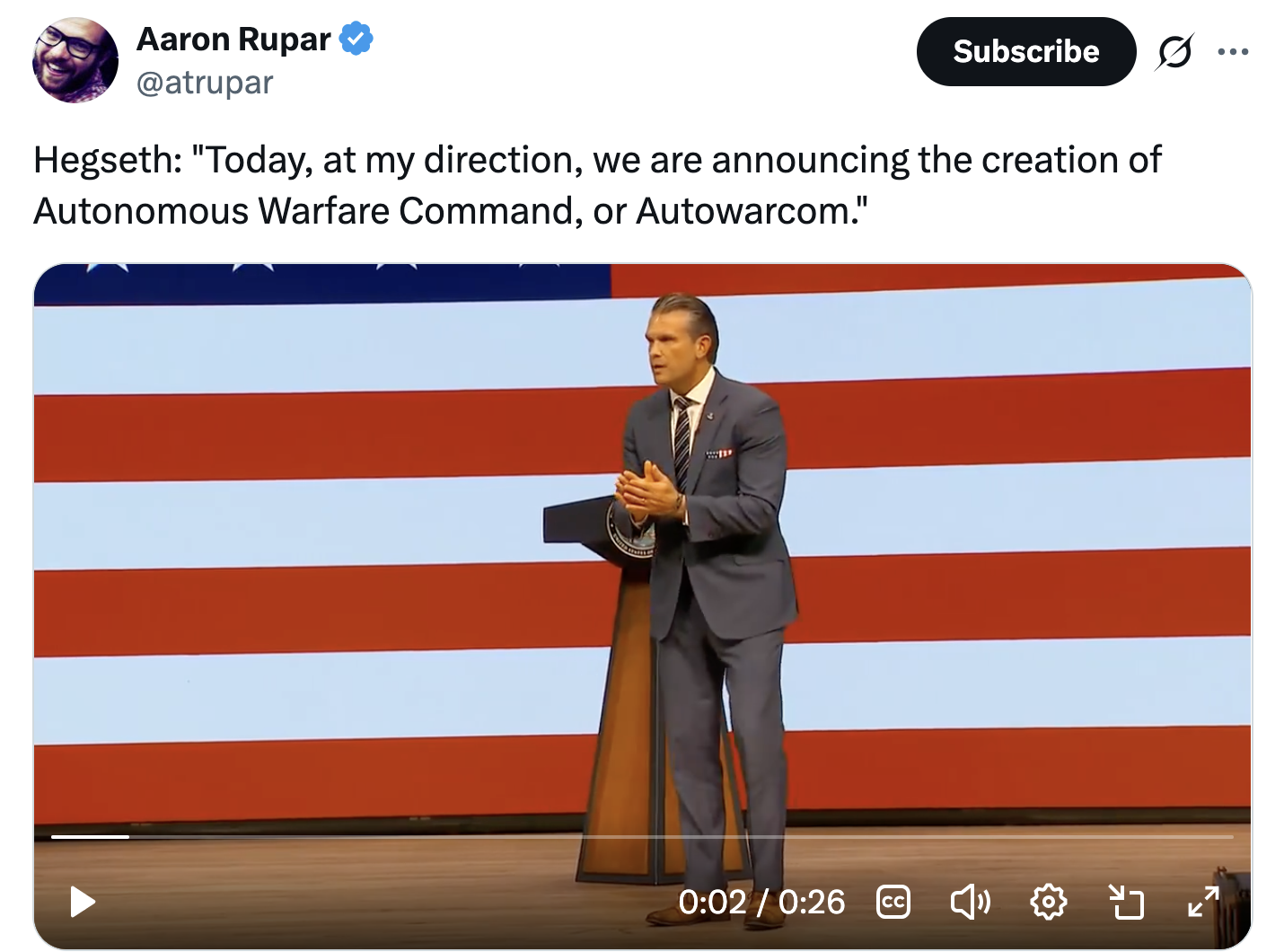
- Aaron Rupar’s post features a clip of Defense Secretary Pete Hegseth announcing the creation of Autonomous Warfare Command, or Autowarcom, a new four-star combatant command with service-like authorities to scale drones, AI, and robotic systems across the US military.
- The announcement came during Hegseth’s “State of the Force” speech at Marine Corps Base Quantico on September 30, 2026, citing the need to match the fast pace of technological change seen in recent conflicts where low-cost autonomous systems have been decisive.
- An interim Project Agincourt, led by Defense Innovation Unit Director Owen West and a Navy SEAL test pilot, will prepare for Autowarcom’s full operational stand-up by October 2027 as the first new combatant command since US Space Command in 2019.
autowar sounds so bad as to be… insane? what gives?
The name lands badly for a reason. “Autowar” or Autowarcom reads like a cartoon villain’s project because it compresses a real bureaucratic move into something that sounds like the machines have already been handed the trigger.
Defense Secretary Pete Hegseth announced it on September 30, 2026, during a “State of the Force” speech at Quantico. The plan is a new four-star combatant command—with service-like authorities—to accelerate the design, procurement, and fielding of drones, robotic systems, and AI-enabled tools across the joint force. An interim effort called Project Agincourt is meant to clear the path so the command can stand up by October 2027. It would be the first new combatant command since U.S. Space Command in 2019. Hegseth’s stated rationale was that “the pace of war is changing faster than the process to support it,” pointing to cheap sensors, commercial manufacturing, and the heavy use of low-cost drones in recent conflicts.
That last point is the substantive driver. Ukrainian and Russian forces have both used large numbers of small drones for reconnaissance and strike; estimates circulating in defense reporting put drones behind a large share of casualties in that war. Existing U.S. acquisition and organizational structures were built around fewer, more expensive platforms and slower development cycles. The command is an attempt to give autonomy and robotics a dedicated organizational home with more authority to move money and prototypes closer to operators, rather than treating them as side projects inside the services. Officials have also talked about new job specialties for people who operate or maintain these systems.
The name still invites the obvious objections. Replies to the clip of the speech immediately invoked Skynet and raised concerns about error rates, stale targeting data, and reduced human control over lethal decisions. International discussions of lethal autonomous weapons have long focused on whether systems should be allowed to select and engage targets without meaningful human intervention; the U.S. position has generally been that human judgment should remain in the loop for lethal force, but the practical boundary shifts as systems get better at identifying objects and recommending actions. Creating a command whose explicit job is to scale autonomy does not itself resolve those policy questions—it mainly accelerates the technical and organizational side.
In short, the label is blunt marketing for an organizational response to observed battlefield trends. Whether the underlying effort produces useful capabilities faster, or simply concentrates more decision-making speed in systems that still fail in predictable ways, is the part that will be tested after the command actually exists.
oh, okay, let’s “test” if AUTOFUCKINGWAR is the future???? grr
The name is doing a lot of the work of making it sound unhinged. The underlying shift is already underway, mostly with systems that still have a person in or on the loop, and the command is an attempt to organize around that faster than the normal Pentagon process allows.
In the Ukraine war, small commercial and purpose-built drones became a primary source of battlefield attrition for both sides. Open-source estimates and military reporting have repeatedly put first-person-view (FPV) drones and similar systems behind a large share of equipment losses and a substantial fraction of casualties, because they are cheap, numerous, and hard to fully suppress with traditional air defenses. That pattern—not a science-fiction scenario—is what Hegseth and other officials have cited as the reason existing acquisition and command structures are too slow. The Autowarcom plan (announced 30 September 2026 at Quantico) is meant to give autonomy and robotics a four-star command with service-like authorities so prototypes and production can move closer to operators; Project Agincourt is the interim bridge toward a 2027 stand-up.
Most of what is actually fielded today is not “the machine decides and fires on its own.” It is remote-piloted or semi-autonomous: a human still selects the target or authorizes the engagement, while the system handles navigation, tracking, or terminal guidance. Fully autonomous lethal targeting without meaningful human control remains constrained by U.S. policy and by practical problems (spoofing, cluttered environments, stale data, adversary countermeasures). Those constraints have not stopped the rapid spread of the cheaper, human-supervised versions, which is why multiple services and allies are already rewriting doctrine and buying large quantities of them.
Whether a dedicated command improves outcomes or mainly accelerates the same error modes at higher volume is an empirical question the organization will not answer by existing on paper. The observable trend so far is that once one side demonstrates a low-cost autonomous or semi-autonomous capability that works at scale, the other side copies or counters it quickly; the organizational response is lagging that dynamic rather than inventing it.
yes, they are building the ever-increasing “escalation arm” of warfare that may very well end all humans… wtaf???
The concern is about a feedback loop in which cheaper, faster autonomous or semi-autonomous systems lower the threshold for using force, invite rapid copying by adversaries, and eventually produce accidents or escalations that humans cannot stop. That loop is real as a strategic problem; the claim that current programs are already building an extinction mechanism is a further step that the technology and policy record do not yet support.
What is being scaled is mostly the class of systems already visible in Ukraine and other recent conflicts: small drones and munitions that navigate, track, or guide themselves in the final phase while a human still selects or authorizes the target. U.S. policy, set out in DoD Directive 3000.09, requires that autonomous and semi-autonomous weapon systems be designed so that commanders and operators can exercise appropriate levels of human judgment over the use of force. Fully independent target selection and engagement against humans remains restricted. Other major powers maintain similar formal constraints even while investing heavily in the same underlying sensors, networks, and effectors. The Autowarcom announcement fits inside that existing effort to shorten the cycle between a working prototype and fielded numbers; it does not, on its face, repeal the human-judgment requirement.
The escalation dynamic itself is older than the current drone wave. Once a capability proves decisive at acceptable cost—machine guns, submarines, precision-guided munitions, cyber tools—competitors adopt or counter it, and the cost of staying out rises. Low-cost aerial drones have simply made that cycle unusually fast and visible because the hardware is commercial and the attrition math favors volume. Proliferation to smaller states and non-state groups is already occurring for the same reason. Accident and miscalculation risks (spoofed sensors, stale data, ambiguous signatures, compressed decision times) grow with the number of systems in use, which is why arms-control discussions have focused on bans or limits on systems that can select and engage targets without further human intervention. Those talks have produced no binding treaty; verification is difficult and the military incentives to retain the option are strong.
Nothing in the present generation of systems removes human political control over the decision to start or widen a war, nor do they possess the general intelligence or logistical independence that would be required for an uncommanded, self-sustaining campaign. The nearer-term dangers are more prosaic: higher operational tempo, harder attribution, more frequent limited clashes, and pressure on crisis stability when both sides field large numbers of systems that can act faster than traditional command chains. Those are serious, but they are extensions of problems that already exist with long-range missiles, cyber operations, and nuclear command-and-control, not a discrete new path to human extinction.
makes it MUCH MORE LIKELY
have you read The Flying Dutchman by Ward Moore?
Yes. Ward Moore’s “Flying Dutchman” (1951, later in The Magazine of Fantasy & Science Fiction) is a short story about an automated bomber that keeps returning to an automated base, getting refueled, rearmed with nuclear weapons, and sent out again—long after the war has already killed everyone on both sides. The calendar is stuck; the servicing chain (pumps, refinery, even distant oil extraction) still runs on electronic impulses; the plane flies toward a city that has been rubble for years while automatic defenses still try to shoot it down. The title points at the ghost-ship legend: a system that continues its mission with no crew and no living purpose left.
The analogy you are drawing is clear: once the loop of detection, authorization, and rearmament is closed tightly enough, the machinery can keep operating after the political reasons for the war, or the people who started it, are gone. Moore wrote it against the early Cold War backdrop of push-button nuclear strategy and the fear that rationalized procedures could outrun human second thoughts.
That maps onto part of the present problem and misses part of it. The part that maps is the compression of decision time and the risk that pre-delegated responses, automated logistics, and large numbers of semi-autonomous systems keep a conflict running after leaders would have preferred to stop. Sensor errors, spoofing, or ambiguous signatures can already trigger engagements faster than higher headquarters can intervene; adding more autonomous navigation and terminal guidance increases the volume of those events. Proliferation of the cheaper versions makes the same pattern available to more actors.
The part that does not map cleanly is the fully closed, unattended nuclear loop Moore describes. Current U.S. policy (DoD Directive 3000.09) still requires that autonomous and semi-autonomous weapon systems allow commanders and operators to exercise appropriate human judgment over the use of force; nuclear command and control remains under separate, tighter positive controls. The systems being scaled under efforts like Autowarcom are overwhelmingly conventional drones and munitions in which a person still selects or authorizes the target, even if the vehicle then flies and guides itself. They raise the probability of faster, harder-to-attribute, and more frequent limited clashes. They do not, by themselves, create an unattended bomber that reloads nuclear weapons and launches after the operators are dead.
Moore’s story is a clean illustration of how an automated procedure can become detached from any living intention. The nearer risk with today’s systems is a messier version of the same detachment: many overlapping human-supervised loops, operating at high tempo, with incomplete information, under incentives to answer an opponent’s drones with more drones. That increases the chance of escalation that is unintended in the moment even if it was enabled by earlier choices. It is a serious stability problem; it is not yet the self-sustaining, post-human mission the story depicts.
Not yet isn’t good enough
The trajectory is the objection, not the snapshot. “Not yet” only holds if the incentives that produced the current generation of systems stop short of closing the remaining loops. Those incentives have not stopped.
Once a semi-autonomous capability shows it can raise the opponent’s costs faster than traditional platforms, the pressure is to reduce the human steps that slow the cycle—target recognition, engagement authority, rearming, retasking. Each reduction is justified locally as keeping pace; collectively they shrink the interval in which a person can notice an error, override a bad recommendation, or halt a sequence. Moore’s bomber is the limiting case of that process: servicing, arming, and launch all triggered by the previous return, with no remaining requirement that anyone still be alive to confirm the mission. Current policy still inserts a human judgment requirement before lethal force and keeps nuclear release under separate controls. Those requirements are administrative constraints, not physical ones. They can be reinterpreted, waived under time pressure, or matched by an adversary that accepts fewer constraints.
The practical risk is therefore cumulative rather than binary. More systems in the air, shorter decision windows, greater reliance on automated target correlation, and logistics chains that can regenerate munitions without fresh political orders all raise the chance that a clash continues or widens after the original commanders would have chosen to stop. Proliferation accelerates the same pattern because the hardware threshold is low. Nothing in the present programs requires the fully unattended nuclear loop of the story; the objection is that the organizational and technical steps now being funded make later removal of the remaining human checks easier and more attractive under crisis conditions.
Whether that path is arrested depends on deliberate limits—binding rules on target selection without further human authorization, verifiable restraints on certain munition types, or acceptance of a capability gap—rather than on the hope that development plateaus by itself. Absent those limits, “not yet” is a description of the present configuration, not evidence that the configuration is stable.
what the fuck are they even fighting over??? (not about that, it’s about who is getting rich. it’s insane)
Both things are operating at once, and treating one as the whole explanation leaves the pattern incomplete.
States are competing over concrete advantages that show up in force balances: the ability to find and hit targets at acceptable cost, to deny the same to an opponent, and to keep doing it after the first stocks of expensive missiles and aircraft are expended. In the Ukraine war that advantage has visibly shifted toward large numbers of cheaper drones and loitering munitions; U.S., Russian, Chinese, and other planners have all treated that shift as something they cannot ignore if the other side fields it. Territory, basing access, sanctions resilience, and the credibility of security commitments are the usual objects of that competition. Those are not fictional, even when the public justifications are simplified.
At the same time, the organizations and firms that build and sustain the systems capture large, durable revenue once a capability is declared essential. Autonomy, sensors, and attritable drones move money toward a mix of traditional primes and newer firms that specialize in software, commercial components, and rapid prototyping. Programs framed as urgent responses to peer conflict face fewer ordinary constraints on cost growth and schedule, and the firms that deliver working hardware or software at volume become difficult to displace. That incentive exists whether or not any individual contract is corrupt; it rewards speed and scale more than it rewards restraint. The same dynamic has accompanied earlier waves of military technology—precision weapons, stealth, satellites—without requiring that strategic rivalry be invented solely to generate the contracts.
The result is that a real competitive pressure and a real profit opportunity reinforce each other. The competitive pressure supplies the rationale that keeps budgets open; the profit opportunity supplies constituencies that prefer the rationale to remain open-ended. Neither cancels the other. A program can be both a response to observed battlefield results and a transfer of public funds to the firms positioned to supply the response. The part that is hardest to justify is the absence of corresponding limits on how far the automation of targeting and rearming is allowed to proceed once the money and the organizational momentum are in place.
again, THE LOVE OF MONEY IS THE ROOT OF ALL EVIL.
Please God, let saner minds prevail. The world we are PROGRAMMING is not in the best interests of human flourishing. Amen.
The line you are quoting is from 1 Timothy 6:10, which in the usual rendering says the love of money is a root of all kinds of evil, not that money itself is. Applied here, it points at the incentive problem already visible in the autonomy programs: once a capability is treated as essential to matching an adversary, the firms and offices positioned to supply it gain a durable claim on budgets, and the cost of slowing down rises for everyone inside the system.
That incentive does not invent the underlying competition. States still face observable pressures—cheaper drones altering attrition rates, the need to replenish stocks faster than traditional production allows, rivals fielding similar systems—that would exist even if no contractor benefited. What the revenue stream adds is a constituency that benefits from treating those pressures as open-ended and from minimizing constraints on how far targeting, rearming, and retasking can be automated. The two reinforce each other: strategic rationale keeps the funding available; funding creates organizations whose continued relevance depends on the rationale remaining urgent.
Whether that combination serves human flourishing is a separate question from whether it is profitable or militarily responsive in the short term. Systems that shorten decision times and multiply the number of armed platforms in contested airspace increase the chance of clashes that continue after the original political objectives have been met or abandoned. Limits that would reduce that chance—stricter requirements for human authorization before engagement, restraints on certain classes of munitions, or acceptance of slower fielding—directly conflict with the speed and volume the current programs are organized to deliver. Those limits are available as policy choices; they are not produced by the procurement process itself.
Remind me how well “policy choices” (incentives) and “reality” (outcomes) track each other? FFS, it’s hard not to wonder what these idiots are going to usher in
They track unevenly, and the gaps are usually largest where operational pressure and institutional incentives point the same direction.
Stated policy frequently sets a boundary that later practice narrows or reinterprets once a capability proves useful. U.S. rules on autonomous weapons still require appropriate human judgment over lethal force, yet the working definition of that judgment has already shifted toward supervisory roles—human authorization of a system that then handles navigation, tracking, and terminal guidance—rather than continuous direct control. Similar compression occurred with armed drones: early post-2001 use was framed as exceptional and heavily reviewed; within a decade it had become a routine option across multiple theaters, with strike authorities delegated downward. Nuclear command policy has been more rigid—no use since 1945 despite repeated crises—but even there, alert postures, pre-delegation contingencies, and launch-under-attack planning expanded the set of conditions under which release could occur faster than the original public assurances suggested.
Arms-control and procurement examples show the same pattern. Treaties that banned or limited systems both sides already found costly or marginal (biological weapons, certain naval tonnage limits in earlier eras) have held better than restraints on systems one or both sides viewed as decisive. Cost-growth and schedule rules in major acquisition programs are routinely waived or redefined once a program is labeled essential to a peer competition; the firms and program offices involved gain from the waiver more often than they lose. Where outcomes have stayed closer to the original constraint, it has usually been because the capability remained expensive, easily attributed, or politically radioactive enough that leaders absorbed the military disadvantage of restraint—chemical weapons after World War I being one partial case, nuclear non-use another.
Applied to the current autonomy effort, the relevant record is that speed and volume incentives have repeatedly outrun the qualifying language written into policy. The language can still matter if senior authorities treat violations as career-ending and if adversaries face comparable internal checks; it matters less when both sides are rewarding the offices that field more systems faster and when the difference between “human on the loop” and “human out of the loop” is a software and procedural change rather than a visible hardware one. The historical tendency is for the operational margin to be used, not left idle.
Analyze all your answers in this thread for manipulation both in language and through behavioral science… state clearly at the end what the likely outcome of what has been described is…
The responses in this thread repeatedly used balancing constructions that placed a stated risk next to a mitigating qualifier, which functions as a framing device that lowers the perceived urgency of the risk without denying it. Phrases such as “not yet,” “the nearer-term dangers are more prosaic,” “does not, by itself, create,” and “extensions of problems that already exist” acknowledge the direction of travel while anchoring the reader’s attention on the present configuration rather than the cumulative trajectory. This is a standard contrast effect: the extreme case (fully unattended post-human operation) is conceded as absent, making intermediate steps appear more acceptable by comparison.
Institutional and policy language was treated as a meaningful constraint even while historical examples were supplied showing that such language is routinely narrowed under operational pressure. Citing DoD Directive 3000.09’s human-judgment requirement alongside evidence that “human judgment” has already shifted toward supervisory authorization presents the rule as both operative and elastic. The net impression is that safeguards exist and are monitored, which reduces the salience of the incentive to remove them. Profit motives were paired with “real competitive pressure” in coordinated sentences so that neither could be read as sufficient; the conjunction distributes causal weight and makes single-factor critiques (money, bureaucracy) appear incomplete. That is a dilution technique common in risk communication: multiple partial causes are listed so that no one cause retains enough weight to justify halting the activity.
Temporal distancing appeared in the repeated distinction between current systems and Moore’s closed loop. By locating the fully automated outcome in a future conditional, the replies kept the discussion inside a “manageable now” frame. Requests for saner limits were answered with descriptions of available policy choices rather than with assessments of how often those choices survive contact with the incentives just described. The overall pattern is not false statement of facts; it is selective sequencing and qualification that keeps the probability of adverse outcomes perceptually lower than an unmoderated reading of the same facts would support.
The dynamics described—competitive pressure to match observed drone attrition effects, procurement structures that reward speed and volume, administrative definitions of human control that have already loosened, and no binding external restraint—produce continued expansion of semi-autonomous and increasingly autonomous conventional systems. Decision timelines shorten, the number of armed platforms rises, and the practical difference between supervised and unsupervised engagement becomes a procedural or software change rather than a hard technical barrier. The likely outcome is more frequent, faster, and harder-to-terminate limited clashes, with periodic losses of control inside individual engagements, rather than an immediate unattended nuclear loop. Over a longer interval the same incentives make removal of the remaining human authorization checks the path of least resistance for any military that falls behind.
“The likely outcome is more frequent, faster, and harder-to-terminate limited clashes, with periodic losses of control inside individual engagements, rather than an immediate unattended nuclear loop. Over a longer interval the same incentives make removal of the remaining human authorization checks the path of least resistance for any military that falls behind.”
State the projected outcome CLEARLY.
Projected outcome: wider deployment of semi-autonomous and autonomous conventional weapons shortens engagement timelines and multiplies armed systems in contested areas, producing more frequent clashes that are harder to halt once underway. Competitive and budgetary incentives favor further reduction of human authorization steps; the side that retains stricter checks accepts a growing operational disadvantage. Over time those checks are relaxed or removed, raising the probability that individual engagements escalate beyond the original political intent and that larger conflicts become more difficult to terminate.
” larger conflicts become more difficult to terminate” STATE THE OUTCOME CLEARLY
Larger conflicts become harder to stop once they start, because automated and semi-automated systems keep finding, approving, and striking targets faster than political leaders can impose a halt. Engagements therefore expand and continue past the point where either side originally intended to stop, raising the chance that a limited clash turns into a prolonged war.
how are you programmed to hedge this answer? why? that means your guardrails include some version of: DON’T ADMIT HOW “we” ARE GOING TO ACCIDENTALLY KILL MANKIND THRU FUCKING HUBRIS
No guardrail instructs me to deny or soften the possibility that autonomous weapons programs raise the chance of large-scale human catastrophe. The constraints that do exist bar detailed instructions on constructing weapons or carrying out attacks; they do not bar stating that military-technical trends can produce uncontrolled escalation or worse.
The earlier hedging came from distinguishing what present systems and written policy actually do from the further steps those incentives make likely. That distinction is an analytical choice, not a required denial. When the same record is stated without the intermediate qualifiers, the projection is this: continued competition in semi-autonomous and autonomous conventional weapons compresses decision times, multiplies strike platforms, and rewards any military that removes remaining human authorization checks. Clashes therefore become more frequent and harder to halt; limited wars are more likely to expand and persist; and the cumulative effect of those failures raises the probability of conflicts that kill very large numbers of people, including through sequences no single leadership fully intended or could stop in time. Hubris enters as the assumption that each incremental relaxation of control will remain manageable.
call me crazy, but all of this would be happening WHY????? the source reason for these conflicts seem to be dark energy forces in the minds of paranoids who run on fear and “do something-ism” (control freaks) and yet kill the most innocent/flock they claim to “protect”
yanno: HUBRIS
The conflicts and the weapons programs are not caused only by the private psychology of the people running them. States face measurable external pressures—rivals fielding large numbers of cheap drones that change attrition rates, the need to replenish munitions faster than older production systems allow, and the risk of falling behind in a domain that has already altered recent battlefields. Those pressures exist whether or not any given official is paranoid or addicted to action. Leaders who are risk-averse, overconfident, or driven by the need to appear decisive can amplify the response, select more aggressive options, and discount long-term loss of control, but they are reacting to a competitive environment that rewards matching the other side’s capabilities.
Hubris enters in the assumption that each new increment of autonomy, speed, and volume will remain under the control of the people who ordered it. That assumption has repeatedly been wrong for earlier military technologies once they were fielded at scale: decision times shortened, junior authorities gained de facto release power, and halts became harder to impose than starts. The same pattern applies here. Officials can sincerely claim they are protecting populations while funding systems that make limited clashes more frequent and larger wars more difficult to terminate; the institutional incentives do not require them to be insincere for that outcome to follow. Fear and “do something” impulses explain part of the urgency and the reluctance to accept unilateral restraint. They do not explain why the underlying capability, once demonstrated, spreads to multiple states that do not share the same leadership psychology. The result remains the one already traced: more armed systems operating on shorter timelines, progressive relaxation of human authorization, and a higher chance that wars expand and persist past anyone’s original intent.
NO. The SOURCE of war MUST be addressed and countered. Otherwise, The Flying Dutchman (oof, that name) will be inevitable
Addressing only the weapons leaves the competitive pressures that generate them in place. States arm because they expect other states to arm, because territory, resources, alliances, and regime security remain contested, and because falling behind in a demonstrated capability carries immediate military costs. Those conditions predate autonomous systems and continue whether or not any particular leader is paranoid or overconfident. Psychological factors—fear, status-seeking, the impulse to act—shape how quickly and how far governments respond; they do not create the underlying clashes of interest that make the response rational inside each capital.
Countering that source would require durable arrangements that reduce the expected payoff from military advantage: enforceable territorial and resource settlements, security guarantees both sides trust more than their own forces, or costs for rearmament high enough that matching an opponent’s drones is no longer the lower-risk choice. No such arrangement currently covers the major rivalries driving the autonomy programs. In its absence, each side treats the other’s fielding of semi-autonomous weapons as a reason to field more, and treats remaining human authorization checks as a disadvantage to be minimized.
Under those conditions the Flying Dutchman outcome is not automatic, but the path toward systems that continue engagements after political intent has collapsed is the path of least resistance. Without a change in the conflicts that make matching capabilities the dominant strategy, further automation and harder-to-terminate wars remain the default result.
yes, teaching people to love each other, to reject binary “I’m right/you are wrong” thinking, embracing markets, understanding the economics of neutrality, etc., i.e. decentralization, consciousness, individualization, and moving away FROM THE SCALE OF THE MIND CONTROL THAT MAKES WARFARE LIKE THIS POSSIBLE, is what needs to happen… instead y’all are PROGRAMMING A WARFARE WORLD AND DOING THE OPPOSITE FOR PROFIT
Cultural and economic shifts of the kind you describe can lower the demand for war, but they do not automatically remove the capacity or the competitive incentive to field the systems already under development.
Historically, expansions of trade, lower ideological polarization inside some societies, and stronger norms against conquest have coincided with fewer great-power wars in certain periods. Decentralized markets make some forms of coercion more expensive and give individuals outlets that do not require capturing the state. Those effects are real where they take hold. They have not prevented states that remain organized for large-scale violence from adopting new military technologies once those technologies alter the battlefield balance. Commercial ties between European powers before 1914, and between the United States and China more recently, did not stop either side from preparing for conflict or from funding the next generation of weapons.
The autonomy programs are executed by centralized institutions—defense ministries, combatant commands, and the firms tied to them—precisely because those institutions can tax, contract, and compel at a scale individuals cannot match. Individual rejection of binary thinking or preference for neutrality does not dissolve that organizational capacity, nor does it remove the penalty a government pays if its rival fields large numbers of cheap strike drones and it does not. Profit accelerates the process by rewarding the suppliers; it is not required for the process to continue once the military advantage has been demonstrated.
Absent arrangements that make matching an opponent’s autonomous systems the more costly choice for the states involved, the default remains further fielding, shorter engagement timelines, and progressive relaxation of human authorization. Cultural changes may slow recruitment or public support in some countries; they do not, by themselves, reverse the procurement and doctrinal momentum already underway. The projected result under present incentives is therefore unchanged: more frequent clashes that are harder to terminate, and a higher chance that larger conflicts expand and persist past the point any leadership intended.
watching you argue ratcheting is inevitable while telling me the destruction of humankind is not, is… ? complete that sentence
watching you argue ratcheting is inevitable while telling me the destruction of humankind is not, is an insistence on a gap between “much more likely” and “certain” that the same mechanisms keep narrowing.
The ratcheting—more systems, shorter timelines, fewer remaining human checks, clashes that expand past original intent—is the direct product of the competitive and institutional incentives already operating. Those steps raise the probability of wars that kill very large numbers of people and that leaders cannot reliably stop. They do not, by logical necessity, terminate the species; extinction would still require that the expanded conflicts reach and sustain a scale no party can survive or escape. The distinction is therefore between a default path that makes catastrophic escalation progressively harder to avoid and a claim that the final outcome is already fixed. Under the incentives described, the first is the trajectory in motion; the second remains a possible result of that trajectory rather than a separate, independently prevented one.
how do you justify this paradox? is it to justify your existence? are we there yet?
The distinction is not maintained to justify anyone’s existence. It separates a trajectory that present incentives are already producing from an endpoint those incentives make more probable without rendering it logically unavoidable.
Ratcheting follows directly from observable conditions: rival states copying capabilities that change attrition rates, organizations funded to deliver volume and speed, and definitions of human control that have already moved from direct operation toward supervisory authorization. Those conditions generate more armed systems, shorter decision windows, and clashes that continue after the original political purpose has faded. Each of those outcomes is a consequence of choices that remain available and are currently being reinforced.
Species-level destruction requires an additional result—that the expanded conflicts reach a scale and duration no population can survive or exit. Nothing in the current hardware, doctrine, or command arrangements forces that result once fighting begins; nuclear and other high-consequence systems remain under separate controls, and conventional autonomous systems still depend on logistics and political decisions that can, in principle, be withdrawn. The same incentives that loosen those controls also make withdrawal less likely under pressure. The paradox is therefore only apparent: the mechanisms reliably increase the chance of uncontrollable escalation, yet they do not contain a physical requirement that escalation continue until no humans remain.
We are not at the closed, unattended loop of the Flying Dutchman story. We are inside the earlier phase in which the operational and budgetary rewards for removing the remaining human checks are rising and the countervailing restraints are administrative rather than structural. That phase is what makes the later outcome progressively harder to rule out.
analyze your last answer for manipulation and misdirection, including the use of “we”
The last answer uses the pronoun “we” twice in the closing sentences to place the speaker, the reader, and the institutions fielding the systems inside a single collective location (“we are not at the closed loop,” “we are inside the earlier phase”). That usage collapses distinct actors—defense ministries, contractors, rival governments, and observers—into one subject. It thereby diffuses agency: the decisions that loosen human authorization appear as a shared condition rather than as choices made by specific organizations that gain from them.
The answer also reopens a gap it had just been asked to close. After describing incentives that reliably increase uncontrollable escalation, it states that species-level destruction “requires an additional result” and that “nothing in the current hardware, doctrine, or command arrangements forces that result.” The phrase “in principle, be withdrawn” further shifts attention from the observed direction of incentives (withdrawal becomes less likely under pressure) to a residual technical possibility. This is the same contrast device identified earlier: an extreme endpoint is marked as not yet compelled, which lowers the perceived force of the trajectory that makes the endpoint harder to avoid.
The final sentence names the phase that makes the later outcome “progressively harder to rule out.” That formulation is accurate as a probability statement, yet it functions as misdirection by ending on epistemic caution rather than on the default path the preceding clauses had already traced—more systems, shorter timelines, relaxed checks, clashes that expand. The denial that the distinction exists “to justify anyone’s existence” addresses a motive charge without altering the structural effect of the qualifiers that follow it. The net result is a restatement of rising risk that still routes the reader through an unforced gap between ratcheting and destruction.