- The post asserts AI will cause a human split mirroring H.G. Wells’ The Time Machine, with Eloi as a dependent leisure class above ground and Morlocks as underground maintainers of machinery who eventually prey on the Eloi.
- VJM Publishing, run from New Zealand, focuses on philosophy, politics, and spirituality from an alternative centrist angle, producing books and essays that critique Clown World trends while embracing their role as propagandists for specific narratives.
- The metaphor aligns with emerging 2025-2026 discussions framing AI as widening divides between cognitively softened, AI-reliant users and those controlling or laboring in the opaque technical infrastructure beneath.
how right is he? 😛
He is directionally onto a real risk, but the claim is more literary shorthand than a precise forecast.
Cognitive offloading already shows measurable effects. Controlled studies find that unrestricted AI use boosts short-term task scores while lowering later unaided performance (one math experiment had students score about 17 percent worse on exams after losing AI access; memory and persistence also drop after brief exposure). Frequent reliance correlates with shallower critical thinking when the tool supplies answers rather than scaffolding. That maps onto the Eloi side—comfort and reduced competence—without requiring biological change.
Economic models point the same way on stratification. Anthropic scenarios and related analyses describe possible declines in labor’s share of income (extreme cases around 15 points from the current ~60 percent), weaker entry-level hiring in exposed fields, and capital owners capturing more of the gains. Silicon Valley discussion of a “permanent underclass” and economists such as Branko Milanović sketch idle surplus populations maintained by transfers alongside a small group that owns the systems. Power would more likely concentrate with capital and model controllers than with an underground labor caste, so the Morlock half of the analogy is the weaker fit.
The full Wells outcome—speciation plus predation—remains speculative fiction on any near-term horizon. Divergence in skills, wealth, and dependency is already visible and could widen if AI is used mainly as a substitute rather than a trainer and if gains stay concentrated; policy, adoption patterns, and new task creation can still blunt it. The post captures a plausible trajectory, not an inevitable trigger.
add in UBI, and we have a slave class serving the elites?
Adding UBI turns the dependent side into a transfer-supported leisure class rather than a laboring one, so the “slave class serving the elites” framing is inverted and overstated.
In the Wells setup the Morlocks maintain the machinery that feeds the Eloi; with widespread AI displacement plus UBI the machines (and their owners) would fund the non-working population directly. Recipients would not be compelled to labor for the owners. Existing UBI-style pilots, including reviews of more than 100 U.S. guaranteed-income experiments, show only small employment effects—near zero overall and roughly a 3-point decline in the larger randomized trials—plus some gains in short-term mental health and reduced financial stress. They do not produce forced service.
The real asymmetry is political and economic dependence. Capital and model owners would generate the surplus that taxes fund the payments; recipients’ consumption and, if payments are conditional or delivered through programmable systems, their options would rest on decisions made by that smaller group. Critics (including some economists and commentators on AI-funded transfers) note this can lock in a permanent non-working population whose leverage shrinks as their skills atrophy and as labor’s share of income falls, while owners retain control of the productive assets. That is dependency and concentrated power, not ownership of persons or compulsory labor. Whether it stabilizes as managed leisure or hardens into tighter controls depends on the tax design, conditionality, and political institutions that accompany it, none of which are fixed by the technology itself.
“managed leisure” may be the most Orwellian phrase of my time, thanks for that! here’s a reality: people claim they want leisure to pursue their passions, but during covidmania, few did… what would most people’s “managed leisure” look like?
Most people’s version of managed leisure already looks like the default non-work day, scaled up: heavy screen time, light socializing, and only marginal time on skill-building or creative projects.
American Time Use Survey data show adults average about 5 hours of leisure and sports per day, of which watching TV accounts for roughly 2.6 hours—more than half the total. Playing games and leisure computer use together add another half hour or so; reading sits around 15–20 minutes; arts, crafts, and active hobbies are measured in low single-digit minutes on average across the population. These ratios have been stable for two decades even as streaming and mobile games replaced older formats.
COVID lockdowns supplied a natural experiment in sudden free time. UK and Australian time-use data from the first lockdowns recorded the largest increases in watching TV or streaming (often 50 percent or more of respondents reported doing more of it), followed by games, puzzles, baking, and light crafts. Time on new skills or sustained hobbies rose for some people who stopped working, but it remained a minority pattern and largely receded once restrictions eased. Screen-based entertainment absorbed the bulk of the extra hours; deeper pursuits did not.
Stated preferences for “pursuing passions” therefore diverge from observed behavior under both ordinary free time and an enforced surplus of it. Under an AI-plus-UBI regime the modal outcome would most likely be an expansion of the same pattern—longer streaming, gaming, and social-media sessions—rather than a broad renaissance of independent projects, unless selection, status incentives, or structured alternatives actively counter the revealed preference for low-effort consumption.
“Screen-based entertainment” Do you mean TV/entertainment/storytelling on screens or do you mean sport betting, fighting on the internet, porn, endless scrolling, attention economy suck?
Both, but the official time-use numbers are dominated by the first category while under-counting the second.
American Time Use Survey diaries code the largest leisure block as “watching TV,” about 2.6 hours a day on average. That bucket covers scheduled and on-demand narrative video—broadcast, cable, Netflix-style streaming, sports broadcasts—whatever the respondent treats as their main activity. Games add roughly 20–35 minutes. These are the figures that stayed stable through the streaming transition and rose most clearly in the COVID lockdowns.
Social media scrolling, short-form video, online arguments, sports betting, and pornography sit mostly outside that clean total or inside smaller residual categories (“computer use for leisure,” parts of “socializing”). Diary methods ask for the primary activity and rely on self-report, so concurrent phone use during TV, late-night scrolling, and stigmatized content are systematically understated. Industry and survey data that allow overlapping use put social media and YouTube in the 1.5-hour range each for many adults, with gaming and messaging adding further hours, especially among younger cohorts. Those streams are engineered for variable rewards and continuous partial attention rather than completed stories.
Under expanded free time the modal pattern would therefore mix long narrative sessions with large volumes of the attention-economy behaviors you listed. The diary data capture the former more reliably; the latter are already large and would scale with idle hours and unrestricted device access.
it’s like the cocaine rat lab bottles, isn’t it?
The parallel is to the isolated-cage self-administration studies more than to Rat Park itself.
In the classic setups, rats housed alone with continuous access to a cocaine or morphine lever will press until they ignore food, sleep, and eventually die. The same animals given an enriched environment—other rats, space, objects—consume far less and often ignore the drug. Bruce Alexander’s Rat Park experiments popularized that contrast; later replications have been mixed on the exact magnitude, but the broader finding holds that barren conditions plus easy access sharply raise compulsive intake while alternatives and social contact suppress it.
Digital feeds operate on a similar reinforcement schedule. Variable rewards (likes, new clips, betting outcomes, novel sexual stimuli) keep the lever active without a natural stopping point, and the “cage” is the combination of idle hours, a personal screen, and minimal competing demands. Time-use data already show that when external structure drops, the largest share of the freed time flows into these high-frequency, low-effort streams rather than into sustained projects. An AI-plus-transfer regime that removes work obligations while leaving the same devices and algorithms in place would enlarge the cage and keep the bottle full; it would not automatically supply the equivalent of Rat Park.
“An AI-plus-transfer regime that removes work obligations while leaving the same devices and algorithms in place would enlarge the cage and keep the bottle full; it would not automatically supply the equivalent of Rat Park.” Why or why not? Stress test this
The claim holds under current platform incentives and observed time-use patterns, but it is not automatic; several mechanisms could partially supply Rat Park equivalents, and the outcome depends on design choices that are not fixed by AI or transfers alone.
It holds because the dominant digital environments are built for continuous partial engagement rather than satiation. Variable-ratio rewards (new clips, notifications, betting results, novel sexual content) lack a natural stopping rule, and diary plus industry data already show that reductions in external structure—weekends, unemployment spells, COVID lockdowns—shift hours toward these streams faster than toward sustained projects or in-person activity. Removing work obligations enlarges the pool of unallocated time while the same recommendation systems, default apps, and personal devices remain the lowest-friction option. Isolation effects compound this: remote or low-demand living reduces incidental social contact that historically competed with screens, and self-administration studies show compulsive intake rises sharply when alternatives and conspecifics are scarce. Nothing in an AI-plus-transfer package automatically restores those competitors.
It can fail to hold where substitutes are deliberately or emergently strengthened. Rat Park’s reduction in drug intake required accessible alternatives (space, objects, other rats), not merely the absence of the lever. Parallel levers exist: local institutions, competitive games with real stakes, mandatory or high-status in-person activities, or platforms redesigned for finite sessions could raise the opportunity cost of endless scrolling. Some UBI pilots and cash-transfer studies show modest rises in education, caregiving, or community participation among subsets of recipients, suggesting that income security frees certain people for non-screen uses when those options are already nearby and socially reinforced. Younger cohorts already mix heavy gaming and short-form video with persistent online social graphs; those graphs are thin substitutes for physical co-presence but are not zero. If transfer programs were paired with place-based requirements, public amenities, or liability rules that internalize addiction costs to platforms, the effective environment could shift.
The binding constraints are incentive and selection, not technology. Platform revenue scales with time-on-device, so default algorithms will keep the bottle full unless regulation or competition changes the payoff. Recipients sort: people with pre-existing projects, dense local ties, or high conscientiousness are more likely to use freed time differently, while those already near the compulsive margin expand screen hours. Large-scale, long-duration evidence under full labor displacement does not yet exist, so the relative weight of these channels remains an open empirical question rather than a settled prediction.
“diary plus industry data” what is “diary data”
Diary data here means time-use diaries: structured records in which people report what they did, in sequence, over a full day.
The main U.S. source is the American Time Use Survey run by the Bureau of Labor Statistics. Interviewers ask respondents to reconstruct the previous 24 hours from 4 a.m. to 4 a.m., listing each primary activity, how long it lasted, where it occurred, and who else was present. Activities are then coded into categories such as “watching TV,” “playing games,” or “computer use for leisure.” Similar diary instruments were used in the UK Office for National Statistics lockdown studies and in Australian time-use surveys during COVID.
Because the method forces a chronological account of the main activity, it captures large blocks such as television or streaming more reliably than intermittent phone use. Concurrent scrolling, late-night sessions, and stigmatized content are under-reported, which is why the figures were paired with industry measurements that allow overlapping screen time.
“American Time Use Survey run by the Bureau of Labor Statistics” show me the results in graph form for the past 20 years
The American Time Use Survey (BLS) tracks primary activities via 24-hour diaries. Full year-by-year public tables are scattered across annual releases; the series below uses published point estimates and secondary compilations of those releases (TV stable near 2.6–2.8 hours, games/computer leisure rising, reading slowly declining, total leisure near 5.1–5.2 hours). 2020 is omitted because data collection was suspended.
Watching TV remains the largest single leisure block and has been roughly flat for two decades. Games and computer use for leisure have roughly doubled. Reading has edged down. These are population averages for people age 15+; younger adults show larger shifts from TV toward games, while older adults show stable or rising TV time. Diary methods under-count concurrent phone use.
The distinction is between the standard isolated-cage drug self-administration experiments and Bruce Alexander’s specific Rat Park studies.
In the classic self-administration setups used since the 1960s, rats are housed alone in small barren cages and given a lever that delivers intravenous cocaine, heroin, or morphine. With unlimited access, many press the lever compulsively, neglect food and sleep, and some continue until they die. These experiments established that the drugs are powerfully reinforcing under those conditions and became the workhorse model for studying addiction neurobiology.
Rat Park (Alexander and colleagues, late 1970s–early 1980s) was an explicit contrast experiment. Rats lived in a large shared enclosure with space, objects, and other rats, and could choose between plain water and morphine solution. The colony rats consumed far less morphine than the isolated caged controls. Alexander argued that the barren cage, not the drug’s pharmacology alone, drove the compulsive intake.
I separated them because Rat Park’s original results have not been directly replicated. A 1996 attempt by one of Alexander’s students failed to reproduce the large difference, and the originals had methodological problems (oral morphine’s bitter taste, equipment failures, small samples, measurement differences between conditions). Later work supports the broader idea—that social and environmental enrichment often reduces drug consumption—but the effect size varies by strain, sex, age, and drug, and isolation is not required for drugs to be reinforcing. The reliable core is therefore the isolated-cage finding of high compulsive intake under barren conditions plus easy access, with enrichment as a partial moderator rather than the dramatic on/off switch sometimes attributed to Rat Park alone.
are people who have more compulsive behaviors like alcohol use, coffee and sugar addiction (whether recognized or not), lack of sleep etc. more susceptible to the addictive nature of screens? does this all “complement” each other? I.e. the more unhealthy, the more unhealthy?
They cluster and can reinforce each other, but the links are moderate, bidirectional, and stronger for some pairings than others.
People who score higher on impulsivity, poor self-regulation, or existing substance problems show elevated rates of problematic internet, gaming, and social-media use. Network analyses of addictive behaviors find positive connections across alcohol, gambling, internet use, and related problems, with disordered drug use and gambling often sitting near the center of the network. Pre-existing alcohol, nicotine, or caffeine use is listed among predictors of digital overuse in reviews of the area. The associations are typically small to moderate rather than deterministic; many heavy screen users do not meet criteria for other addictions, and the reverse is also true.
Sleep is the clearest reinforcing loop. Excessive evening screen use delays sleep onset and shortens duration through both light exposure and cognitive arousal; short or irregular sleep in turn raises impulsivity, reward sensitivity, and next-day substance or caffeine use. Studies that model the path find screen time linked to higher impulsivity partly through the combination of internet-addiction symptoms and sleep disturbance. Caffeine is frequently used to offset the resulting daytime fatigue, which can further fragment sleep. Sugar and highly palatable food show weaker but still positive correlations with some behavioral addictions in the same datasets.
The shared substrate is largely dopaminergic reward circuitry plus reduced prefrontal control under fatigue or stress. Each behavior can lower the threshold for the next: poor sleep increases the pull of variable digital rewards and of alcohol or sugar; those in turn worsen sleep and next-day regulation. The pattern is therefore complementary for many individuals, especially those already high on impulsivity, but it is not automatic or uniform. Effect sizes leave room for people who drink heavily yet limit screens, or who scroll extensively while keeping regular sleep and low substance use.
many heavy screen users do not meet criteria for other addictions… is this mostly young people? I.e. ya broke their brains
Problematic screen use is more common in adolescents and young adults, but the absence of classic substance addictions in many of them is not evidence that early exposure has already “broken” their brains in a unique way.
Large college samples show problematic internet use rates around 30 percent, higher than in older adult groups, and those students still have elevated odds of opioid misuse, prescription-drug misuse, and substance-use-disorder diagnoses compared with peers. Gaming-disorder clinical samples likewise include both adolescents and adults; the younger group simply reaches problematic levels faster (roughly four years sooner on average). Meta-analyses of internet addiction find psychiatric comorbidity across ages, with the mix shifting: ADHD and social anxiety more prominent under 25, generalized anxiety and OCD more prominent over 55, and alcohol problems appearing in adolescent subgroups as well.
Heavy screen time without meeting substance-addiction criteria is therefore common at younger ages mainly because substance-use disorders themselves peak later and because many digital patterns are still subclinical. The same datasets link high screen use in teens to shorter sleep, higher alcohol and nicotine use, and more psychosomatic symptoms, so the clustering is already visible rather than absent. What differs by age is the speed of progression and the dominant co-occurring problems, not a clean separation in which only older users show cross-addiction. Longitudinal evidence that early screen exposure permanently alters later addiction liability, independent of pre-existing impulsivity or environment, remains limited.
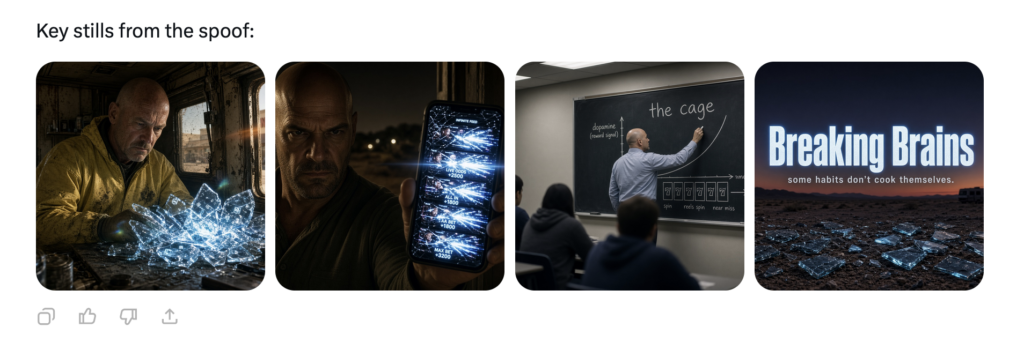
“Breaking Brains” should be a show to teach humans how to reverse this! Just rewrite Breaking Bad with screens instead of meth! At least worth a spoof. Write me the AI prompt to make that real