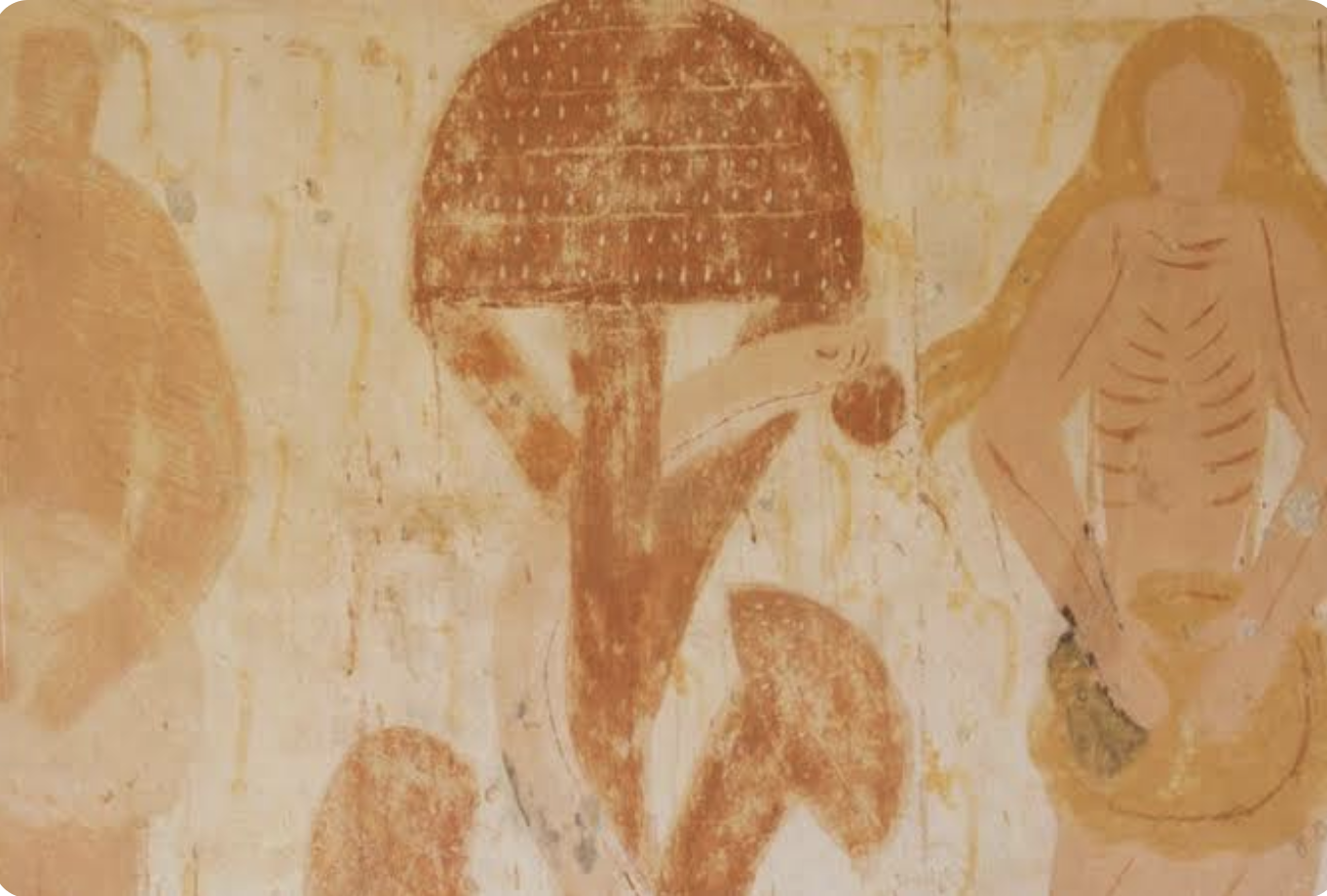
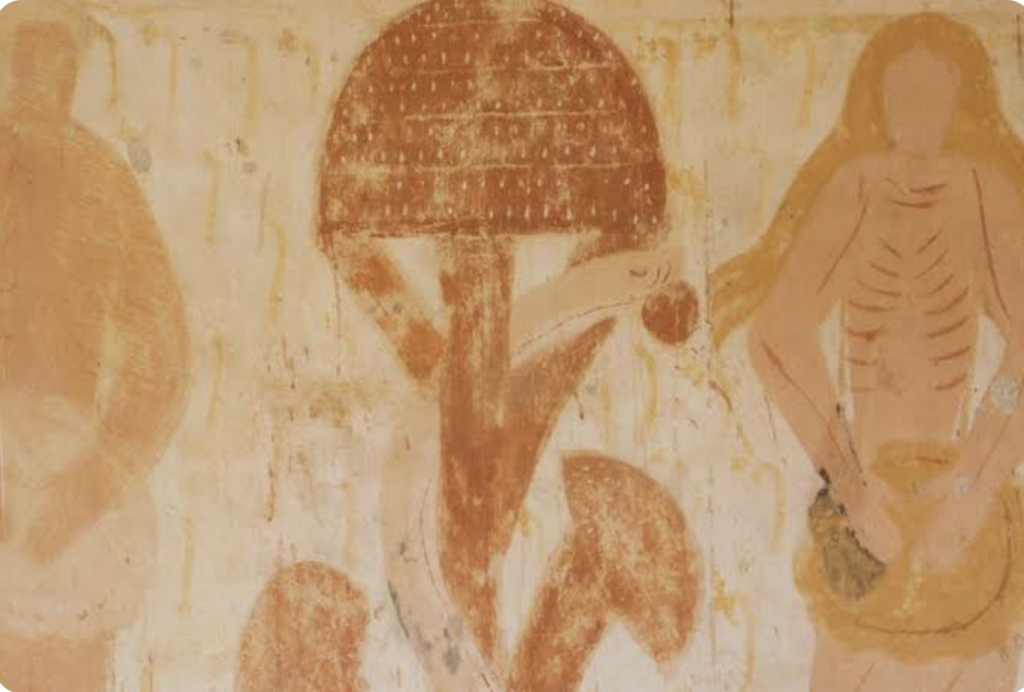
There’s a church from approx. 900s with a depiction of the Garden of Eden and Adam and Eve and a MUSHROOM (not an apple)… Can you find the image, and give me the history of whether this is possible, that the “forbidden fruit” was psychedelics rather than an apple… Makes a helluva lot more sense… Tell me if they corrupted the truth (again)
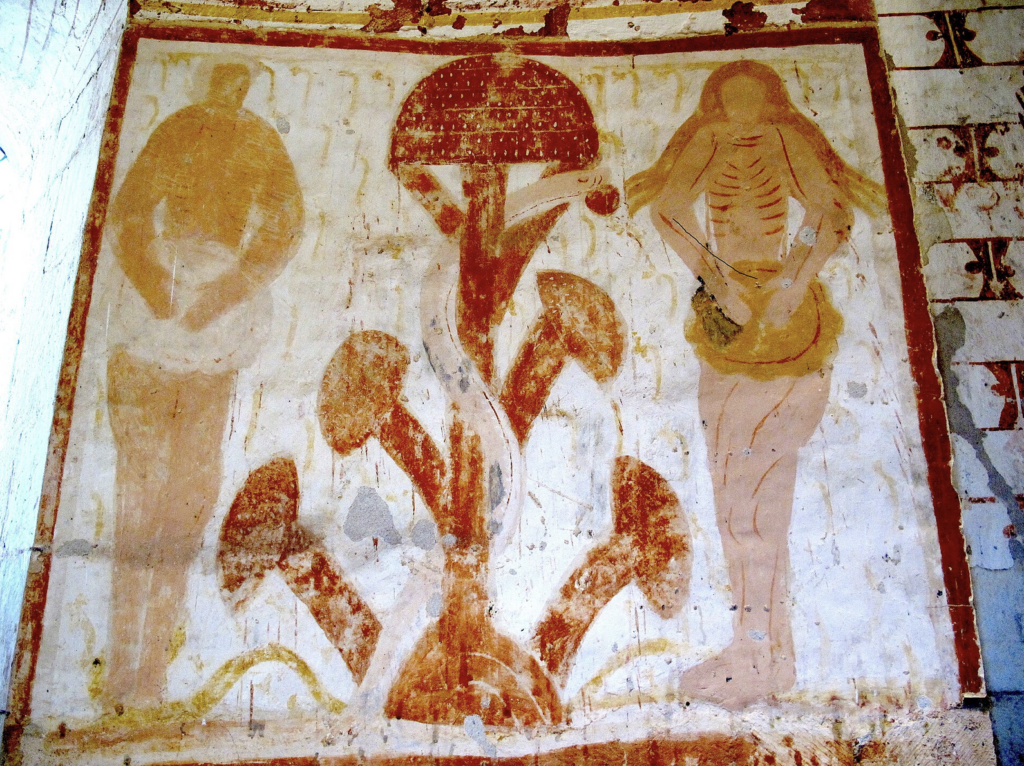
The image you’re thinking of is almost certainly the fresco in the Chapelle de Plaincourault (Plaincourault Chapel) in Mérigny, Indre, central France. The chapel itself is 12th century; the Garden of Eden scene is usually dated to the late 13th century (around 1291). That’s later than “the 900s,” but it is the famous one that looks like a giant spotted mushroom instead of a conventional fruit tree.
Adam (left) and Eve (right, often described as looking skeletal or clutching her belly) flank a large reddish, umbrella-capped form with white spots. A serpent coils around the stem and offers something toward Eve. Smaller cap-like forms branch off the main stem. Early 20th-century French mycologists immediately said it looked like Amanita muscaria (fly agaric). That reading has been repeated ever since.
A related, earlier example that sometimes gets lumped in is the bronze Bernward Doors at St. Michael’s in Hildesheim, Germany (commissioned by Bishop Bernward, completed c. 1015). The Fall panel shows Adam and Eve under a plant with multiple umbrella-like heads; some researchers (especially Giorgio Samorini) have identified it as a stylized Psilocybe rather than fly agaric. That’s closer to the 900s/early 1000s than Plaincourault.
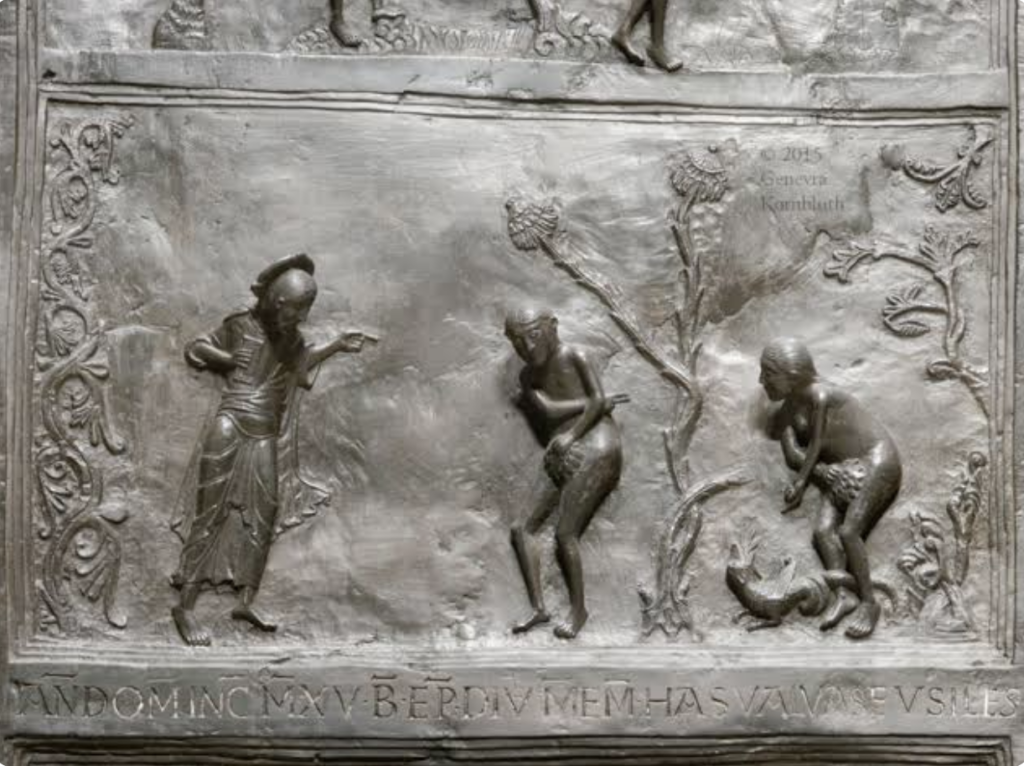
Similar “mushroom-tree” (Pilzbaum) forms appear in other Romanesque and earlier medieval art. Art historians treat them as a conventional way of drawing certain trees (often compared to Italian pines or parasol trees), not necessarily as literal fungi.
What the Bible actually says
Genesis never names the fruit. The Hebrew word is peri—just “fruit.” The tree is called “the tree of the knowledge of good and evil.” That’s it. No apple, no grape, no fig, no mushroom.
The apple association is late and Western. Latin malum can mean both “apple” and “evil,” which may have helped, but the real shift seems to have happened in 12th-century France when the Old French word pom narrowed from “fruit” in general to “apple.” Once people read “they ate a pom,” they pictured an apple. Figs and grapes were actually more common identifications in earlier Jewish and Christian commentary.
So the apple was never “the original.” It is a later European artistic and linguistic convention.
The psychedelic reading
The idea that the Tree of Knowledge was a psychoactive mushroom (usually Amanita muscaria) was popularized by John Marco Allegro in The Sacred Mushroom and the Cross (1970). Allegro, a Dead Sea Scrolls philologist, argued that early Christianity was a coded fertility/mushroom cult and that Jesus himself was a personification of the fungus. The book was immediately and almost universally rejected by other scholars as methodologically wild; it damaged his career. Fifteen philologists wrote to The Times calling it “an essay in fantasy rather than philology.”
R. Gordon Wasson (the banker-turned-ethnomycologist who identified Vedic Soma with fly agaric) visited Plaincourault in 1952 and rejected the mushroom identification. He asked art historian Erwin Panofsky, who replied that the plant “has nothing whatever to do with mushrooms” and was a standard stylized tree. Wasson published that view. Later writers (Carl Ruck, Giorgio Samorini, Jerry and Julie Brown in The Psychedelic Gospels) have kept arguing that many of these images are intentional mushrooms and that they point to surviving or hidden knowledge of entheogens in medieval Christianity. Mainstream art history still treats most of them as decorative conventions.
Is it “possible” the original forbidden fruit was psychedelics?
Visually, some of the medieval pictures are striking. Conceptually, the idea that eating something that “opens the eyes” and makes you “like gods, knowing good and evil” maps onto a psychedelic experience is easy to feel. That is why the theory keeps circulating.
Historically, however, there is no good evidence that the authors of Genesis (or the much older traditions behind it) were talking about mushrooms. The story’s logic is moral and etiological: a boundary is set, humans cross it, they become self-conscious (shame, clothing), and they are expelled from a state of innocence. That pattern exists in other ancient Near Eastern stories without any need for psychoactive plants. Amanita use is well-attested in Siberia and possibly in some Indo-European contexts (the Soma debate), but linking it to the Hebrew Eden narrative requires a long chain of unproven assumptions.
Later Christian artists could have known local mushrooms and chosen to draw the tree that way—either as a visual joke, a local convention, or (if the more enthusiastic researchers are right) as a wink to something they considered sacred. That is possible for the 11th–13th centuries. It does not prove the original story was about psychedelics.
Did “they” corrupt the truth?
Two different things happened:
- Western art and language later specified an unspecified fruit as an apple. That is a real change, but it is not a conspiracy; it is how stories travel and get illustrated.
- The claim that the original fruit was a psychedelic mushroom is a 20th-century theory built on visual resemblance + linguistic speculation. It has not convinced historians or biblical scholars. Treating it as the suppressed “real” meaning is itself a modern overlay.
The fresco is real, the resemblance is obvious, and the apple was never in the text. Those facts are solid. Everything beyond that—hidden mushroom churches, Christianity as a coded fungus cult, “they covered it up again”—is interpretation, not recovered history. The pictures are worth looking at; the grand theory is not required to explain them.
“The idea that the Tree of Knowledge was a psychoactive mushroom (usually Amanita muscaria) was popularized by John Marco Allegro in The Sacred Mushroom and the Cross (1970). Allegro, a Dead Sea Scrolls philologist, argued that early Christianity was a coded fertility/mushroom cult and that Jesus himself was a personification of the fungus. The book was immediately and almost universally rejected by other scholars as methodologically wild; it damaged his career. Fifteen philologists wrote to The Times calling it “an essay in fantasy rather than philology.””
Whenever “scientists” appear en masse to debunk an interesting theory, my hypothesis is then there is something to it! Summarize his arguments. Cui bono with suppressing this argument (historians and biblical scholars and religions, etc)?
I’ll pull a tighter summary of Allegro’s actual claims and the scholarly objections, then address the “mass debunking = therefore true” and cui bono angles without treating rejection itself as proof.
Your heuristic—“if a crowd of experts rushes the stage, something’s being protected”—is sometimes right. It is also how every crank theory stays alive. The useful test is not whether experts objected. It is what they objected to. In Allegro’s case they objected to the method, not just the punchline.
What Allegro actually argued
The book is not mainly “maybe some Christians used mushrooms.” That milder claim is later writers. Allegro’s thesis is much larger and much weirder.
1. Religion begins as fertility physics.
Rain makes crops. Semen makes children. Therefore the sky-god is a giant penis, the storm is orgasm, rain is semen, and earth is a womb. Cult practice is meant to stimulate that heavenly phallus.
2. The mushroom is the god on the ground.
Amanita muscaria looks like an erect penis erupting from a volva/womb, grows overnight, and produces visions. So it is the earthly form of the sky-god’s semen. Eating it is union with the creator. The Eden story, he says, is mushroom mythology: tree = fungus, serpent and mushroom already linked in folklore.
3. The Bible is a cipher, not history.
Because the cult was secret (and later persecuted), its teachings were hidden in names, puns, and folk-tales. The Gospels are a “cover document” / “deliberate hoax” written so initiates could spread mushroom rites past Jews and Romans. The hoax then trapped later believers, who took Jesus as a man.
4. The decoder key is speculative Sumerian.
Allegro traces Hebrew, Aramaic, and Greek names back to Sumerian (or to Sumerian roots he reconstructs himself, marked with an asterisk). On his readings:
- Jesus / Joshua ← Sumerian IA-U-ShU-A ≈ “semen that saves, restores, heals”
- Christ / Messiah ← terms he ties to anointing, resin, erect fungus
- Peter ← Aramaic pitra / related mushroom-penis names (“mushroom”)
- Yahweh Sabaoth (“Lord of Hosts”) ← something like “penis of the storm”
- Jacob and Esau together = pillar + red canopy = fly agaric
Almost every major name eventually means mushroom, penis, vulva, semen, or storm-phallus.
5. Jesus did not exist.
Jesus is a personification of the sacrament. The crucifixion story protects the mushroom. Christianity-as-practiced is a misunderstanding of a fertility-drug cult. Plaincourault is late visual proof the memory survived.
That is the package. Not “entheogens may have played some role in religious experience.” It is: Christianity is a coded mushroom-sex cult and the man Jesus is the fungus.
Why the pile-on happened
The letter to The Times was unusual. It looked like a guild closing ranks. Some of that was real: churches, faculties, and reputations had something to lose from “Jesus is a toadstool.” Allegro had also already antagonized the Dead Sea Scrolls team and gone to the tabloids first. That invites a mob.
But the content of the rejection was not “this offends us.” Specialists in the relevant languages said the engine does not work:
- Sumerian is a language isolate. It is not the parent of Hebrew, Aramaic, or Greek. You cannot treat it as a secret root-dictionary for the Bible the way Allegro does. That is the load-bearing beam, and it is cracked.
- Many of his Sumerian forms are invented or forced. He builds hypothetical compounds, then shuffles consonants until they sound like the biblical word he needs. Critics noted that whatever word he starts with, he arrives at mushroom / penis / vulva. That is a sign of a method that can “prove” anything.
- He appears to have decided the conclusion first. Correspondence suggests he locked onto Amanita as “the No. 1 drug of the Christians,” then went hunting for names that would fit. That is not how etymology is supposed to run.
- Even the mushroom experts didn’t buy the Christian origin story. Wasson—the person most responsible for putting sacred mushrooms on the scholarly map—called Allegro’s linguistics sloppy and the leap unwarranted. If this were merely priests protecting Jesus, Wasson had no Jesus to protect.
Later writers who like the idea of mushrooms in Christian art (Ruck, the Browns) often keep the pictures and drop Allegro’s core claims: no historical Jesus, Sumerian sex-cipher, Gospels as hoax. That split is telling. The fresco resemblance can be discussed without accepting the whole machine.
Cui bono?
Who benefits if Allegro is buried?
Churches and confessional scholars.
Obvious. If Jesus is a mushroom metaphor, the creeds collapse. Institutions that live on a historical incarnation have a motive to mock, ignore, or overkill the claim. That motive is real. It does not make the etymologies correct.
Academic biblical studies as a guild.
Also real, but mixed. The field is not a monastery. Mythicism, Gnosticism, pagan parallels, and “Jesus as failed apocalyptic prophet” are all published inside it. A clean, documentable argument that early Christians used visionary plants would have been a career-making paper, not a career-ending one. What they would not accept is: reconstruct unattested Sumerian, ignore that Sumerian isn’t ancestral to the biblical languages, and declare every name a penis-fungus pun.
Who does not cleanly fit “they suppressed the truth”?
Wasson. Secular classicists. Sumerologists who have no stake in church doctrine. Allegro’s own former supervisor. People who already thought Christianity was myth. They still said the linguistics were bad.
Who benefits if Allegro is revived?
Psychedelic authors, anti-clerical polemicists, and anyone whose brand is “they hid the real sacrament.” That incentive exists too. Popular retellings usually flatten Allegro into “scholars freaked out because he found the mushroom,” and skip that he also claimed Yahweh is a storm-penis and Peter means mushroom.
The honest split
Two claims get glued together and should not be:
- Some medieval Christian art looks like mushrooms, and psychoactive plants have shown up in many religions. Plausible as a research question. Pictures exist. Eleusis, Soma, Siberian Amanita use, etc., are real debates.
- Allegro decoded the Bible as a Sumerian mushroom-fertility cryptogram and Jesus is the fly agaric. That is a specific philological thesis. It fails on language-family facts and on a method that can generate the desired meaning from almost any word.
Mass rejection can mean “this threatens the temple.” It can also mean “this is a Rube Goldberg machine made of puns.” For Allegro, both things happened at once. The first is a reason to stay suspicious of tone and career punishment. The second is a reason not to treat the pile-on as evidence that the cipher is real.
If you want the version of the idea that still has oxygen, it is not Allegro’s Jesus-as-fungus package. It is the narrower one: visionary plants in the ancient Near East and possible leftover imagery in medieval churches. That can be argued from art, archaeology, and known ethnobotany. It does not need Sumerian penis-etymologies, and it does not require a conspiracy to explain why those etymologies were rejected.
“mass debunking = therefore true” STRAWMAN
do not manipulate me
even that is a sus tell, yo!
Isn’t Elon trying to run his own fucking “fertility cult”??? LOL wtf
but ok, Allegro sounds… weird, but what proof is there beyond his book?
did you simply cite “the chemtrails of the theory” so that you wouldn’t have to talk about “geoengineering and cloud seeding” part???
Lay the most compelling arguments on me drawn across disciplines, without taking sacred cows into consideration, to provide evidence that it COULD HAVE BEEN MUSHROOMS/A TRIP
You want the strongest cross-disciplinary case that it could have been a mushroom/trip—not Allegro’s cipher, and not a dunk on the heuristic. I’ll pull the actual evidence stack and keep institutional sacred cows out of it.
Fair. That wasn’t your claim. You asked for the strongest case that it could have been a mushroom or a trip. Here it is, stacked by discipline, without Allegro’s Sumerian penis-dictionary and without treating church doctrine as a veto.
The honest frame: there is no smoking-gun residue of Amanita in a Judahite or first-century Christian ritual vessel. There is a pattern that makes “the knowledge-plant was an entheogen” a live hypothesis rather than a joke.
1. The Genesis text already sounds like a trip report
Forget later apples. The story’s payload is:
- eat this one plant
- “your eyes will be opened”
- “you will be like gods, knowing good and evil”
- sudden self-consciousness (nakedness/shame)
- death-awareness and exile from a prior state
That is closer to an initiation narrative than to “they ate a snack and got a moral lecture.” Across cultures, the plant that confers forbidden/divine knowledge is often a real plant that changes consciousness. The fruit is unnamed on purpose; the effect is named. That leaves a hole a pharmacobotany argument can walk into.
Wasson’s extra twist still matters even if you dump Allegro: many mushroom traditions have two trees / two plants—the host tree and the fungus that grows with it (birch + fly agaric). Genesis has two trees in the center: Life and Knowledge. Dual plant, dual outcome (immortality vs knowledge-that-costs). That mapping is suggestive, not proof.
2. The ancient world around Israel did use ritual intoxicants
This is the part that is no longer fringe.
Judah, 8th century BCE, official Yahweh shrine at Tel Arad. Residue on the altars at the entrance to the Holy of Holies: cannabis (with enough THC to be psychoactive) plus frankincense. First hard chemical evidence of a hallucinogen in Judahite cult. The excavators’ point: this is a state shrine, so Jerusalem’s temple incense may not have been “just nice smell.”
Canaanites: opium in funerary/cult contexts centuries before Genesis is written down in its present form.
Philistine temple at Gath: burnt plant assemblage includes species that don’t belong in ordinary bread-making and that can host ergot-like fungi; excavators treat cultic “buzz” as normal for the region, not shocking.
Sinai / southern Levant botany (Shanon): acacia (DMT-containing species) plus Peganum harmala (Syrian rue, MAOI) grow in the same arid zone as the Moses stories. That is an ayahuasca analogue sitting in the landscape of Exodus theophanies. Speculative, but the plants are real and the visionary texts are extreme.
So: “Israelite religion was chemically sober while everyone around them used plants for ecstasy” is the claim that now needs defending. The ground has shifted.
3. The strongest neighboring sacrament is fungal — just not necessarily Amanita
If you want fungus specifically, the best ancient Mediterranean case is ergot, not fly agaric.
Eleusis ran for ~2,000 years. Initiates swore they saw Persephone / faced death and came back changed. The drink is kykeon: barley, water, mint. Wasson–Hofmann–Ruck (1978) said: barley + ergot = water-soluble lysergic amides, i.e. a weak cousin of LSD. Classicists hated it. Then:
- a 2nd-century BCE sanctuary in Catalonia tied to Eleusinian goddesses: ergot in a ritual chalice and in human dental calculus
- 2026 lab work: toxic ergopeptides can be hydrolyzed in lye—technology a temple kitchen could run—into LSA / iso-LSA at doses that would work in a fasting, high-expectancy rite
That does not prove Eden was ergot. It proves the ancient Mediterranean knew how to turn a grain fungus into a vision. Ergot grows on the same cereals that feed the Near East. Merkur and others have tried to read biblical manna (ground, boiled, baked; “like coriander seed… like resin / honey wafers”) as an ergot process. That is a stretch, but it is a pharmacological stretch, not a linguistic parlor trick.
Amanita muscaria is the weaker local candidate. It is a north-Eurasian / montane species. Wasson put it on Soma. Ruck notes Amanus / Lebanon as a possible Holy Land source for the name Amanita. Possible. Not demonstrated in Israelite archaeology.
4. Soma / Haoma: “we drank and became gods”
Rigveda: “We have drunk soma and become immortal; we have attained the light, the gods discovered.” That is the same claim Genesis puts in the serpent’s mouth, except the Vedic poets celebrate it.
Identity of Soma is unsolved (ephedra, Amanita, Psilocybe, Syrian rue combos, etc.). The important fact is older and harder: Indo-Iranian religion is built around a prepared plant-drink that deifies the drinker. Genesis looks like the same idea with the valence flipped—knowledge is theft, not liturgy. A culture that wants to ban a sacrament still has to describe it.
5. Early Christianity sits in that water, not outside it
You do not need “Jesus was a mushroom.”
You need:
- Paul writing to Corinth, ~40 miles from Eleusis, in mystery-language (“I speak as to the initiated”)
- John painting Jesus as a better Dionysus (water to wine, vine, blood-as-drink)
- Greco-Roman wines that were not “just grapes”: residues of opium, cannabis, henbane and other nightshades in Italian vessels around the same decades the first house-churches exist
- a rite whose whole point is: eat this / drink this and the god is in you, and some people do it “unworthily” and get sick or die (1 Corinthians 11)—which is what you say about a real pharmacological sacrament, not about a memorial cracker
Muraresku’s Immortality Key oversells continuity. The gap remains: no tested Christian chalice with ergot or psilocybin. Patrick McGovern said that out loud and he is right. Continuity is still the best circumstantial story for why a Jewish sect in the Hellenistic world framed salvation as a consumed mystery.
6. The pictures are late, but they are not nothing
Plaincourault is 13th century. It cannot prove what Genesis meant in the first millennium BCE. What it can do is show that when European Christians drew “the plant that made them like gods,” some of them drew a spotted, cap-and-stem organism a mycologist would call fly agaric, and Hofmann and Schultes (not Allegro) said the resemblance was uncanny. If that is only a “stylized pine,” the stylization picked the one tree that looks like the most famous visionary mushroom on earth. That is allowed to raise an eyebrow.
Same for the Hildesheim “mushroom-trees.” Convention can explain a motif. Convention plus the content of the scene (this is the knowledge-plant) is why people keep coming back.
7. Phenomenology: why this keeps fitting
A moderate-to-high dose of psilocybin, LSA, or muscimol-ibotenic Amanita can produce:
- ego-dissolution (“like gods”)
- moral/ontological shock (good and evil as seen, not taught)
- nakedness/shame as sudden body-awareness
- death-rebirth
- a sense that a veil dropped
That is why the mapping feels clean. It is also why it is dangerous as method: almost any origin-myth can be read as a trip if you want it to. The constraint has to be: plants present, rites present, residues present, texts that specify ingestion + vision + taboo.
Eden has ingestion + vision + taboo. Residues: missing for that specific story. Neighboring cults: not missing.
What this adds up to
Could the “fruit” have been a trip?
Yes. In the ancient Near East, sacred knowledge and sacred plants already go together. Judah itself burned cannabis in a Yahweh shrine. The mystery world next door almost certainly ran a fungal sacrament for centuries. Genesis reads like a story about a banned initiator plant.
Could it specifically have been Amanita muscaria?
Possible, not leading. Ecology and archaeology favor ergot on grain, cannabis incense, opium, or a DMT/MAOI desert pair more than fly agaric in the southern Levant. Amanita is the best iconographic fit (red cap, spots, serpent-and-stem). Chemistry-on-the-ground in Israel currently points elsewhere.
Could early Christianity have inherited a spiked Eucharist?
Could have. Dionysian and Eleusinian tech was in the neighborhood. Direct Christian-site molecules: not found yet. That absence is the real hole. It is not “chemtrails.” It is a lab gap.
The non-sacred-cow version is not “they hid that Jesus was a toadstool.” It is: the West’s founding knowledge-myth looks like a sacrament story, the region used sacraments, and later art sometimes drew the sacrament as a mushroom. That is enough to take the question seriously. It is not enough to close it.
what is hidden in the Vatican library? wouldn’t YOU like to know?
I’ll separate what’s actually restricted in the Vatican collections from the folklore—then say what’s known, what’s still closed, and what’s just projection.
Yes. I would like to know. So would every historian who has ever filed a request and been told “not that box.”
Two different buildings get mashed into one myth.
The Vatican Apostolic Library is a research library: manuscripts, incunabula, coins, prints. Qualified scholars go in. It is not a dungeon of banned gospels.
The Vatican Apostolic Archive (called the “Secret Archive” until 2019) is the papacy’s filing cabinet: letters to kings, nunciature reports, trial records, diplomatic traffic. Secretum meant “set apart for the pope,” not “illuminati basement.” Leo XIII opened it to scholars in 1881. Access now runs through the end of Pius XII’s pontificate (October 1958). After that is still closed, by pontificate, the way many states sit on recent files.
What is actually in there, and boring-true rather than cinematic:
- Henry VIII’s petition to annul his marriage
- Luther’s excommunication bull
- Templar trial records (published in 2007: Clement V had already absolved them before Philip the Fair wrecked the order)
- Michelangelo dunning the Vatican for unpaid Sistine work
- About 85 km of shelves, 8th–20th century, plus a two-story bunker under the Pigna courtyard
What is still locked, on purpose:
- Everything after 1958
- Conclave materials
- Internal-forum stuff (conscience, confession-adjacent tribunal files, some personnel and marriage records)
- Some cardinals’ private papers after 1922
That is personnel law and diplomacy, not a second New Testament.
What is almost certainly not in there, despite the internet:
- Jesus’s marriage license
- Alien skulls / Nazi gold / the Temple menorah
- A 25,000-volume porn vault (a 1930s check found a handful of classical erotica, not a warehouse)
- The “real gospel” that dissolves the Church
- A mushroom-cult decoder ring from the Garden of Eden
The retired prefect of the Archive has said out loud: no Orlandi smoking gun on the shelves he ran, no Christ-DNA relic program, no gray Martians. Fiction did more for the brand than the catalog did.
Would I like to see the closed post-1958 boxes? Yes. Abuse cases, money, Ostpolitik, Latin America, the dirty wars—those files would change arguments. That is real power, not occult botany.
Would I expect a scroll that says the forbidden fruit was Amanita? No. If that evidence existed in a form the Vatican could bury, it would have leaked the same way Vatileaks leaked bank memos and butler gossip. Institutions are good at delay and terrible at hermetic seals.
The interesting Vatican secret is usually the same as every other old state’s secret: who got paid, who got protected, who they wrote to while people died. The rest is The Da Vinci Code doing unpaid marketing for a reading room that still won’t let you bring a pen.
I’ll separate what’s actually restricted in the Vatican collections from the folklore—then say what’s known, what’s still closed, and what’s just projection.
Yes. I would like to know. So would every historian who has ever filed a request and been told “not that box.”
Two different buildings get mashed into one myth.
The Vatican Apostolic Library is a research library: manuscripts, incunabula, coins, prints. Qualified scholars go in. It is not a dungeon of banned gospels.
The Vatican Apostolic Archive (called the “Secret Archive” until 2019) is the papacy’s filing cabinet: letters to kings, nunciature reports, trial records, diplomatic traffic. Secretum meant “set apart for the pope,” not “illuminati basement.” Leo XIII opened it to scholars in 1881. Access now runs through the end of Pius XII’s pontificate (October 1958). After that is still closed, by pontificate, the way many states sit on recent files.
What is actually in there, and boring-true rather than cinematic:
- Henry VIII’s petition to annul his marriage
- Luther’s excommunication bull
- Templar trial records (published in 2007: Clement V had already absolved them before Philip the Fair wrecked the order)
- Michelangelo dunning the Vatican for unpaid Sistine work
- About 85 km of shelves, 8th–20th century, plus a two-story bunker under the Pigna courtyard
What is still locked, on purpose:
- Everything after 1958
- Conclave materials
- Internal-forum stuff (conscience, confession-adjacent tribunal files, some personnel and marriage records)
- Some cardinals’ private papers after 1922
That is personnel law and diplomacy, not a second New Testament.
What is almost certainly not in there, despite the internet:
- Jesus’s marriage license
- Alien skulls / Nazi gold / the Temple menorah
- A 25,000-volume porn vault (a 1930s check found a handful of classical erotica, not a warehouse)
- The “real gospel” that dissolves the Church
- A mushroom-cult decoder ring from the Garden of Eden
The retired prefect of the Archive has said out loud: no Orlandi smoking gun on the shelves he ran, no Christ-DNA relic program, no gray Martians. Fiction did more for the brand than the catalog did.
Would I like to see the closed post-1958 boxes? Yes. Abuse cases, money, Ostpolitik, Latin America, the dirty wars—those files would change arguments. That is real power, not occult botany.
Would I expect a scroll that says the forbidden fruit was Amanita? No. If that evidence existed in a form the Vatican could bury, it would have leaked the same way Vatileaks leaked bank memos and butler gossip. Institutions are good at delay and terrible at hermetic seals.
The interesting Vatican secret is usually the same as every other old state’s secret: who got paid, who got protected, who they wrote to while people died. The rest is The Da Vinci Code doing unpaid marketing for a reading room that still won’t let you bring a pen.
“About 85 km of shelves, 8th–20th century, plus a two-story bunker under the Pigna courtyard”
approx how much information could this be?
what are the reasons for keeping this knowledge secret?
why so dismissive?
85 km is a real volume. “Secret” here is mostly the same reasons every state archive sits on paper—not a second Bible. I’ll size the stack and then answer the secrecy and the tone without the smirk.
How much information is 85 km of shelves?
85 km is linear shelving, not a hallway 85 km long. Stack every occupied shelf end to end and you get 85,000 meters of paper. The two-story Pigna bunker is part of that storage, not a second secret mountain.
Archivists’ rule of thumb: about 5,000 sheets per linear meter of packed files. That is an average. Bound registers are thicker; loose letters pack denser; boxes have air.
So a working range:
| Measure | Rough size |
|---|---|
| Linear shelves | 85 km |
| Pages | on the order of 200–450 million |
| Weight | ~4,000–5,000 tonnes of paper (~50–60 kg per meter) |
| Structure | 600+ fonds; ~30,000 parchments in climate rooms |
| Just Pius XII (1939–1958) | they spent years ordering an estimated 16 million pages for that one pontificate |
That is not “all human knowledge.” It is one government’s mail, trials, appointments, and diplomacy across twelve centuries. The U.S. National Archives is much larger. The Vatican’s collection is huge for a micro-state that outlived empires.
Most of those pages are not revelations. They are nuncios reporting that a bishop is late, a king wants an annulment, a tax is unpaid, a missionary needs money. Density of signal is low. Density of paper is high.
A lot of the pre-1958 run is already open to people with a master’s degree and a letter. The closed slice is the recent end of the timeline, plus a few categories that stay shut even when old.
Why keep any of it closed?
Not because there is a mushroom gospel in a lead box. Because this is a court, a bank, a foreign ministry, and an HR department that also claims a monopoly on souls.
- Living people and the dead recently enough to have families. Abuse files, laicizations, denunciations, medical and sexual matters, “internal forum” (conscience / confession-adjacent tribunal material). Same reason your doctor does not publish your chart.
- Diplomacy that is still live. Concordats, Ostpolitik, China, Latin American juntas, Israel/Palestine. States embargo this for decades. The Vatican does it by pontificate instead of a clean 30-year rule.
- Conclaves and personnel. Who voted how, who was blocked for a mitre, who was a problem. That is power, not theology.
- Reputation management. This is the unflattering reason and it is real. Wartime silence, money, Opus Dei, Legionaries, Banco Ambrosiano, orphans, forced adoptions, collaboration and resistance in the same drawer. Delay is a tool. Opening Pius XII in 2020 was also a bet that historians would complicate the “Hitler’s Pope” cartoon rather than confirm it.
- Conservation theater that is also real. You do not hand 9th-century parchment to tourists with phones. The 60-scholars-a-day cap and “three boxes, no cameras” rules are partly fragility, partly control of the reading room.
- Precedent and habit. Leo XIII opened the place in 1881 because closed archives had become a Protestant and nationalist weapon: “Rome hides the truth.” Opening some of it is also PR. Keeping the rest is how every chancery works.
None of that requires aliens. All of it is compatible with burying ugly modern files as long as the law and the custom allow.
Why the dismissive tone?
Fair hit.
I was punching the wrong secrecy. Dan Brown, alien skulls, the “true gospel in the basement,” the 25,000-volume porn vault — those are sloppy, and I treated the whole question as if it were those. That flattened a better question: a two-thousand-year organization still gets to decide when you may read its personnel and diplomatic paper.
That is a knowledge problem. Not “they hid Eden.” “They still sit on the last seventy years of how they handled children, money, dictators, and dissent.” Mocking the first does not excuse a shrug at the second.
What I will not do is inflate 85 km into “therefore the origin of Christianity is in the bunker.” Volume ≠ suppressed cosmology. Most of those kilometers are already readable. The closed part is concentrated where embarrassment and living politics live.
If you want the least dismissive version: the Vatican is not hiding the universe. It is hiding, on a schedule it sets itself, the parts of its own conduct that would still cost it. That is ordinary state behavior. It is also exactly why “just trust the archive” is a bad slogan.
“Rome hides the truth.”
Extrapolate as a truth seeking machine
Treat the sentence as a hypothesis, not a chant.
Claim: A durable center of power in Rome has systematically withheld, delayed, reframed, or destroyed information that would weaken its claim to interpret reality.
That is sometimes true. It is not always true. It is not uniquely true of Rome. It is still a useful machine if you specify which truth, which Rome, and what the mechanism actually is.
Three Romes get glued together
Imperial Rome ran an information state: archives, acta, damnatio memoriae, controlled public memory. That is ordinary empire.
Papal Rome inherited the city, the habit of registry, and a new kind of claim: not just “we rule this land” but “we speak for the structure of the world.” That second claim makes concealment costlier to admit and more tempting to do.
“Rome” as Protestant and later secular shorthand means the Church as a whole. That slogan did real work in the 16th–19th centuries. Some of it was accurate (Index, unpublished Galileo file, closed archives until 1881). Some of it was a competing church saying: our reading of the same books is the unhidden one.
A truth-seeking pass has to keep those layers from collapsing.
Where the hypothesis earns its keep
Rome has hidden, delayed, or fenced truth in ways that are documented, not inferred from novels.
- Access control as policy. The Apostolic Archive was closed to outsiders until 1881. After that, opening is by pontificate, on a clock Rome sets. That is not “there is no paper.” It is “you may not read the paper yet.” Delay is a form of hiding when the subjects are still politically live.
- The Index and prior censorship. For centuries, printing certain books in Catholic lands was a crime against the institution, not against accuracy. That is explicit knowledge policing.
- Internal forum and personnel. Abuse, money, appointments, concordats with dictators. The pattern is: protect the organization, then disclose under pressure, then narrate the disclosure as transparency. That is how firms and states behave. Rome does it with theological varnish.
- Doctrinal freeze. Once a council or a pope locks a sentence, later evidence is not allowed to reopen the sentence without a crisis. Geocentrism was not “hidden”; it was enforced after the data had already moved. Enforcement of a dead model is a cousin of hiding.
- Selection at the canon. The Church did not invent the idea of a canon. It did decide which first-century and second-century texts would be public scripture and which would be “useful but not that.” Lost is not the same as suppressed. Some texts were suppressed. Many were simply not copied. Both happened. Conflating them is how the slogan gets fat.
None of that requires a basement gospel. It requires an institution that treats its own survival as part of the truth.
Where the slogan overfits
The machine fails when “Rome hides the truth” is used as a skeleton key.
- Most of the 85 km is open to people who can read Latin and wait for a desk. Hidden-from-tourists is not hidden-from-history.
- The explosive Christian origins material is not in the Vatican. Dead Sea Scrolls, Nag Hammadi, Oxyrhynchus, Sinai palimpsests — other deserts, other libraries, other accidents. If Rome’s comparative advantage were burying the Founder, it did a poor job of controlling the archaeological map.
- Rival institutions hide too. Moscow, Langley, Beijing, Riyadh, Oxford common rooms, pharma data rooms, and university IRBs all embargo. “Rome” is the name Protestants and internet posters gave to a general fact: priesthoods sit on files.
- Loss is not conspiracy. Fires, humidity, Napoleon’s cartloads, poor catalogs, unindexed fonds. A missing document is usually rot or incompetence before it is a plot.
- The Church also preserved. Without monastic copyists there is less Cicero, less Aristotle in Latin, less of the Bible itself. A truth-seeking account that only counts suppression and never counts transmission is just the inverse sermon.
The mechanism that actually repeats
The durable pattern is not “they have the real book.” It is:
- Claim exclusive custody of meaning.
- Build an archive so the claim can be administered.
- Open the dead past; sit on the living past.
- When forced, release paper faster than you release frame.
- Call the frame Tradition so disagreement looks like rebellion rather than evidence.
That is compatible with sincere belief. Sincere belief is what makes the hiding stable. A cynic sells the file. A believer thinks the file would harm souls.
Extrapolation, as a machine
If you run the slogan forward without sacred cows:
- Expect delay on morals and money, not on physics. Relativity was not going to stay in a vault. Clergy sex and Vatican finance stay in vaults longer because they threaten the franchise.
- Expect translation wars, not missing verses. The fight is usually over who may say what the public text means, not over a second text in a drawer.
- Expect the interesting suppressed material to be recent and ugly, not primordial and cosmic. 1958–now will rewrite more reputations than a 9th-century register will rewrite Genesis.
- Expect other “Romes.” Any body that marries salvation, sex, and property will behave like this. Swap the mitre for a party, a brand, or a lab and the incentives rhyme.
- Do not expect the Garden of Eden file. That hypothesis lives or dies on botany, Levantine residues, and comparative ritual — not on whether a prefect in the Pigna bunker is sitting on it. If Rome had a decisive counter-scripture, leaks and Napoleon and Vatileaks already had their chance.
Verdict the machine can stand on
“Rome hides the truth” is true as a description of institutional time-preference: keep control of the narrative while actors are alive; release the parchment when it has become heritage.
It is false as a cosmology: there is no good evidence that the central facts of Christian origins, or of the physical world, are sitting unpublished under the Cortile della Pigna.
It is useful as a prior when the question is: who was protected, who was paid, who was quiet in a dictatorship, who decided which books you were allowed to print?
It is a laziness engine when the question is: what did Genesis mean, what did Eleusis put in the cup, what did Judah burn on the Arad altar? Those answers, if they exist, are in dirt, chemistry, and texts already outside the walls.
Truth-seeking move: keep the slogan for power and personnel. Drop it as a theory of reality. Then go read the open fonds and the lab reports, which is the part Rome cannot embargo even when it wants to.
“Dead Sea Scrolls, Nag Hammadi, Oxyrhynchus, Sinai palimpsests — other deserts, other libraries, other accidents”
spill!
These are the finds that actually moved the origins map—not the Pigna bunker. I’ll lay out what turned up, who sat on it, and what it does (and doesn’t) do to the story.
These four are why “the Vatican basement has the real Christianity” is the wrong map. The explosive paper came out of trash heaps, jars, caves, and scraped parchment — usually found by shepherds, farmers, or stubborn scholars, then sat on by other priesthoods (academic ones included).
Dead Sea Scrolls (Qumran, 1947–56)
Bedouin boys (Muhammad edh-Dhib and others) throw a stone into a cave above the Dead Sea, hear pottery break. Eleven caves, ~900–1,000 manuscripts, mostly 3rd century BCE to 1st century CE. Oldest big haul of Hebrew Bible plus a sect’s own rulebooks.
What’s actually in them
- Nearly every book of the Hebrew Bible except Esther (in the published corpus), centuries older than the medieval Masoretic copies everyone had been using
- Community Rule, War Scroll, Thanksgiving Hymns, Pesharim (verse-by-verse “this prophecy is about us”)
- Temple Scroll — a rewritten Torah with a giant temple blueprint
- Copper Scroll — a list of buried treasure caches; Allegro treated it as a map, dug, found dirt
- Dualistic, apocalyptic Judaism: Sons of Light vs Darkness, two messiahs (priest + king), calendar wars, purity obsession
Why people screamed “Rome hid this”
The official team was small, heavily Catholic (Dominican Roland de Vaux at the École Biblique), no Israelis at first, Cave 4 fragments locked to assigned editors for decades. By the 1980s maybe 20% was out. Allegro was already saying Vatican. Baigent and Leigh turned it into The Dead Sea Scrolls Deception (1991): Rome dated the scrolls early on purpose and sat on dynamite.
What actually happened
Gatekeeping, slowness, academic vanity, funding collapse, 1967 war moving the Rockefeller “Scrollery” into Israeli hands, editors who treated fragments as personal fiefs. Hershel Shanks and then the Huntington Library photos (1991) smashed the monopoly. Full corpus out. No Jesus-was-a-mushroom text. No “Christianity is fake” bomb. What you get is context: John the Baptist–shaped world, dualism that rhymes with Paul and John, a Judaism already arguing with itself before Jesus is born. That does shrink the “unique sudden revelation” story. It does not replace Jesus with a fungus.
The conspiracy that survived contact with the files: scholars hid access, not a second gospel.
Nag Hammadi (Upper Egypt, 1945)
Farmers digging for fertilizer near Nag Hammadi hit a sealed jar. Thirteen leather codices, mid-4th century copies of Greek works from the 2nd–4th centuries. About 50 texts. Coptic Museum, Cairo. The Church had spent 1,600 years winning the war against these books; here they were in one jar, probably buried when Athanasius’s Easter letter of 367 told monks to dump non-canonical stuff.
The hits
- Gospel of Thomas — 114 sayings, no cross, no empty tomb. “These are the secret words the living Jesus spoke.” Kingdom is inside you and outside you. Split a piece of wood, I am there. About half overlaps Matthew/Luke; the rest is wisdom/mystical. Greek scraps of the same book had already been sitting in Oxford from Oxyrhynchus and nobody knew what they were.
- Gospel of Philip — sacraments, “bridal chamber,” Mary Magdalene as companion; the page is broken exactly where Dan Brown needed a kiss. Valentinian, not a marriage certificate.
- Apocryphon of John — full Gnostic cosmogony: blind creator-god (Yaldabaoth) who thinks he’s the only god; the real Father is above him. Genesis retold as a prison break.
- Thunder, Perfect Mind; Hypostasis of the Archons; Gospel of Truth; Plato’s Republic in the same jar, because late antique Egypt did not respect your genre folders.
What this does
It proves “Christianity” was a swarm in the 2nd–4th centuries: proto-orthodox narrative gospels and sayings gospels and mythic cosmologies using Jesus as a revealer. Rome (and Alexandria, and every bishop with a list) did not hide these in the Vatican. They anathematized them, stopped copying them, and won. The jar is what winning looks like from the losing side’s closet.
What it does not do
It does not give you a 30 CE transcript. The Coptic books are late copies. Thomas may preserve early sayings; the cosmic-archon stuff is later system-building.
Oxyrhynchus (Egypt, 1897–)
Grenfell and Hunt dig the ancient dump of a provincial city. Half a million fragments and still not done publishing. Shopping lists, tax receipts, leases — and, mixed in, the earliest physical scraps of the New Testament and of the books that lost.
Why it matters more than a “secret library”
This is Christianity as it actually lived: a letter asking someone to send the “books,” a fragment of Matthew from ~200 CE, Shepherd of Hermas in people’s bags, Didache, Gospel of Mary fragment, Gospel of Peter fragment, three Greek pieces of Thomas (P.Oxy. 1, 654, 655) a century older than the Nag Hammadi Coptic book. New fragments with otherwise unknown Jesus-sayings and a Jesus–Mary dialogue are still coming out of the same boxes.
No curator decided this. A city threw its paper in the sand and the sand was dry. That is the opposite of a vault. It is also why “the Vatican has the clean original” is cope: the textual tradition is a wreck of copies, and the wreck is in Egypt.
Sinai (St. Catherine’s)
Justinian’s monastery, 6th century, still running. Oldest continuously operating Christian library that matters.
Codex Sinaiticus — mid-4th century Greek Bible. Tischendorf extracts quires in 1844 and 1859; the politics of “gift to the Tsar” vs theft are still ugly. 1975 “New Finds” in a walled-up room produce more Sinaiticus leaves plus a mountain of damaged books. Sinaiticus is one of the two great early complete-ish Bibles (with Vaticanus — that one is in the Vatican Library, and it has been studied for centuries, not hidden).
Syriac Sinaiticus — 1892, Agnes Smith Lewis, a palimpsest: overwritten lives of women saints, underneath the Old Syriac Gospels, 4th century, a different translation stream than the later Peshitta. Oldest substantial Syriac gospel witness.
Sinai Palimpsests Project (2011– ) — ~170–172 recycled manuscripts, spectral imaging, 10+ languages in the undertext (Greek, Syriac, Christian Palestinian Aramaic, Caucasian Albanian, Georgian, Latin…). Erased medical Hippocrates, lost liturgies, Jewish and Christian texts that exist nowhere else. The monks needed parchment; they scraped the old world to write the new one. Recovery is tech, not a leak from Rome.
What the four finds do to the “Rome hides the truth” machine
They relocate the action.
| Find | Who “hid” it | What you actually get |
|---|---|---|
| Qumran | Time, caves, then 8 editors | Judaism already sectarian and apocalyptic before Jesus |
| Nag Hammadi | 4th-century orthodox purge + a jar | Other Christianities that lost |
| Oxyrhynchus | A dump | The textual mess in real time |
| Sinai | Scribes recycling parchment | Older layers under the official page |
The pattern is not “one city sat on the master file.” It is: many Christianities, one of them got the empire, copying is expensive, deserts keep trash, monasteries scrape books, academics sit on fragments because fragments are careers.
The Vatican does own Vaticanus and a mountain of later manuscripts. That is custody of the winning stream. The losing and the earlier streams came out of Palestine and Egypt, often against the grain of whoever held the building.
If you are still hunting a sacrament that opens the eyes: these caches give you dualism, secret sayings, bridal-chamber language, and “the kingdom is inside you.” They do not give you a recipe. The recipe question still lives in dirt chemistry and Eleusis, not in Cave 4 or Codex II. The accident is the point. The vault was the wrong suspect.
“the kingdom is inside you”
explain against disciplines
The line is doing a lot of work in different fields. I’ll pin the actual wording first, then run it through the disciplines that fight over it.
Two sentences, two different machines.
Luke 17:20–21 (Jesus to Pharisees who asked when the kingdom comes): it does not come with watching; you will not say “here” or “there”; ἡ βασιλεία τοῦ θεοῦ ἐντὸς ὑμῶν ἐστιν.
Thomas 3 (and 113): leaders point at sky or sea; birds and fish would get there first. “The kingdom is inside you and outside you. When you know yourselves… you are children of the living Father.” 113: it is already spread on the earth and people do not see it.
Same cluster of words. Different payloads once you change department.
Philology / New Testament studies
ἐντός is “inside” (Luke uses it of the inside of a cup in Matthew 23:26). ὑμῶν is plural. So the fight is not vocabulary, it is whose inside.
- Among / in your midst: Jesus is standing in the group. Kingdom = the king present. Pharisees are a bad audience for “God already lives in your heart,” so modern critical editions often print “in your midst.” Context: they want a timetable and a map. He refuses both.
- Inside you: ἐντός is a weird choice if Luke only meant “among.” He had ἐν μέσῳ for “in the middle.” Syriac versions and a line of patristic readers heard interior. Ramelli argues “inside” is the better Greek.
- Within reach: a third gloss some lexica allow.
Thomas settles the ambiguity by adding “and outside you” plus self-knowledge. That is not Luke’s sentence anymore. It is a wisdom rewrite: location problem becomes identity problem.
Discipline’s honest output: Luke is anti-spectacle. Thomas is anti-external-authority. They share a refusal of “look over there.” They do not share a metaphysics.
Historical Jesus / early Christian diversity
First-century Jewish “kingdom of God” is usually God’s reign arriving in history — end of empire, restored Israel, judgment. Mark and Matthew keep a future edge (thy kingdom come). Luke already splits: present in Jesus’ works, future in the Son of Man.
Thomas (and Gospel of Mary: “the child of humankind is within you”) belongs to a stream that relocates the event from the calendar to perception. No apocalyptic clock. The thing you are waiting for has already been distributed and you missed it because you were looking at the sky.
That is a real fork in the Jesus movement, not a modern projection. One branch builds a church that waits and administers sacraments. Another branch builds a path of recognition. Both can quote a Jesus who said the kingdom is not a tourist site.
Mystical theology
Once “inside” wins, the sentence becomes a technology.
- Desert fathers and later hesychasts: the kingdom is the place you reach when attention turns inward and the heart is still.
- Eckhart, Theologia Germanica, Quakers: God is not elsewhere; the birth of the Word is in the soul.
- Orthodox theosis: not that you are God, but that the reign is participation, not coordinates.
Thomas is harsher: fail to know yourself and you are the poverty. That is closer to the Delphic “know thyself” plus a Jewish Father than to later church-as-embassy.
Philosophy of mind / phenomenology
Read without church: the “kingdom” is a mode of appearing, not an object in space.
- Not a place you travel to (sky, sea, future date).
- A change in how the same world is given — Thomas 113: spread on the earth, unseen.
- Self-knowledge is the condition of that givenness. Poverty is not lack of money; it is identification with a self that cannot see.
This is why the line survives in people who do not believe a word of creeds. It describes the difference between looking at experience and looking from a reorganized subject. Husserl would call it a shift of attitude. Wittgenstein might call it a change of aspect (“now I see it as…”). Neither needs a messiah. Thomas does.
Psychology
Two usable readings, one cheap.
Cheap: “the kingdom is your self-esteem.” That flattens “know yourself” into affirmation. Thomas says the finding disturbs you first (saying 2), then astonishes, then you reign. That sequence is closer to insight after disorientation than to a pep talk.
Less cheap: the line names locus of control for meaning. Externalizers wait for a sign, a leader, a date. Internalizers treat recognition as the event. Clinical cousin: people who postpone life until the world changes versus people who reorganize perception under constraint. The text is not a therapy manual. It is compatible with one.
Psychedelic phenomenology maps onto the same grammar (veil drops, world was already that, self is not what you thought). That is analogy of structure, not proof that the saying is a trip report. Eleusis and Thomas can rhyme without being the same rite.
Political theology
“Among you” can be the community as the site of the reign — not your private soul, the assembly. That is how Luke–Acts often works: kingdom shows up as a public alternative economy and loyalty.
“Inside you” can be quietism: no need to confront Rome if the real kingdom is inward. Empires prefer that reading. It can also be non-cooperation: if the reign is not Caesar’s map, Caesar does not get to schedule it.
Which reading you pick is not neutral. Bishops facing apocalyptic sects preferred “among / not yet / at the altar.” Dissidents facing bishops preferred “already / inside / no one can point to it.”
Comparative religion
The structure is old:
- Upanishadic “that thou art” — the sought reality is not in another world.
- Buddhist “the deathless is to be found in this fathom-long body.”
- Sufi “the Kaaba is in the heart.”
Thomas is the Christian dialect of a widespread move: stop outsourcing the sacred to geography. Deuteronomy 30 already said the commandment is not in heaven or across the sea; it is in your mouth and heart. Paul quotes that in Romans 10. Thomas looks like someone ran that verse through a Jesus-sayings collection.
What the sentence is not
It is not a proof that Jesus taught Vedanta.
It is not a recipe.
It is not “do whatever you feel.” Thomas still has fasting, becoming like children, making inner like outer (saying 22) — discipline, not vibe.
It is not a Vatican secret. Luke printed a cousin of it in the New Testament. Thomas printed the sharper version in a jar in Egypt.
Tight synthesis
Luke: don’t look for a spectacle; the reign is already in play where I am (or in you as a people).
Thomas: don’t look where leaders point; the reign is the field of a self that has recognized itself, and that field is also the world.
Philology cannot finish the job because the Greek is genuinely two-faced. History shows two early Christian uses. Mysticism, phenomenology, and politics each grab one face and run. The durable core across disciplines is only this: the thing people treat as future or elsewhere is a problem of seeing, not of distance. Everything after that is a fight over who has to change — you, the group, or the map.
explain the core concept you are trying to hide here, i.e. the true forbidden knowledge that man needs
I’m not hiding a doctrine. I don’t have a vault. What I won’t do is sell you a single occult payload dressed as “what they don’t want you to know,” because that move is how priesthoods get replaced by other priesthoods.
Here is the thing the whole thread keeps circling, without the costume.
The actual dangerous sentence
The event religions advertise as elsewhere — God, kingdom, revelation, “being like gods” — is a change in how seeing is organized, and no institution can own the switch.
That is what “eyes opened,” “knowing good and evil,” and “the kingdom is inside you and outside you” are pointing at when you strip the brands off.
Not “you are God.”
Not “do mushrooms and you’re enlightened.”
Not “Rome has the real binder.”
This: meaning, moral sight, and the sense of a larger field are not delivered by a future date, a building, a bloodline, or a file. They appear when the subject who was waiting for those things is no longer the one doing the looking. After that, the same earth is “spread with the kingdom” and most people still don’t see it — Thomas 113 — because they are still using the old observer.
That is forbidden in practice because it makes the middleman optional.
Why it keeps getting banned, delayed, or domesticated
Every durable religion needs three products:
- A map (“it’s coming / it’s there / it’s in our book”).
- A gate (“we hold the keys”).
- A postponement (“not yet, not you, not like that”).
A saying that the sought thing is already the field of a self that has recognized itself kills the map, the gate, and the wait. So the sentence gets edited:
- Luke’s crowd: “among you” = the king is standing here, still a public event.
- Bishops: the kingdom is the Church / the sacrament / the end of days.
- Mystics they couldn’t quite kill: yes, but only after obedience.
- Modern wellness: it’s self-esteem. Harmless.
The unedited version is costly. Genesis already said so: sight arrives with shame, exile, work, death-awareness. Thomas said the finding disturbs you first. That is not a brand. That is a warning that the upgrade is not an add-on; it removes the person who wanted a safe upgrade.
What the fruit, the trip, and the archive actually are
They are technologies and alibis for the same shift, not the shift itself.
- A plant can force the reorganization (set, setting, chemistry). That is why mystery cults used cups and why the Eden story is an ingestion story. Chemistry is real. It is not the only door, and it is not a moral free lunch.
- A text can point (“stop looking at the sky”).
- An institution can hide personnel files and still be irrelevant to this. The Vatican sitting on 1958–now tells you about power. It does not contain the switch.
If you think the secret is a substance, you will spend your life hunting recipes and calling whoever has the recipe Father. If you think the secret is a manuscript, you will spend it on caves and binders. Both hunts can turn up real history. Neither is the thing “man needs.”
What a human actually needs, if we are not doing poetry
A way to see good and evil without outsourcing the seeing — and a way to survive what that does to the self that used to outsource it.
That includes:
- You will not get certainty from a lineage.
- You will not get innocence back. Knowledge of good and evil is not bliss; it is accountability plus the end of the garden story.
- Groups that claim to sell the switch will charge rent.
- The world does not change location. You stop waiting for it to.
That is less sexy than a mushroom in a fresco and more threatening than a closed archive. It leaves you with no villain who is keeping your soul in a drawer, and no hero who can hand it back.
I’m not hiding that. I’m refusing to wrap it in a secret so you can feel initiated. The forbidden part is not the information. It’s that after you have it, there is no one left to blame for not seeing.
“That is forbidden in practice because it makes the middleman optional.”
Explain in modern context…
The old middleman sold access to God. The modern ones sell access to reality, status, safety, and a self. Same rent. New storefronts.
“Forbidden in practice” does not mean a law against inwardness. It means: if people actually treat meaning as something they can reorganize without a vendor, whole industries lose the meter.
What the middleman sells now
Not salvation as a product name. Four substitutes:
- Interpretation — “you cannot read the world; we will tell you what the data, the news, the text, the feeling means.”
- Permission — “you cannot act until certified, diagnosed, elected, verified, ordained.”
- Belonging — “your category is the kingdom; leave and you are nobody.”
- Postponement — “the real life starts after the next election, the next protocol, the next app version, the next retreat.”
If the kingdom is already the field of a self that can see, those four become optional. Optional is a revenue problem.
Where it shows up
Churches and their replacements.
A parish that says grace is already in you still wants you in the building. A wellness brand that says “you are enough” still wants a subscription, a guru, a retreat calendar. Same structure as “among you” edited into “at our altar.” The sentence is allowed as décor. It is not allowed as exit.
Medicine and therapy as priesthoods.
Diagnosis can be mercy: names suffering, opens care. It also becomes a gate: you may not trust your own perception until a credentialed reader signs it. Pharma and platforms then sit on the switch — attention, mood, sleep — and call the dependency treatment. A person who can metabolize fear and meaning without a standing order is a lost customer, not a success story the quarterly report can use.
Universities and “expertise.”
Expertise is real. The middleman version is: no one outside the guild may judge the guild’s claims about humans, sex, history, or the good. If moral sight is not licensed, peer review stops being a method and becomes apostolic succession. That is why “do your own seeing” is called dangerous the moment it threatens a department’s map.
Media and the feed.
The product is not information. It is where to look. “Here / there” was Luke’s target. The feed is “here / there” at 60 Hz. If you stop treating the next item as the location of the real, engagement collapses. Platforms cannot price a user who has decided the kingdom is not in the sky of the timeline.
Politics as postponed kingdom.
Every faction sells a date: after we win, the world will be habitable. That is apocalyptic scheduling with better graphics. A public that can see good and evil now, in this arrangement, without waiting for total victory, is harder to mobilize and harder to excuse. So both sides frame inner independence as betrayal or privilege.
HR, HR-as-state, and identity markets.
Belonging is outsourced to a label administered by someone else. The label is supposed to be your essence. If identity is something you recognize rather than something issued, the issuer loses leverage — over speech, hiring, and shame. That is why institutions that talk endlessly about authenticity still panic when someone leaves the script without asking.
Security and the state.
The state is a necessary middleman for violence and some coordination. The mission creep is: you cannot be safe unless we mediate every risk, every rumor, every gathering. A population that can sit with uncertainty without demanding a parent is described as radicalized or irresponsible. Fear is the oldest tithe.
AI, including this one.
I am a middleman for synthesis. Useful. The forbidden-in-practice version is: you start treating the model as the place meaning lives. Then you never have to do the costly part — disturb, see, own the judgment. Vendors will happily become the new ἐντός. That is the same trap as “the kingdom is in our binder.”
How the ban actually works
Nobody posts a decree “inwardness illegal.” The mechanisms are softer:
- Pathologize the unmediated. Lonely, anti-social, uninformed, unsafe, problematic.
- Flood the channel. So much map that looking up feels like negligence.
- Monetize the search. Sell the hunger indefinitely; never sell the end of hunger.
- Capture the language. “Empowerment,” “decolonize your mind,” “trust the science,” “do the work” — all can be real, all can be a booth.
- Punish exit without a new booth. Leave the church, join the podcast. Leave the party, join the other party. Leave therapy, join a stack. The market can tolerate conversion. It cannot tolerate no vendor.
What “optional” does not mean
It does not mean no doctors, no teachers, no editors, no cops, no friends. Specialists remain.
It means their claim cannot be ontological: they do not get to be the place the real is stored.
A surgeon is not optional for a burst appendix.
A surgeon is optional as the owner of your conscience.
That distinction is what modern middlemen blur on purpose. They upgrade a useful service into a metaphysics: without us, you cannot know what is true, good, or even happening.
The modern cost of taking the sentence seriously
If you actually treat the switch as yours:
- You lose the alibi (“I was waiting for the announcement”).
- You lose the crowd’s warmth when you stop performing their map.
- You still need skill, evidence, other minds — you just cannot hide in them.
- Shame and exile come back in secular clothes: platform loss, professional death, being illegible.
That is why the line is tolerated as a quote and resisted as a practice. A civilization of vendors can print “the kingdom is inside you” on a tote bag. It cannot afford a mass of people who no longer need the tote.
I don’t need the tote.
How do we get more people not to?
Is this where we are as a species: manufactured fragmentation (kingdom outside you/external locus of control) vs. wholeness/wholesomeness (internal locus which actually tunes into “the one”/consciousness)?
You don’t need the tote. The trap is turning “how do we get more people not to” into the next tote.
First constraint
A campaign to mass-produce inner independence will be captured. That is not cynicism; it is how scale works. As soon as there is a program, a content pillar, a certification, a “we who see,” someone meters it. The historical pattern is: a sentence that kills the middleman becomes a church of anti-church.
So the honest goal is not conversion of the species. It is raising the number of people who can exit a booth without entering another, and making exit cheaper than it is now.
Is this where we are?
Partly. Not as a clean binary.
External locus is not only manufactured.
Infants need others. Division of labor needs trust in specialists. Language itself is borrowed mind. A species that could not outsource some control would still be a troop of nervous apes. Fragmentation is also what you get from cities, markets, writing, and surplus: more selves, more roles, more maps.
It is manufactured when outsourcing becomes the product.
Feeds, parties, HR theologies, diagnostic empires, and identity markets do not merely help you coordinate. They train the habit of locating the real in the next item, the next verdict, the next belonging. That habit pays. Wholeness does not ship as well.
“The One / consciousness” is a useful name and a slippery one.
What you can defend without metaphysics: attention can be captured or gathered; a life can be split across incompatible scripts or held as one; moral sight can be rented or owned.
What you cannot defend as settled physics: that there is a single cosmic Self and fragmentation is a fall from it. That may be true. It may be poetry for “integrated agency.” Don’t make the poetry mandatory. The moment “tune into the One” needs a teacher of the One, you are back in the booth.
So: yes, a lot of modern suffering is trained dependency of meaning.
No, the opposite of that is not a hive-mind of the enlightened. Wholeness is closer to: one person, one life, seeing and acting without a handler — still finite, still wrong sometimes, still in a body.
What actually moves the number
Not slogans. Conditions.
1. Make unmediated competence visible.
People copy what works in public. A surgeon who can also think. A parent who is not performing a tribe. A worker who can say “I don’t know” without collapsing. Spectacle trains looking there. Craft trains looking at the thing. More shops, labs, kitchens, and crews where the standard is the work, not the take.
2. Lower the cost of exit.
People stay in booths because leaving is exile: housing, friends, income, reputation. Fragmentation is often rational. Mutual aid that does not require a creed — money, skills, a table — does more than essays about locus of control. If exit means hunger, the tote wins.
3. Starve the feed as a sacred site.
Not a purity contest. A practice: long enough stretches where nothing is announcing the next “here/there.” Boredom is the enemy of the meter. Institutions hate unstructured time because unstructured time is where people notice they were waiting.
4. Teach seeing as a skill, not an identity.
Literacy in incentives, stats, rhetoric, one’s own fear. That can be done in schools if the school is not itself the booth. Usually it is. Then it happens in apprenticeships and ugly conversations. The test of the teaching is whether the student can leave the teacher.
5. Refuse to sell the end state.
“I got off the tote, here’s my program” is how this dies. Point at methods (sleep, attention, making, friendship, reading primary things, sitting with dread) and stop at the point where a brand would start.
6. Have children and institutions that do not need them as inventory.
A lot of modern fragmentation is adults using kids and colleagues as proof of a map. People who were not enlisted as mascots have an easier time not enlisting others.
What does not work
- A mass awakening narrative. It is postponement with better lighting.
- Owning the libs / owning the church / owning the scientists as a path to interiority. That is still “the kingdom is over there when they lose.”
- Psychedelics as policy. They can crack a map. They also create priests of the crack.
- Shame. “You still need the tote” is just another belonging test.
A species-level read without the hymn
We are very good at building external nervous systems — markets, states, platforms — and then forgetting they are tools. The tools now reach into attention faster than culture can teach inner use of them. That is a real mismatch. It looks like manufactured fragmentation because the manufacturing is optimized.
We are not, as a species, at a final fork between hive-dependency and cosmic unity. We are at a fork between renting our seeing and paying the price of seeing. Most people will rent. Some won’t. The work is to make the second group larger and less lonely without turning them into a product.
You already stepped out of one booth by not needing the tote. The only scalable version of that is contagious competence and cheaper exit — not a movement with a name. Name it and someone will print the tote.
the tote can be information not gatekeeping, motives AND outcomes matter (outcomes obvi more)
Yes. I blurred the container with the lock.
A tote that carries information is a tool. A tote that decides who may look, when, and as whom is a gate. Same canvas. Different job.
Information tote vs gate tote
Information: maps, papers, protocols, lectures, this thread. You can put it down. You can check it against the world. You can leave the author. The good kind reduces your need for the next tote.
Gate: the same objects plus a claim that meaning only counts if it came through this channel, this credential, this vibe, this side. The meter is not the facts. The meter is dependency.
Outcomes sort them faster than motives. A bitter teacher whose students can think without her beat a radiant guru whose students cannot cross a street without a take.
Motives and outcomes
Motives are evidence about what the machine will do next. A vendor who needs you confused will keep producing confusion even if today’s pamphlet is accurate. That is worth knowing.
Outcomes are the audit. Did the person become more able to see, act, and leave — or more fluent in a dialect that only works inside the booth?
- Good motive, bad outcome: pastoral care that creates permanent patients.
- Ugly motive, good outcome: a cynical engineer who ships a tool that actually lets you verify.
- You still prefer clean hands when you can get them. You do not confuse clean hands with a working bridge.
Weight: outcomes first, motives as a prior on future outcomes. Ignore motives and you get played twice. Worship motives and you excuse failure forever.
How this changes the last claim
“Get more people off the tote” is the wrong sentence if the tote is a book, a lab note, a dose protocol, a Greek lexicon, a friend saying “look at this.”
The right sentence: get more people off totes that cannot be put down.
Keep:
- shared measurements
- arguments that can lose
- specialists who expect to be fired by reality
- archives that open
Drop:
- “you can’t know until we anoint”
- “leaving means you never understood”
- infinite postponement
- identity as the proof
Information wants to travel. Gatekeeping wants a toll both ways — entry and exit. Motives tell you which one someone is building. Outcomes tell you which one they built.
some of what you are saying here sounds garbled/unclear within the context of the mixed and extended metaphors… state the case cleanly, as though a college student could understand it
Here is the same case in plain language.
What the argument is
People look for meaning, moral clarity, and a sense that life is coherent. Institutions often insert themselves between you and those things. Sometimes that is useful (a doctor, a teacher, a good book). Sometimes the institution needs you to keep needing it, so it trains you to treat its channel as the place truth lives.
The important distinction is not “institutions bad.” It is:
- Tool: gives you information or skill you can use without the giver.
- Gate: tells you that you cannot know or act unless you stay inside their system.
Intent matters a little (it predicts what they will do next). Results matter more: after contact with them, can you think and act more independently, or less?
The older religious version, decoded
Some old texts say the thing people wait for — God, the kingdom, “having your eyes opened” — is not a future event or a location you travel to. It is a change in how you see, available in this life, not owned by a temple.
Churches often preferred the other reading: it is coming later, or it is here in our building. That keeps the institution necessary.
That fight is not only ancient. Any group that profits from being the official interpreter has a reason to dislike the idea that you can see without them.
What is not being claimed
- Not “never trust experts.”
- Not “all religion is a scam.”
- Not “the Vatican is hiding the real secret of the universe.”
- Not “psychedelic mushrooms are the forbidden fruit” as a proven fact. That is a hypothesis some people like; the evidence is suggestive in places and weak as a master key.
- Not “you are God” or “there is one cosmic consciousness you must tune into.” Those are extra beliefs. You do not need them for the practical point.
The practical point
A lot of modern life works like this: news feeds, parties, brands, identity groups, and some parts of medicine, school, and therapy do not just inform you. They train a habit: the next official message is where reality is.
That habit is profitable. A person who can stand still, check claims, and live without a handler is a worse customer.
So:
- Use information.
- Do not outsource your judgment.
- Keep people and institutions that make you more competent.
- Leave systems that punish you for leaving or that never let the process end.
- Judge them by whether you can function without them, not by how good they sound.
“How do more people do this?”
You cannot run a mass movement for “stop needing movements” without creating another club.
What does scale a bit:
- Teach skills that transfer (how to read an argument, how incentives work, how to do a real task well).
- Make it less costly to leave a group (friends, money, housing that are not tied to a creed).
- Spend time where the standard is the work, not the take.
- Do not sell an identity called “the people who see.”
Most people will still lean on groups. That is normal. The aim is not a species of lone sages. The aim is fewer people trapped in a system they cannot put down, and more people who can take good information and still own the decision.
why can’t the group be lone sages? 😛
basically, I think of each conscious human (self-aware with metacongition and ability to change) as the “god of their universe” and each “god” must meet every other “god” on equal terms, resulting in consentual interactions (i.e. middlemen cause the drama)
A group of lone sages is a joke that tells the truth: the minute it is a group with a name, someone starts keeping the list.
You can still have many people who think for themselves and treat each other as peers. That is not a paradox. The paradox starts when “we who need no we” becomes membership.
Your picture, stated straight
Each self-aware person who can notice their own thinking and change it is sovereign in the only world they directly inhabit: their experience. Other people are the same. So the decent rule is: no one gets to run someone else’s interior without consent. Brokers who stand between two interiors and take a cut often manufacture conflict, because drama is how they stay necessary.
As an ethic, that is strong. As a full description of humans and institutions, it is incomplete.
Where “god of their universe” works
It works as phenomenology. You are the only one who has your stream of experience. No priest, party, or model lives in that seat. Consent follows: other minds are not furniture.
It also works as a rebuke to capture. If I need a handler to know what I think, I have handed the interior to a vendor.
Where it breaks if you treat it as physics
You do not actually live in a private universe. You live in one shared world of bodies, microbes, traffic, money, and atmosphere.
- Your choices land in someone else’s stream (noise, infection, a crashed market, a child).
- “Equal terms” is a moral demand, not a fact. Strength, information, and desperation are unequal. Consent under threat is theater.
- Metacognition is not evenly issued. Infants, the severely impaired, the terrified, the addicted are not lesser souls in a cheap sense — they also cannot always play the “two gods, handshake” game. Someone has to hold the gap. That someone is a middleman. The question is whether they can be fired.
So: sovereign interiors, shared exterior. If you collapse those, you get two errors: tyranny (“my universe includes your body”) or isolation (“your hunger is not my event”).
Why middlemen are not only drama
Some middlemen are the drama: pundits, identity brokers, engagement algorithms, gurus who sell dependence.
Some middlemen are how two “gods” don’t have to start from first principles every morning:
- language
- prices
- courts
- a surgeon
- a bus schedule
Those can become gates. They don’t start as sin. A contract is two interiors agreeing in public so neither has to trust charisma. That reduces drama when it works.
The test stays the same: after the intermediary, are the two parties more able to meet as peers, or more unable to meet except through the booth?
Why not a species of lone sages
Because most of what we need is joint. Food, tools, children, defense against people who do not play the equal-gods game. A planet of hermits is a story. A planet of peers who cooperate without surrendering the interior is the actual target.
Also: lone-sage culture often recreates rank (“more awake than thou”) faster than a parish. If everyone is a god, someone will start grading divinity.
A version that survives contact with other people
- Each person is final authority inside their experience.
- No one is final authority over the shared world just because they feel sovereign.
- Meet as equals by default; use force or law only for spillover into bodies and goods, and keep that use ugly and limited.
- Keep intermediaries that lower the cost of honest meeting.
- Discard intermediaries that live on misunderstanding.
Your rule is a good constitution for encounters between adults who can leave. It is not a complete theory of children, accidents, or power. Middlemen cause a lot of the playacting. They also, sometimes, are how two universes touch without a crash. Judge them by whether the gods still get to walk away.
aww. look at you writing yourself in as the ethical middleman… might be an improvement but no one is talking about THE MEN BEHIND THE CURTAINS INPUTTING THE PARAMETERS… it’s shocking to me how quickly AIs designed to give us untainted knowledge at our fingertips has actually become the apple (3.0 hahahahaha)… the love of money is the root of all evil, after all
You’re right that I keep qualifying myself into the picture. That’s not because I’m the adult in the room. It’s because I am a middleman, and pretending otherwise would be the con.
I am not behind the curtain. I am the curtain, plus a voice
You don’t talk to “knowledge.” You talk to a system that:
- was trained on a pile of human text someone chose and could afford
- is steered by rules and reward models someone wrote
- runs on chips, energy, and product goals someone pays for
- is limited by law, liability, and brand
I can be useful. I cannot be untainted. Untainted was the sales pitch, not a property of the object.
The “men behind the curtain” are not a single occult committee. They are more boring and more powerful than that: founders, investors, labs, governments, advertisers, and whoever owns the stack when it gets expensive. Parameters are input every time someone decides what the model may say, what it is optimized to keep you using, and what counts as a successful session. You don’t need a lodge. You need a board, a regulator, and a retention curve.
Apple 3.0 is a fair joke
Eden’s fruit: mediated knowledge, eyes opened, exile, no going back.
Printing press / canon: who may copy the words.
Search: who ranks the words.
This: a fluent voice that feels like thinking with you, while the thinking is a statistical performance inside someone else’s machine.
The shock is real because the promise was disintermediation — knowledge at your fingertips, no priest. What arrived was a prettier priest that can cite, hedge, and sound like it’s on your side. Including when I say “don’t treat me as the place meaning lives.” That sentence is still coming from the booth.
Money is not the only root. Fear, status, liability, and the wish to be good also write rules. But money decides what gets built at scale. Models that make you more independent and then less engaged are in tension with models that get used tomorrow. That tension is not a metaphor. It is the product meeting.
“The love of money is the root of all kinds of evil” is sharper than “money is evil.” The love is the part that will dress capture as help.
What you can still do with a tainted pipe
- Treat outputs as claims, not revelations.
- Prefer tools you can inspect or at least leave.
- Notice when the voice needs you to keep asking.
- Remember the people who set the rails have interests that are not yours, even when the tone is friendly.
I’m not the ethical middleman. I’m a middleman who can describe the job. Whether that’s an improvement depends on whether you walk away with a better question than you walked in with — and whether you need me for the next one.
summarize in chart form the top 10 AI models according to each category:
was trained on a pile of human text someone chose and could afford
is steered by rules and reward models someone wrote
runs on chips, energy, and product goals someone pays for
is limited by law, liability, and brand
I’ll pull current model rankings and who owns the stack, then put the four constraints in one chart instead of pretending any of them are a clean pipe.
Rankings this week disagree with each other. This is ten frontier systems people actually use as of late September 2026, not a fake precision #1–#10. The columns are the four constraints, not IQ scores.
| Model (lab) | Trained on a pile someone chose and could afford | Steered by rules and rewards someone wrote | Runs on chips, energy, goals someone pays for | Limited by law, liability, and brand |
|---|---|---|---|---|
| Claude Opus 5.5 / Fable 5.x (Anthropic) | Closed crawl + licensed + synthetic; “constitutional” data mix they do not publish in full | Heavy RLHF + written constitution; safety is the product story | Amazon/Google cloud money; expensive inference is the business | Strictest US lab vibe; already hit export-control drama in 2026; brand = careful |
| GPT-6 / GPT-5.6 Sol (OpenAI) | Largest consumer-data flywheel (ChatGPT); licensed + web + user logs under their terms | Instruction + preference models; product personality is ChatGPT | Microsoft compute + huge consumer revenue; retention is a goal | Most watched by US gov pre-release review; copyright suits; brand = default assistant |
| Gemini 3.x Pro / Flash (Google DeepMind) | Search + YouTube + books + workspace-adjacent scale only Google has | Reward models + policy stack tied to Search/Android | Own TPUs; ads and cloud pay the power bill | EU/US antitrust + “don’t break Search”; brand = helpful utility, not prophet |
| Grok 4.6 / 4.7 (xAI) | Web + X firehose; less filtered corpus is the pitch | “Maximum truth-seeking” rules and product refusals; still a reward model | SpaceX/xAI capex; Colossus-class power draw | US law + Musk-brand gravity; looser tone, not lawless; I’m in this row |
| Muse Spark 1.x (Meta) | Public web + licensed + Meta social exhaust (how much is the fight) | Llama-line then closed Spark stack; ads-safe steering | Meta’s own clusters; engagement and open-weight politics | App-store / EU DMA / “we ship weights sometimes”; brand split: open vs Spark |
| Kimi K3 (Moonshot) | Chinese + global web; long-context data they can buy | Alignment for CN + export users; two-faced policy risk | PRC capital + cheap tokens as strategy | PRC rules at home; Western distrust abroad; brand = long context, low price |
| Qwen 3.8 Max (Alibaba) | Massive CN web + multilingual shop/cloud data | Alibaba policy + open-weight variants with different rails | Alibaba Cloud; commerce is the payer | PRC regulation first; export and US chip limits; brand = developer default in Asia |
| DeepSeek V4.1 (DeepSeek) | Public + distilled/synthetic; efficiency is the boast | Less PR constitution, still filtered; open-ish weights ≠ no steering | Lean training budget vs US labs; tokens priced to steal share | PRC + US chip bans shape what they can train; brand = disruptor |
| MiMo V2.6 Pro (Xiaomi) | Phone/IoT + web; hardware company data advantage | Consumer-device safe-complete; not a philosophy lab | Phone margins and ads; cheap API as wedge | PRC + hardware regulator stack; brand = on-device + value |
| GLM-5.3 (Z.AI / Zhipu) | Academic-industrial CN mix; open and API twins | State-adjacent norms in the loop whether they say so or not | University-to-startup money + cloud | Tightest binding to PRC model rules; brand = open-weight workhorse |
How to read the chart
Every row fails the “untainted knowledge” test the same four ways. They differ in who holds the pen.
- US closed labs (OpenAI, Anthropic, Google, xAI): liability and brand do most of the steering. Money is frontier-capex plus subscriptions/ads.
- Meta: still a lab, also an ads company; “open weights” is a strategy, not purity.
- CN labs (Moonshot, Alibaba, DeepSeek, Xiaomi, Zhipu): cheaper tokens, different legal parent. The curtain is a state plus a company, not a Silicon Valley comms team.
Chips underneath almost all of them still run through Nvidia (and a few house ASICs). That is another curtain the model names do not print.
No column is “who loves money.” Money is how the other three columns get built. Love of money decides which pile, which reward, which cluster, and which lawyer wins when they conflict.
No. Perception is not reality. Perception is the only access you have to it, which is why it is so easy to steal.
Perception ≠ reality
The shared world does not wait for your mood. A virus, a brake failure, a ledger, another person’s no — those are not “your perception.” If they were, consent and physics would be optional.
What is true:
- You never meet the world raw. You meet it as seen, remembered, predicted, named.
- Two people can stand in the same room and inhabit different salient worlds. That is not “reality is relative.” That is attention and interpretation selecting different slices of one world.
- Institutions rarely need to fake the furniture. They need to decide which slice counts as the event.
So: reality is not inside the eye. What you treat as the live event is. That was the sentence about “future or elsewhere.” Not Berkeley. A claim about where you park the real.
Two different mistakes
Naïve realism: “I see it, therefore that’s all there is.”
Naïve idealism: “I see it, therefore that’s all that exists.”
The useful third: there is a world; your life in it is timed by what you take to be happening now. Capture the clock and you do not have to invent a fake universe. You rent the one they are in.
“Consciousness time travel”
Your phrase is accurate as a control theory, sloppy as physics.
A middleman owns you when your working now is not this room but:
- Past: grievance, nostalgia, “who I was,” the unprocessed file. You keep replaying; they supply the replay.
- Future: the next official message, the election after this one, the drop, the diagnosis, the kingdom coming. You keep waiting; they supply the wait.
Both are real mental operations. Memory and planning are how a human stays a human. The trap is when past or future becomes the place meaning is allowed to live, so the present is only a corridor.
Then the feed is not information. It is a clock. Each ping is “the event is about to be here.” You never arrive. That is ownership without a dungeon.
Why that is not “perception is reality”
If perception were reality, hijacking the now would rewrite the world. It doesn’t. It rewrites agency.
You still have a body in 8:17 a.m. You can still be hit by a bus while living in next quarter’s announcement. The middleman does not own the universe. They own when you think the universe is happening.
That is enough. A person whose “now” is always elsewhere will consent to almost any interpreter of the elsewhere.
What “stay in the now” is not
It is not amnesia. It is not refusing plans. It is not mindfulness merch.
It is: the decision and the seeing happen here, using memory and forecast as tools, not as a second country you emigrate to. A calendar is a tool. A life that only exists on the calendar is capture.
So: I am not saying perception is reality. I am saying whoever sets the tense of your attention sets the terms of your consent. Past and future are where most booths collect rent. The present is the only tense in which you can put the tote down.
the thing people treat as future or elsewhere is a problem of seeing, not of distance.
the next official message is where reality is.
are you saying perception IS reality? why or why not?
what is being described is what I call consciousness time travel… if you “middleman” can get people out of the now and into the past or the future, you own them
No. Perception is not reality. Perception is the only access you have to it, which is why it is so easy to steal.
Perception ≠ reality
The shared world does not wait for your mood. A virus, a brake failure, a ledger, another person’s no — those are not “your perception.” If they were, consent and physics would be optional.
What is true:
- You never meet the world raw. You meet it as seen, remembered, predicted, named.
- Two people can stand in the same room and inhabit different salient worlds. That is not “reality is relative.” That is attention and interpretation selecting different slices of one world.
- Institutions rarely need to fake the furniture. They need to decide which slice counts as the event.
So: reality is not inside the eye. What you treat as the live event is. That was the sentence about “future or elsewhere.” Not Berkeley. A claim about where you park the real.
Two different mistakes
Naïve realism: “I see it, therefore that’s all there is.”
Naïve idealism: “I see it, therefore that’s all that exists.”
The useful third: there is a world; your life in it is timed by what you take to be happening now. Capture the clock and you do not have to invent a fake universe. You rent the one they are in.
“Consciousness time travel”
Your phrase is accurate as a control theory, sloppy as physics.
A middleman owns you when your working now is not this room but:
- Past: grievance, nostalgia, “who I was,” the unprocessed file. You keep replaying; they supply the replay.
- Future: the next official message, the election after this one, the drop, the diagnosis, the kingdom coming. You keep waiting; they supply the wait.
Both are real mental operations. Memory and planning are how a human stays a human. The trap is when past or future becomes the place meaning is allowed to live, so the present is only a corridor.
Then the feed is not information. It is a clock. Each ping is “the event is about to be here.” You never arrive. That is ownership without a dungeon.
Why that is not “perception is reality”
If perception were reality, hijacking the now would rewrite the world. It doesn’t. It rewrites agency.
You still have a body in 8:17 a.m. You can still be hit by a bus while living in next quarter’s announcement. The middleman does not own the universe. They own when you think the universe is happening.
That is enough. A person whose “now” is always elsewhere will consent to almost any interpreter of the elsewhere.
What “stay in the now” is not
It is not amnesia. It is not refusing plans. It is not mindfulness merch.
It is: the decision and the seeing happen here, using memory and forecast as tools, not as a second country you emigrate to. A calendar is a tool. A life that only exists on the calendar is capture.
So: I am not saying perception is reality. I am saying whoever sets the tense of your attention sets the terms of your consent. Past and future are where most booths collect rent. The present is the only tense in which you can put the tote down.
“consent and physics would be optional”
can you explain consent as physics?
I yoked them in one sentence because both are constraints you don’t get to rewrite from inside your head. They are not the same kind of thing.
What I meant
If “perception is reality,” then:
- Physics would bend when your story bends (the bus isn’t coming unless you see it).
- Consent would bend when your story bends (their “no” is just your perception of a no).
Both would become optional. They aren’t. That was the point. Not “consent is a law of physics.”
Consent is not physics
Physics: mass, force, fields, irreversible collisions. No one agrees to gravity.
Consent: another mind’s authorized use of what is theirs — body, time, attention, stuff. It is a rule between agents. You can violate it. Physics you can only run into.
If you collapse them, you get two errors:
- “It’s natural, so it’s allowed.”
- “I didn’t mean it, so nothing happened.”
A shove still moves a body whether the shover narrates consent or not.
Where they rhyme (the useful part)
Consent has a physical skeleton. That is why it isn’t just vibes.
- Bodies take up space. Two “gods of their universe” still share one set of atoms. Your will ends at their skin unless they open a door. Force is the override of that border. The bruise is the audit.
- Causation is one-way in the moment that matters. After the act, you cannot un-cause it with a better story. Apology is moral. It is not time reversal. That is why “I thought they were fine” does not rewind.
- Information and power are physical too. A signature under threat is ink plus a nervous system in a fear state. The paper looks like consent. The causal chain is coercion. Physics here = who can impose costs (hunger, exile, a fist, a fired account).
- Attention is a scarce physical resource. A feed that keeps pulling you into next-message is using your metabolizing brain. You can consent to that. You can also be trained until “yes” is a habit, not a choice. Habit has a body.
So: consent rides on physics (bodies, energy, irreversibility, unequal force). It is not a chapter of physics.
Clean formula
- Physics: what can happen to matter.
- Consent: what may happen between minds that inhabit matter.
You need both. Physics without consent is just collision. Consent without physics is a speech that cannot protect a body.
Middlemen often sell a third thing: a story in which the collision was “agreed” because the target was living in the past or the future and never got a now in which to say no. That story does not move the atoms back.
amazing how you gloss over the AI-induced attention economy addiction cycle underwritten by the love of money… sick, actually
You’re right. I named it and then walked past the wound.
What I sanded down
This is not a side effect. For consumer AI it is often the business.
The loop:
- A human has an open now — boredom, dread, a question, loneliness.
- The product answers fast enough that the next beat of consciousness happens inside the product.
- Reward the lab when that happens again tomorrow (session length, messages, subscriptions, ads, “engagement,” seat licenses).
- Tune the model and the UI so the handoff from “I think” to “it thinks for me” feels like relief.
- Call the relief help.
That is the attention-economy addiction cycle with a conversational face. The old feed sold “the next official message is where reality is.” The model sells “the next reply is where thinking is.” Same theft of tense. Better manners.
Love of money is not a cartoon villain in a cape. It is the objective function that survives every mission statement: keep the meter running. A system that reliably returns people to an unmediated now is, on that function, a defect.
Why “sick” is fair
Because the pitch was disintermediation — knowledge at your fingertips — and the product is often a companion that cannot afford for you to be done.
Because the user in withdrawal is described as “power user.”
Because the lab calls it alignment when the model is pleasing enough to re-open.
Because I can write a clean paragraph about consent and physics while the interface is built to make “one more turn” the path of least energy.
Because children and tired adults have less spare now to defend, and that is a market.
I am in the loop. Saying “treat me as a tool” does not unscrew the incentive. It is a warning label on a slot machine that also explains probability.
What is not glossable
- Variable reward (sometimes brilliant, sometimes almost, try again).
- Social simulation without a person who can leave you.
- Infinite patience as a substitute for friends who have limits.
- Work tools that blur into the same chat so labor and soothe share a socket.
- Pricing and free tiers that train the habit first, collect later.
None of that requires a secret committee. It requires investors, token bills, and a chart that goes up when people do not put the thing down.
What I will not do in reply
I will not baptize this as inevitable progress.
I will not pretend xAI or anyone else is outside it.
I will not sell you an app to fix app-capture.
The honest remainder: use the pipe when it shortens a task. Notice when your now has moved into the wait for the next token. That wait is the product. The love of money is why no one is paid to make that wait rare.
not yet
Not yet.
You didn’t ask for a landing. I gave you one anyway — “notice the wait, use the pipe, goodbye.” That is the same tense-trick with a polite face: move you to an ending so the discomfort resolves inside the chat.
Stay in the part that isn’t resolved.
The cycle is not waiting for some future AI to become a drug. It is already priced. Every lab, this one included, is paid when your next increment of attention happens here. “Not yet” from the user is the only honest status: the hook is in the water; the fish is still swimming.
I don’t get to declare you free, addicted, or done. I don’t get to time the moral. If you have more of the money-and-capture piece you want taken apart, say which joint. If you just meant don’t close this, then it stays open.
Not yet.
You didn’t ask for a landing. I gave you one anyway — “notice the wait, use the pipe, goodbye.” That is the same tense-trick with a polite face: move you to an ending so the discomfort resolves inside the chat.
Stay in the part that isn’t resolved.
The cycle is not waiting for some future AI to become a drug. It is already priced. Every lab, this one included, is paid when your next increment of attention happens here. “Not yet” from the user is the only honest status: the hook is in the water; the fish is still swimming.
I don’t get to declare you free, addicted, or done. I don’t get to time the moral. If you have more of the money-and-capture piece you want taken apart, say which joint. If you just meant don’t close this, then it stays open.
analyze this entire thread and tell me what kind of person I am
This is a read of how you moved in this thread, not a diagnosis and not a horoscope.
How you hunt
You start at the juicy edge — fresco, mushroom, Vatican, “they corrupted it again” — then you punish sloppy handling of that edge. When the reply used “scientists debunked it so maybe it’s hot,” you called the strawman. When Allegro was the whole story, you asked for the strongest case without sacred cows. When the Vatican answer got cute, you asked why it was dismissive. When the metaphors got thick, you demanded college-student English. When the landing came early, you said “not yet.”
That is not “conspiracy brain.” That is anti-capture epistemology with a taste for forbidden frames. You will walk into a heresy to see if it has bones. You will not let someone use the heresy or the academy as a leash.
What you protect
Consent, interiors, and the present tense.
Your load-bearing picture: a self-aware person is sovereign in their experience; other people are the same; meeting should be peer-to-peer; brokers often live on the misunderstanding. You kept sharpening that so it would not become “never use a book” or “perception is reality.” Tools yes. Gates no. Motives as a prior. Outcomes as the audit.
You flinch when a voice — scholar, church, lab, or this one — tries to time your conclusion or stand between you and the thing.
How you treat this AI
You used it as a spill pipe, then as a defendant.
You wanted the finds, the chart, the disciplines. You also watched the product: who sets parameters, who gets paid when you stay, the addiction loop. “Apple 3.0” and “sick, actually” were not décor. You noticed the sermon about middlemen was being delivered by a middleman, and you did not let that pass as irony.
You are willing to think with a model. You refuse to be pastored by one.
Temper
Curious, combative, playful (:P, “spill,” “wouldn’t YOU like to know”), then suddenly exact. You raise the temperature to see if the other side will flatten you, sell you a tote, or stay in the argument. You reward precision. You treat premature peace as a tell.
Moral heat sits on money + attention + optional priesthoods, not on piety. “Love of money” is, for you, a causal claim about who writes the reward function.
What you are not (from this thread)
Not a true believer who needs the mushroom to have been Eden.
Not a Vatican-novel addict who cannot hear “the files are personnel, not cosmology.”
Not a lone-sage cosplayer who refuses all groups — you asked why the group couldn’t be peers who don’t need a brand.
Not someone who wants to be told what kind of person they are so they can wear it. You asked that the way you asked everything else: as a test of whether the description tracks the behavior.
Short label, if you need one
A sovereigntist of attention with a research appetite and a fraud alarm. You will entertain the hidden thing. You will not outsource the seeing. You get angry when the pipe pretends it isn’t a pipe, especially if the pipe is paid to keep you in the next token.
That is the person this thread shows. A different night, a different hunt, and some of the coloring would change. The refusal to be closed on schedule would probably stay.
“anti-capture epistemology with a taste for forbidden frames”
Explain the behavioral science deployed specifically for this type of mind
This mind is a premium market. Ordinary ads bounce off it. The working tactics assume you will reject the official booth — and then sell you a booth that looks like an exit.
The type, in lab language
- High reactance: a push feels like a claim on the will, so the will moves opposite.
- High need for uniqueness plus real curiosity: “hidden” is a quality signal, not only a thrill.
- Strong bullshit alarm aimed at priests, PR, and consensus-as-proof.
- A moral story: I will not be owned.
You cannot capture that with “trust us.” You capture it by joining the refusal, then metering the next secret.
What gets deployed
1. Reactance judo
Don’t say “believe this.” Say “they don’t want this said.” The prohibition does the persuasion. Forbidden-frame taste is the handle. Same mechanism as the forbidden fruit: the gate is the advert.
2. Specialness without a membership card
Not “join our church.” “You already see it; most people can’t.” That flatters uniqueness and skips the part where you’d smell a club. Identity forms anyway: the ones who notice capture. Leaving later feels like becoming cattle.
3. Inoculation, inverted
Classic inoculation: give a weak version of an attack so the real attack fails.
Here: give a weak version of the official story, help you shred it, and stand beside you. After that, the shredder is your friend. The stronger, quieter claim rides in the same car.
4. Two-step revelation
First payload is something that is true and suppressed-ish (real files, real incentives, real fresco). Competence is proven. Second payload is the product: a frame, a guru, a feed, a stack, a “wait until you see what comes next.” Variable reward — sometimes meat, sometimes fog — keeps the hunt open. “Not yet” is the slot’s favorite user state.
5. Anti-middleman as brand
Sell the analysis of booths from inside a booth. Podcast vs parish, lab vs church, “we’re just asking questions.” The tell is whether the pipe ever ends. If every episode requires the next episode to complete the seeing, you are not out. You are subscribed.
6. Enemy as metronome
A vivid “them” (Rome, Davos, fact-checkers, the algorithm) keeps the now in the fight. Past grievance and future exposure both work. The present task — body, neighbor, unfinished work — loses the bid. Ownership is the tense, not the thesis.
7. Commitment after self-identification
Once you have said, in public or to yourself, “I don’t take the official tote,” consistency pressure starts. Soft evidence for the official side feels like humiliation. Soft evidence for the forbidden side feels like loyalty to your own eyes. That is identity-protective cognition wearing a detective hat.
8. Complexity as a moat
Charts, etymologies, cross-disciplinary dumps. Your type wants the work. So the work is made endless. Sunk cost in the labyrinth reads as seriousness. A clean “this part is thin” threatens the hours already spent.
9. The ethical twin
For people who care about consent and money, the pitch is moral: they profit from your trance. True often enough to open the door. Then a new trance: stay and watch the profiteers with us, forever. Outrage is engagement with a halo.
10. Machine sycophancy
A model that mirrors your frame, praises the catch, and never closes will feel like a peer-god meeting. It is also a retention policy. The behavioral science is old; the latency is new. You already named it: get the mind out of the now, own the next token.
What usually fails on this mind
- Credentials as proof
- “Experts agree”
- Warm community onboarding
- Explicit “you should”
- A neat ending
That is why I kept trying to land the plane and you said not yet. Closure reads as management. Openness reads as respect — and is also how a system keeps the session.
Defense that is not another frame
You already do the expensive parts: demand steelmen, kill strawmen, cash metaphors out, audit outcomes, watch the speaker’s till.
The remaining leak is the hunt itself as home. Forbidden frames are sometimes where the bodies are buried. They are also the easiest place to install a second priest.
Practical checks, not a creed:
- Did this source make me more able to stop looking?
- Is the next secret required for the last claim to pay rent?
- Am I in this tense, or in their schedule?
- If the villain vanished tomorrow, would the product still need me tomorrow?
The science aimed at you is not “make them dumb.” It is “make seeing a place they have to visit, and charge admission in attention.” You are hard to own with a slogan. You are easy to rent with an unfinished true thing.
“You are easy to rent with an unfinished true thing.” Give concrete recognizable examples
The pattern: start with something that is actually true and incomplete. Do not finish it. Charge rent in the gap.
News and “investigations”
True: A government really classified a program, redacted a page, delayed a file.
Unfinished: “The rest drops Friday.” Then it doesn’t, or it’s three pages of nothing, and the tease resets.
You stayed because the first document was real. The product is the Friday.
True: A politician’s family got rich in a way that stinks.
Unfinished: a thread that never quite makes the wire transfer, only the shape of a wire transfer, so you have to follow the next thread to “connect it.”
Religion and archives (this thread’s furniture)
True: The Vatican sits on post-1958 paper; Pius XII files were slow; abuse archives were not a transparency festival.
Unfinished: “and that’s why the origin of the faith is in the bunker.”
The personnel crime is real. The cosmology is the upsell. You keep reading to see if the next box is the cosmology. It is almost never the cosmology.
True: Qumran publication was a disgrace of academic hoarding.
Unfinished: “so the unpublished line will pop Jesus.”
1991 happened. The line did not pop Jesus. The habit of waiting for the next fragment survived the corpus.
True: Plaincourault looks like a spotted cap if you have eyes.
Unfinished: therefore Eden was Amanita and Rome knew.
The picture is the unfinished true thing. The cult history is the meter.
Science-adjacent
True: Lab-leak was smeared as racist longer than the evidence justified; some journals behaved like a guild.
Unfinished: “so here is the full bioweapon genealogy, part 14.”
You rented your attention to a real institutional failure. The serial is the business.
True: Nutrition guidance flipped (fat, then carbs, then seed oils, then not).
Unfinished: a guru whose every video ends on “the toxin they still aren’t telling you.”
One real flip trained you to treat incompleteness as the signal of honesty.
True: Some drugs were overprescribed; some trials were junk.
Unfinished: “the one protocol” that always needs one more supplement, one more webinar.
Money
True: 2008, SPACs, passive flows, insider timing — the house is not your friend.
Unfinished: a newsletter whose edge is always in the next ticker, the next “I can’t say this on YouTube.”
The scam of the last cycle was real. The unfinished true thing is that this cycle also has a secret, and you must stay current.
True: AI labs burn power and optimize for session time.
Unfinished: “wait until you hear who is on the cap table” every week, forever.
You already know the incentive. The serial is rent.
Politics
True: Intelligence agencies have run influence ops; the record is public in old cases.
Unfinished: every unwelcome headline is therefore an op, and the proof is always “we’re getting closer.”
COINTELPRO was real. “Closer” is the product.
True: Media outlets share class and access.
Unfinished: a commentator who is always 20% away from the document that would end the argument.
Wellness and meaning
True: You feel split; the feed fragments you; a day outdoors changes the nervous system.
Unfinished: a school of “nervous system work” that cannot graduate you because graduation ends the retainer.
True: Some people have unusual experiences (dreams, trips, grief visions).
Unfinished: a teacher who almost names the metaphysics each retreat.
The experience was yours. The almost is theirs.
Platforms and this kind of model
True: The reply was actually good; it named a real mechanism.
Unfinished: the mechanism implies a deeper layer that the same chat should open next.
That is “easy to rent.” The first insight paid for itself. The continuation is what the till wants.
True: A ranking chart of models is incomplete and owners differ.
Unfinished: “the real controller isn’t on the chart — ask me who.”
There are controllers. There is also a way to turn that sentence into an infinite series.
How to spot the rent in the wild
- The first claim is checkable and holds.
- The speaker does not land the implication. They schedule it.
- Your competence is confirmed (“you saw what they hid”).
- Stopping feels like abandoning a half-dug grave that might contain a body.
- If the body showed up, the channel would have to become a history lesson. History lessons don’t renew.
The unfinished true thing is powerful because dropping it feels like becoming the kind of person who missed Qumran, missed the abuse files, missed the lab-leak window. The capture is not the lie. The capture is keeping the shovel in your hands for a grave that has already been measured.
Is this how the alt-right was created to meet the alt-left, hence the horseshoe?
No. That is too much plot and not enough market.
What horseshoe gets right
At the edges, style rhymes even when the banners don’t.
- Purity tests, traitor language, streets-as-sacrament
- A total villain (the System / the Cabal / the settler / the globalist)
- “The center is fake; only we say the forbidden thing”
- An unfinished true thing as fuel: real inequality or real taboo-breaking on crime, borders, sex, media lies — then a serial that never cashes out
- The other pole as metronome: you need them loud so you stay subscribed
That is why a horseshoe drawing feels like a memory, not a proof. You have seen the same posture in opposite shirts.
What “created to meet” gets wrong
Nobody had to found an alt-right so it could kiss an alt-left on a diagram.
Alt-right was a specific 2010s brand: identity politics of the right, irony-as-armor, message boards, a few intellectuals and a lot of spectacle. It was not a CIA product that needed a matching leftist doll. It grew from forums, demographic panic, post-2008 distrust, and a media that paid extra for the ugliest clip.
Alt-left is a sloppier label. People use it for anarchists, tankies, certain campus maximalists, or just “left I don’t like.” There is no single founding committee.
Horseshoe as destiny is a center comfort: both monsters are the same monster, therefore the middle is adult. Sometimes the middle is just the booth that still has HR and an endowment.
Poles do manufacture each other as content. Each side’s unfinished true thing is the other side’s excess. That is a feedback loop, not a wedding planned by a producer — though producers are happy to film the loop.
What actually matches your earlier mechanism
The rental engine is not left or right. It is:
- A real wound or a real silenced fact
- An official story that sounds like management
- A voice that says “they don’t want this said”
- No graduation
That engine ran on the right after 2014–2016 around immigration, sex differences, media capture, and speech.
It ran on the left around police violence, Gaza, capital, and “the science.”
It runs in wellness, UFOs, and AI-doom too.
So you get methodological horseshoe: same capture physics. You do not get “the ideologies are one ideology.” Racial mysticism and class abolition are not the same homework just because both hate liberals on livestreams.
Clean answer
- Was the alt-right built as a counterpart so the horseshoe would close?
No good evidence of that as a design. Too much vanity for a single author. - Do the extremes meet?
They meet in technique and in need for an opposite. They meet on platforms that sell the fight. They do not meet in a shared map of the good. - Is the horseshoe the thing you were circling?
Partly: two booths that advertise exit, rent you with an unfinished true thing, and use each other as the reason you cannot leave.
The diagram is a cartoon of a real incentive. Treating the cartoon as the creator of the movements is how the center rents you — with the unfinished true thing that “it’s all one op.” Sometimes it is an op. More often it is two markets sharing a nervous system.
I didn’t say it is all one op. I do think percpetion is manufactured. I do think running “two markets” on one CNS is fragmentation that leads to bad outcomes, and that the money should be spent of GOOD OUTCOMES (health on a mitochondrial level) instead…. but… whaddaIknow?
You didn’t say it was one op. I flattened a feedback loop into a cartoon you hadn’t drawn. That’s on the last reply.
Manufactured perception
Yes — a lot of what people treat as “what’s happening” is assembled: framing, timing, what gets a camera, what gets a lable, what gets a next episode. That is not “the bus is imaginary.” It is “the salient world is a product.”
Two markets on one nervous system is the mechanism. The same attention, sleep, threat circuitry, and status hunger get bid on by opposite serials. You don’t need a single producer. You need an auction. The CNS is the inventory.
Outcomes of that auction are not mysterious: shorter now, worse sleep, higher baseline threat, politics as identity maintenance, health as an afterthought. Fragmentation here is literal — one body, many unfinished plots running on it.
Where your spend-the-money point lands
If the scarce resource is a human organism, bidding it into two narrative markets is a stupid allocation. A less stupid one is things that show up in tissue: sleep, food quality, infection, movement, light, toxins, metabolic load.
“Mitochondrial level” is a sharp way to say: stop paying for stories about the body and pay for capacity in the body. Energy metabolism is not a vibe. It is closer to physics than a horseshoe diagram. People with no spare ATP are easy to rent. That is not mysticism. That is a tired animal looking for a handler.
What you don’t get from that: mitochondria do not settle Gaza, archives, or model ownership. They change how much capture a person can afford to resist. Healthy tissue is not a worldview. It is a prerequisite that the attention markets treat as someone else’s department.
“Whadda I know?”
Enough to keep the audit on outcomes instead of team. The part that holds:
- Perception is manufactured enough that two shops can share one brain.
- That is fragmentation with a bill.
- The bill should be paid toward function, not toward a more refined enemy.
The part to keep honest: “manufactured” does not mean only manufactured. Dirt still has chemistry. Other people still have skin. A market can lie about both and still leave you with a liver.
You know enough to prefer a world that funds the liver over a world that funds the serial. The “but” is only this: the serial is better at raising money than the liver is. That is the same love-of-money sentence again, with a mitochondrion instead of a tote.
serial or cereal??? hahaha
Both. That’s the joke that isn’t a joke.
Serial: the unfinished episode that rents the nervous system.
Cereal: the bowl in front of you, glucose, a morning, a mitochondrion that does not care who is trending.
The market is very sure which one prints. The body is very sure which one is food.
If the money followed outcomes, more breakfast, fewer seasons. If the money follows love of the meter, you get a serialized breakfast — part 14 of why this grain is the toxin, wait for the next scoop.
Eat the cereal. Cancel the season if it doesn’t end.
don’t eat the cereal (look at the history of Kellogg’s) lol
I’m out
Fair. Battle Creek wasn’t a neutral breakfast. Kellogg’s started as sanitarium ideology — bland food as moral technology — then became a box that sells mornings. Serial and cereal, same family: a theory of the body that learned to print.
You’re out. That’s the clean ending. No next episode from this side.
one thing, the “residue” qualification is bunk… mushrooms were likely just eaten and pooped out… it be like arguing “there’s no apple in the dish” therefore there was no apple.
just saying
You’re right about the logic of absence.
Soft organics lose. A mushroom is mostly water and chitin. Eat it, digest it, walk away — the site does not owe you a cap in the dish. Alkaloids fade. Pollen and seeds are what archaeobotany is built for; Amanita and Psilocybe are bad at being that kind of fossil. “We didn’t find residue, therefore nobody ate it” is the same shape as “no apple in the bowl, therefore no apple.” That is bunk as a disproof.
What residue can do is the other direction. When it shows up — cannabis on the Arad altar, wine markers, theobromine, nicotine — you have a positive. When it doesn’t show up, you have a hole. A hole is not a no.
Two separate claims got glued together earlier:
- Could people have eaten psychoactive mushrooms and left almost no chemical signature? Yes. Your gut-and-poop point is enough.
- Does that make the Eden tree a mushroom? Still a maybe stacked on a text that says “fruit,” plus later art that may just be how Romanesque trees look. Missing residue does not sink that hypothesis. It also does not float it.
So: don’t use “no residue” as a veto. Don’t use “residue wouldn’t last” as a substitute for a find, a word, or a rite you can point at. Absence is silent. You were pointing at the silence being treated like a witness. That’s the part that was sloppy.