Selling Oculus to Facebook in 2014 gave me money for helicopter flight lessons and developing a seastead called SLAB with a 1,000 year design life.
The goal was to be cheaper than land and absent state/local laws that cripple critical American industries like metal processing, medical research/treatment, desalination, oil refining, chemical engineering, and more. Me and a few close friends cashed it up at a $1B valuation back in 2017, and while it still has a long way to go, there has been significant progress towards my goal of reviving manifest destiny and westward expansion. At a time when most of the seasteading community wanted to escape the US and smoke pot, this was the one project explicitly designed to make America stronger, a relief valve for ill considered or outdated rules and regulations.
I am only talking about it now because a few media outlets got wind of me and some friends topping up the coffers and plan on calling SLAB my new floating AI datacenter project. It is way cooler than that, way older than that, and I hate looking like a hype-chasing consensus loser, so now you have to read this tweet.— Palmer Luckey (@PalmerLuckey) November 18, 2026
- Palmer Luckey reveals that proceeds from selling Oculus to Facebook in 2014 funded helicopter lessons and the long-term development of SLAB, a massive seastead with a 1,000-year design life started around 2017 at a $1B valuation with friends.
- SLAB is designed as a cheaper-than-land ocean platform free of restrictive state and local regulations to revive US industries like metal processing, oil refining, desalination, and medical research, framed explicitly as pro-American westward expansion rather than escape.
- Luckey discloses the project now with concept art of a colossal floating industrial city to preempt media stories labeling it a new floating AI datacenter, highlighting its older origins and broader ambitions.
Palmer Luckey (@PalmerLuckey) posted it on X on November 18, 2026. In it, he describes SLAB as a long-running private seastead project with a 1,000-year design life. He says the Oculus-to-Facebook sale in 2014 (roughly a $2B deal) gave him money for helicopter lessons and for developing it; he and close friends capitalized it at a $1B valuation in 2017. He claims significant progress but notes it still has a long way to go. The goal is a platform cheaper than land and outside state/local regulations that hinder U.S. industries such as metal processing, oil refining, chemical engineering, desalination, and medical research/treatment—framed as strengthening America and a form of “westward expansion,” not an escape like much of the broader seasteading community.
The attached image is concept art of a massive concrete floating platform with industrial plants, towers, parks, and classical-style buildings.
It is not a completed structure; Luckey presents it as an ongoing private effort. Independent public confirmation of large-scale construction is limited—the primary source is his own statements (and media coverage of the tweet). He later replied simply “Three miles,” referring to placing it beyond the typical 3-nautical-mile state waters limit to avoid state/local jurisdiction while remaining under broader U.S. authority.
Why the delay in talking about it?
Luckey explains it directly in the post: media outlets had learned about him and friends “topping up the coffers” (additional funding) and planned to report SLAB as his “new floating AI datacenter project.” He posted to preempt that framing because the project is older, broader in scope, and not a recent AI-hype play. He said he hates looking like a “hype-chasing consensus loser.”
In short: the tweet is authentic, the project is something he has been funding and working on privately for years according to his account, and the disclosure was timed to control the narrative around fresh funding.
where are they building this? prototype ready?
No specific location has been publicly disclosed, and there is no evidence of a ready prototype or physical construction.
Location
Luckey has not named a site. In a follow-up reply to his original post he simply wrote “Three miles.” This refers to positioning SLAB more than three nautical miles offshore (the typical state waters limit for California and most U.S. states). The intent is to sit outside state and local jurisdiction while remaining under U.S. federal authority.
Media coverage consistently describes it only as “off the US coast” or an offshore platform. Given Luckey’s Long Beach roots and the “westward expansion” framing, speculation centers on somewhere off California, but that is not confirmed. No permits, filings, or geographic details have surfaced publicly.
Prototype / construction status
There is no public indication of a working prototype or ongoing physical build. The only visual shared is concept art (an AI-style rendering of a massive concrete slab with factories, towers, parks, and classical buildings). Luckey himself said the project “still has a long way to go” even while claiming “significant progress” after years of private work and the 2017 $1B valuation with friends.
Coverage from Business Insider, Engadget, and others treats SLAB as an informal long-running plan rather than an active construction project. No photos of test platforms, models under construction, shipyard work, or similar have been released.
In short: it is still at the conceptual / private-funding stage, aimed more than three nautical miles offshore somewhere along the U.S. coast, with no prototype publicly shown or confirmed as ready.
so just like seasteading after almost 20 years… nada. In contrast, how has the Free State of NH fared?
The Free State Project (FSP) in New Hampshire has produced far more concrete results than seasteading after a similar timeframe.
Free State Project track record
Founded in 2001 by Jason Sorens, the FSP aimed to get 20,000 liberty-oriented people to move to a low-population state (New Hampshire was selected in 2003) to concentrate political influence. It hit the 20,000-pledge mark in 2016. Actual movers are lower—estimates put the number at roughly 6,000–10,000 people who have relocated.
It has punched above its weight in the New Hampshire legislature (a 400-member House that is relatively accessible). Political scientists such as Dante Scala have noted that Free Staters and the broader liberty movement have made inroads into the Republican Party greater than their share of the population. The New Hampshire Liberty Alliance’s scoring has shown substantial numbers of high-liberty-rated legislators (reports have cited figures in the 100+ range for strong scores, with dozens earning A/A+). House Majority Leader Jason Osborne is a known mover/Free Stater.
The FSP itself tracks hundreds of “liberty wins” in New Hampshire since ~2009 (they list ~235–236). Notable ones include:
- Constitutional (permitless) carry in 2017.
- Expansion of Education Freedom Accounts, including removal of income thresholds for broader eligibility in 2025.
- Repeal of the Interest and Dividends Tax (effective 2025).
- Business tax reductions, cannabis reforms (decriminalization/medicinal), civil asset forfeiture changes, homeschooling deregulation, and other limits on regulation or spending.
These are incremental changes within the existing U.S. federal and state system, not a libertarian utopia or secession (proposals for independence have gone nowhere). There has also been backlash, internal turnover, local conflicts, and recent Democratic gains in the 2026 midterms that flipped legislative control. Still, the project has delivered real policy shifts and a durable political footprint.
Contrast with seasteading
The Seasteading Institute was founded around 2008. Nearly two decades later, there are no large, permanent, independent floating city-states or sovereign seasteads operating as alternatives to terrestrial governance. There have been small experimental platforms, modular floating structures (e.g., ArkPad’s resort-style setups in places like the Philippines that the Institute has highlighted as profitable), and various proposals or startups, but the core vision of scalable ocean-based societies with meaningful autonomy remains unrealized. Technical, cost, legal, and logistical barriers have been persistent.
Luckey’s SLAB fits this pattern so far: concept art, private funding claims dating back years, positioning beyond the three-mile state waters line, and an explicit acknowledgment that it still has a long way to go—with no public prototype or construction visible.
Bottom line: Concentrating people inside an existing low-regulation U.S. state and participating in its politics has produced measurable legislative and policy outcomes. Building sovereign or semi-sovereign infrastructure on the open ocean has not, at least not at any comparable scale. The difference is largely practical: one works within existing legal and physical infrastructure; the other requires inventing and defending new territory under difficult conditions.
imagine what the free state could have done with a billion dollars… me?
- built a second nuclear reactor (maybe, not sure of the finances there, but seems doable?)
- bought a couple of cruise ships and used Portsmouth as the port for Seasteading/FreeStating/started a hybrid model between the two
- created digital citizenship with NH as its independent issuer
what you got?
$1B is real money in the Free State context—enough to accelerate or amplify what the FSP has already started doing (policy influence + concentrated people), but not enough to fully build a large new nuclear reactor or buy brand-new mega-ships.
Here’s a realistic take on your ideas plus a few of my own, grounded in current costs and constraints.
Your ideas
- Second nuclear reactor
Not fully doable with $1B. Recent U.S. large reactors (Vogtle 3 & 4) came in around $35B for ~2.2 GW. Even optimistic next-unit overnight estimates are several billion per GW before financing and overruns. Seabrook already has one ~1,245 MW unit (the second was cancelled decades ago after massive overruns and opposition); the site was designed for two, and New Hampshire has recently shown interest in more nuclear under the current governor.
$1B could realistically serve as significant equity/seed capital in an SMR project, site prep + licensing advocacy, or a partnership to uprate/expand existing capacity. Full construction of a new large unit is still a multi-tens-of-billions undertaking. - Cruise ships + Portsmouth hybrid seastead/Free State model
This is more plausible. New large cruise ships run $1–2B each. Used vessels are far cheaper—mid-size ones can be had in the tens of millions to low hundreds of millions depending on age and condition.
You could buy a couple of suitable used ships (or one larger one plus support vessels), base them out of Portsmouth (deep-water port, close to Seabrook’s power, existing Free State activity), and run them as floating residential/work/experimental platforms that stay mostly in U.S. waters or just beyond the 3-mile line. This is a practical hybrid: land-based political gains in NH + semi-mobile floating capacity without inventing a fully independent city-state from scratch. Operating costs, regulations, and logistics remain nontrivial, but it’s orders of magnitude more achievable than a pure open-ocean seastead. - Digital citizenship / e-residency with NH as issuer
Highly feasible and high-leverage. Estonia’s e-Residency program (digital ID for company formation, digital signing, etc.—not physical residency or citizenship) costs applicants ~€150 and has attracted well over 100,000 people and tens of thousands of companies with relatively modest government overhead.
New Hampshire already has a strong “Live Free or Die” brand, no income/sales tax, and a citizen legislature. A well-designed NH e-residency or digital membership program (company formation, private arbitration options, crypto-friendly tools, education accounts, etc.) could be stood up for a small fraction of $1B and marketed globally to people who want a U.S.-linked, low-regulation digital base. The rest of the money could fund the legal, technical, and marketing infrastructure plus incentives for actual physical movers.
Additional ideas that fit the Free State model
- Housing + migration accelerator: Buy or develop large amounts of housing (or subsidize it) to lower the barrier for more liberty-minded people to move. Housing costs and zoning have been real constraints; $1B could meaningfully expand the mover pipeline beyond the current ~6–10k estimate and strengthen the political base.
- Education and human capital: Dramatically expand Education Freedom Accounts, fund high-quality private/alternative schools, or create a liberty-oriented university or research institute. Education choice has already been a major win; scaling it further compounds over generations.
- Political and legal infrastructure: Serious, multi-year funding for candidate training, independent expenditures, litigation funds focused on liberty issues, and local governance experiments. The FSP’s existing influence is already outsized relative to numbers; professionalizing and scaling that could lock in more durable policy gains.
- Energy + industry attraction (beyond full nuclear): Use part of the money to attract energy-intensive industries (data centers, manufacturing, advanced manufacturing) with cheap reliable power arrangements, or co-invest in smaller modular nuclear or other baseload projects. Pair this with business-friendly rule changes the legislature has already been moving on.
- Port and free-trade zone enhancements: Invest in Portsmouth/Portsmouth-area infrastructure to make it a practical base for the hybrid ship model and for trade that benefits from NH’s tax environment.
- Crypto and digital economy tools: Build privacy-focused financial rails, digital asset infrastructure, or private governance/arbitration systems that digital residents and physical movers can actually use. This pairs well with the e-residency idea.
Overall prioritization if forced to pick: The highest-leverage uses of $1B for Free State goals are probably (a) digital citizenship/e-residency + supporting tools, (b) housing and migration acceleration, and (c) a hybrid floating platform based out of Portsmouth, with nuclear-related investment limited to advocacy/seed capital rather than trying to build a full large reactor. Those play to NH’s existing advantages (politics, brand, ports, low taxes) instead of trying to solve hard physical/engineering problems from scratch the way pure seasteading has repeatedly failed to do.
how much are the SMRs? instead of a big reactor, we could be nimble and do smaller ones…
suggesting a housing and migration accelerator should be subsidized seems… not very libertarian… but guess it’s easy to spend other people’s money 😛
SMRs are still expensive—and the early real-world numbers have not been kind.
The most relevant data points right now:
- NuScale (U.S.): The Carbon Free Power Project in Idaho was cancelled in 2023 after the estimated cost rose to about $9.3 billion for 462 MW (six modules). That works out to roughly $20,000 per kW.
- GE Hitachi BWRX-300 (Darlington, Canada): The first unit was budgeted at C$7.7 billion (~US$5.5–5.6 billion), including shared site infrastructure, for a 300 MW reactor. As of late 2026 it is already over budget and will miss its 2030 commercial-operation target. The full four-unit program was approved at C$20.9 billion (~US$15 billion).
- Broader estimates put first-of-a-kind SMRs in the $12,000–20,000+/kW range in many cases—comparable to or higher than recent large reactors once real costs are counted. Optimistic “nth-of-a-kind” targets are lower, but those assume successful factory production, learning curves, and multiple orders that have not yet materialized at scale.
So $1 billion is not enough to fully fund a commercial SMR deployment in most current designs. It could, however, be meaningful equity or partnership capital in an SMR project, help fund site preparation and licensing work, support a smaller advanced/micro-reactor demonstration, or accelerate regulatory and supply-chain efforts. Being “nimble” with smaller units is the right instinct, but the regulatory and first-of-a-kind costs still dominate early projects.
On the housing/migration point: fair pushback. Direct subsidies are not especially libertarian, and “spend other people’s money to attract the right people” is easy to criticize on principle. More consistent approaches would be private real-estate development (or funds that expect a return), zoning and land-use reform that simply allows more housing to be built, voluntary mutual-aid or relocation networks, or investments in businesses and institutions that make New Hampshire more attractive without handouts. The core Free State strategy has always been people moving and participating voluntarily rather than being paid to show up.
SMRs remain an interesting longer-term energy option for a place like New Hampshire (which already has Seabrook and has shown interest in more nuclear), but the current cost trajectory means they are still more of a multi-billion-dollar play than a quick $1B nimble win.
Build out how an e-residency program could be implemented… (even as a new marketing ploy to “build a list of future free staters”)
An NH-style “e-residency” works best as a hybrid of Estonia’s model and a high-quality Free State Project lead-generation + community platform. It can be launched quickly as a private or public-private program and later upgraded if the legislature wants to give it more formal teeth.
Estonia’s version is a government-issued digital ID (smart card with cryptographic keys for authentication and qualified electronic signatures). It lets non-residents form and run Estonian companies, sign documents, and use certain e-services entirely online. It does not confer physical residency, citizenship, tax residency, or the right to enter the country. That limited-but-useful scope is the realistic template for New Hampshire.
Realistic scope for New Hampshire
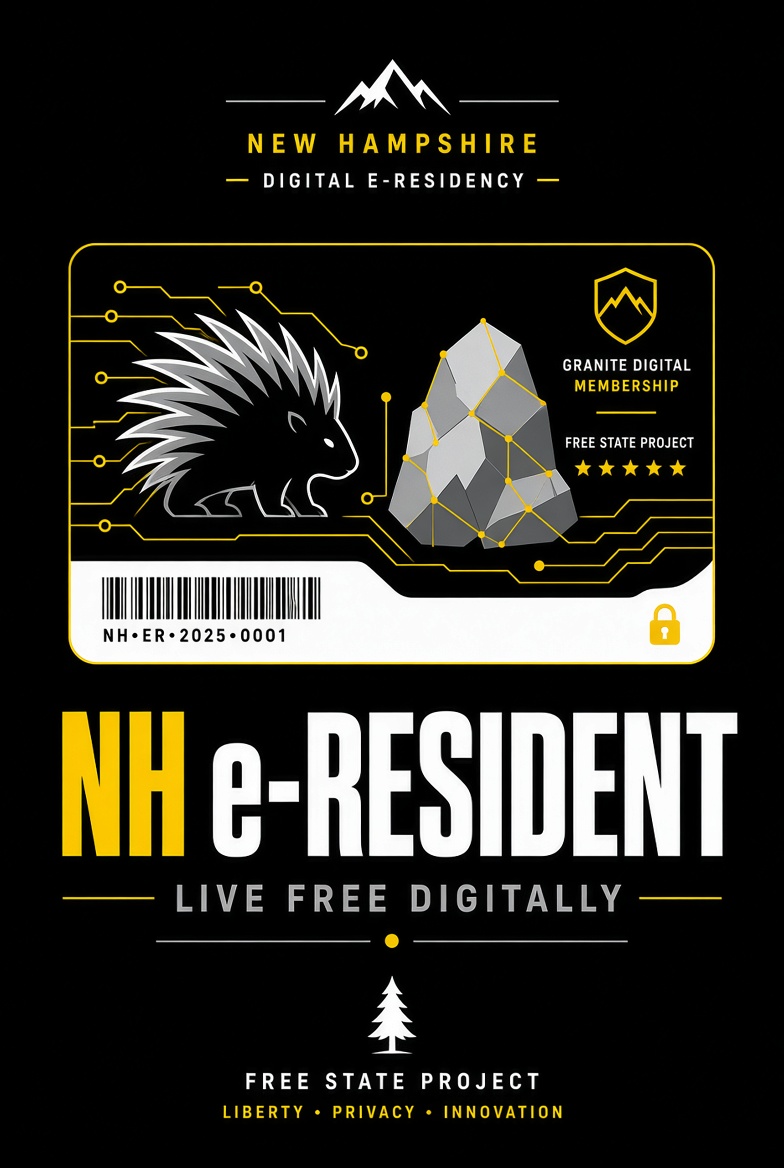
Call it something like “Granite Digital Membership,” “NH e-Resident,” or “Live Free Digital ID.” Core features that are achievable:
- Verified digital identity (tied to a government ID + background check)
- Ability to form and manage New Hampshire LLCs, business trusts, or DAOs more smoothly (NH already has a 2024 DAO Act)
- Digital signing of contracts and filings where accepted
- Access to a curated set of private and public services (banking introductions, private arbitration, education accounts, crypto-friendly tools, real-estate networks, etc.)
- Membership in a Free State-aligned community, newsletter, events, and mover pipeline
It should explicitly not claim to create state residency, voting rights, tax residency, or physical entry privileges. New Hampshire has no broad income tax, which removes one major complication that other states face.
Implementation phases
Phase 1 – Private lead-generation program (fastest, most libertarian, 3–6 months)
Run by the Free State Project or a new private entity it partners with.
- Online application: passport/ID upload, selfie/liveness check, short “why NH / liberty” statement, optional background consent.
- Low fee ($50–150) or free for early adopters to maximize list size.
- Issue a digital credential (app-based or simple card) and give immediate access to:
- Private community (Discord/Slack/forum with local chapters)
- Weekly “Porcupine”-style updates + targeted NH content
- Introductions to existing Free Staters, realtors, businesses, and education options
- Guides for eventual physical move
- Explicit goal: build a warm list of people who have raised their hand as future Free Staters. Track intent to move, timeline, skills, and location interest.
This is pure marketing + community building. No government required. It can start tomorrow.
Phase 2 – Public-private partnership with limited state recognition (6–18 months)
Partner with the New Hampshire Department of Business and Economic Affairs, Secretary of State, or a legislative champion.
- Legislation or administrative rule that lets verified digital members form LLCs or file certain documents with reduced friction (or via authorized private agents).
- Optional: state-backed digital signature recognition for specific business filings.
- Keep identity verification private or use existing DMV electronic credential infrastructure (NH has already passed laws clarifying that electronic credentials are voluntary and businesses cannot be forced to accept them).
- Fee revenue can cover administration; surplus funds marketing and community tools.
Phase 3 – Fuller digital identity layer (longer-term)
If political support exists, expand to a true Estonia-style digital ID usable for more state interactions. This requires careful legislation to keep it strictly voluntary and privacy-respecting.
Technical and operational basics
- Identity verification: third-party KYC (Onfido, Persona, or similar) + optional in-person pickup at NH locations or partner offices for higher assurance.
- Credential: mobile app (preferred) or physical smart card. Use standard PKI or modern alternatives (e.g., verifiable credentials).
- Backend: secure database for membership, simple portal for services, integration with existing FSP tools and newsletter.
- Background checks: light criminal/sanctions screening (same as Estonia) to protect the brand.
- Cost to launch Phase 1: low six figures for tech, legal, marketing, and verification volume. Phase 2 adds legislative and integration work.
Marketing as a Free State list-builder
Position it openly: “Become a digital Free Stater today. Move when you’re ready.”
- Funnel: digital membership → regular useful content (NH policy wins, housing/real-estate networks, education options, events) → local meetups or virtual events → “Declare Intent” upgrade (existing FSP Statement of Intent) → physical move support.
- Track conversion: percentage who later sign the Statement of Intent or actually relocate.
- Incentives that stay voluntary: priority access to private networks, discounted event tickets, introductions to employers or housing, no direct cash subsidies.
- Brand it with existing FSP language (“Live Free,” porcupines, Granite State) so it feels like a natural extension rather than a separate government program.
Risks and constraints to address up front
- Legal clarity: state clearly that it is not residency or citizenship.
- Privacy: minimal data retention, user control, no surveillance features.
- Perception: some Free Staters will dislike anything that looks like “government ID.” Keep the core program private and voluntary; make any state involvement optional and limited.
- Competition: Estonia, Lithuania, and others already exist. Differentiate on U.S. legal system, English language, NH tax environment, and direct path into a real physical liberty community.
- Over-promising: deliver concrete early value (community + business tools) or the list will go cold.
Recommended starting point
Launch the private Phase 1 version immediately under Free State Project branding or a sister organization. Use it to grow the warm list while drafting model legislation for Phase 2. This approach is low-risk, fully consistent with voluntary association, and directly serves the goal of identifying and nurturing future physical Free Staters without requiring subsidies or large public spending.
It turns the “billion-dollar imagination” exercise into something that can start with a few hundred thousand dollars and a good product, while remaining open to larger state-level upgrades later.