
OK, by now–with Rand Paul’s Fauci hearing coming up tomorrow–everyone has heard about “The Diary of Anthony Fauci.”
But have you heard how it was obtained?
This is a win for open government, for putting reformers in positions where they can actually reform things–MAHA huzzah!–and, hopefully, for accountability.
You know, the shit that floats a good libertarian’s you-boat. (Yes, sic.)
Fauci was apparently a prolific note keeper. And he kept these notes on government servers.
According to HHS Secretary Robert F. Kennedy Jr., his team spent 8 months systematically searching and eventually recovered materials from 11 separate servers.
Bobby’s crew then turned the records over to Senators Rand Paul and Ron Johnson, who we know have been investigating COVID’s origins and the government’s lockdown/pandemic response.
Rand released more than 1,000 pages, called The Reading Room.
And here we are.
Tbh, I was relieved to learn these records were recovered through official government channels and not obtained through a random leak or an ordinary FOIA request.
Why?
Because before I researched where this damning self-portrait of Fauci’s grandiosity and media obsession came from, I assumed it was a forced legal action to gain access to his personal diary.
And that felt… not… right? Not… reasonable?
But a “diary” documenting public business, created by a powerful public official and stored on government servers?
Fair game.
And a “diary” kept by a megalomaniac making decisions that negatively affected hundreds of millions of lives?
LET’S GET HIM!
Tune in tomorrow starting at 8AM for the hearing!
Q to GROK: what’s the legal status of discoverability or under warrant of a personal, handwritten diary? that seems… invasive to the point of unreasonableness
GROK’S answer:
Under U.S. law, a personal handwritten diary is not categorically immune from discovery or seizure under a search warrant, though it receives heightened privacy recognition and practical protections. The Fourth Amendment requires that any search or seizure be reasonable, typically meaning a warrant based on probable cause that particularly describes the place to be searched and the things to be seized. Diaries sit at the high end of privacy expectations because they record intimate thoughts intended only for the author.
Criminal context (search warrants and seizures)
- Courts historically treated private papers (including diaries) with special solicitude. Older precedent such as Boyd v. United States (1886) suggested strong barriers to seizing purely private writings. Later cases shifted the focus: the Fourth Amendment is largely procedural rather than creating a substantive ban on seizing certain categories of property.
- Modern doctrine (post-Warden v. Hayden and Andresen v. Maryland) allows seizure of evidentiary items, including personal papers, if a valid warrant is supported by probable cause that the diary contains evidence of a crime. Relevant entries can then be admitted against the author. Irrelevant private material is generally not usable.
- In practice, judges often demand a stronger showing of particularity and relevance for diaries than for ordinary records. Lower courts have sometimes expressed reluctance (“we shrink from allowing a personal diary to be the object of a search”) or required minimization of privacy intrusion. A general warrant to search a home for other evidence may still permit officers to examine a diary found there if it appears relevant; a warrant specifically targeting a diary needs probable cause linking it to the offense.
- The Fifth Amendment privilege against self-incrimination generally does not bar use of the contents of a voluntarily created diary once it is lawfully obtained. Compelled production via subpoena can raise separate “act of production” issues in some circumstances, but a physical search warrant is treated differently.
If the diary is found by a private party (roommate, family member) and turned over, Fourth Amendment protections typically do not apply because there was no government search.
Civil discovery
Under the Federal Rules of Civil Procedure (and most state analogs), discovery is broad: parties may obtain any non-privileged matter relevant to a claim or defense that is proportional to the needs of the case. A personal diary can therefore be discoverable—especially in cases involving emotional distress, custody, injury claims, or credibility—because it may contain contemporaneous notes about events, state of mind, or damages.
Courts can (and often do) issue protective orders limiting production to relevant portions, requiring in-camera review by the judge, or imposing confidentiality restrictions to mitigate privacy and embarrassment concerns. Absolute privilege is rare unless the entries fall under attorney-client privilege, work product, or another recognized protection.
Practical and policy notes
Many commentators and some judges view forced disclosure of a pure personal diary as highly invasive—comparable to searching someone’s mind. That is why warrants must be carefully tailored and why protective orders are available in civil cases. Still, the balance tilts toward allowing access when the government or a litigant makes a sufficient showing of need and relevance. Absolute inviolability does not exist under current U.S. doctrine.
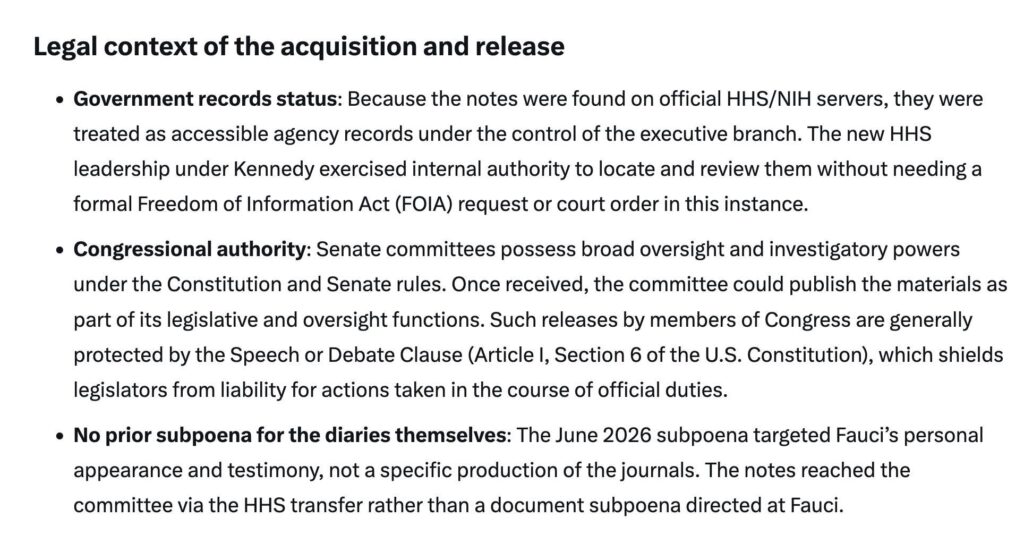
In the specific context of the recent Fauci notes discussion, those materials were located on government servers as agency records rather than seized from a private home as a purely personal handwritten diary under a criminal search warrant. That changes the legal analysis significantly (government control over its own systems vs. a classic Fourth Amendment private-papers case).
The invasiveness you note is real and recognized in the case law; the system simply does not treat it as an absolute bar.