Yesterday, my dog saved my neighbor’s life.
I don’t say that lightly.
We’d been out the night before—Robbie “the Fire” Bernstein at The SHELL, laughter, late-night liberty peeps, camaraderie. We stayed in Dover. Had three courses at Stalk beforehand (those bao buns, my God), brunch at a French bistro in Portsmouth the next morning, bought fancy macarons—Earl Grey flavor, anyone?—for Brinck and Elena as a thank-you for dog-sitting Obi.
We roll home around 1pm. Chickens unchecked. Dishwasher mid-pack. Life humming along.
And Obi.
Barking.
Not her normal “Amazon is here and you must know this” bark.
This was sustained. Insistent. Different.
I go to my office door to call her in.
And then—
“Carla! Carla! Help!!!! Help meeeeeeeeeeeeeeeee!!!!”
From across the street.
A voice I know.
Marie.
Twenty-three degrees out.
“OK! OK! I hear you! We’re coming!”
Louis and I are in boots and jackets in under thirty seconds.
She’s on her stomach on the handicap stairs her brother installed years ago. Cerebral palsy makes gravity an adversary most days. Today it won.
Her forehead is bleeding. Hair matted to a lump that is already swelling fast.
My body goes cold.
Then hot.
Then tight.
I am not in New Hampshire anymore.
I am in Mafikeng, Bophuthatswana.
Monkey bars. Showing off. Hands slip. Drop like a stone onto a sawed-off pipe filled with cement because early-80s Africa was a death trap lying in wait.
I can still feel the impact.
Still feel the giant unnatural knob rising on my forehead.
Still see the cerise crescents forming under my eyes.
Still remember returning home hours later to an empty house. Parents at a party. Sister at boarding school. Me still laughing it off. “It’s (probably) fine.” Head pounding. Don’t trouble anyone. Don’t be dramatic.
Don’t ask for help.
Back on Marie’s porch, my nervous system is doing what nervous systems do.
The amygdala doesn’t care that it’s 2026 and I’m surrounded by blinding white snow, not dust and heat and thorn trees.
It cares that a head wound once meant you might die.
It cares that you were alone.
It cares that you would rather laugh off injury than ask for help.
It flips the sympathetic switch: heart rate up, blood shunted, vision sharpens, hands fast.
Adrenaline is not subtle.
But here’s the part I’m proud of.
I noticed.
“I am having a moment,” I say in Afrikaans to Louis. “This is reminding me of that time in Mafikeng.”
That right there? That’s the prefrontal cortex coming back online.
Naming a trigger recruits the thinking brain. It literally dampens the amygdala’s alarm. There are fMRI studies on this. When you label emotion, activation in the threat center drops.
Neuroscience is just fancy language for: say it out loud and you calm down.
I need a moment.
So after we get her on a chair in the kitchen, I take one.
I walk home.
I don’t remember the walk. Dissociation is efficient like that.
I “come to” holding Ziplocks in my kitchen.
I stop.
Breathe.
In.
Out.
In.
Out.
Obi presses into my leg. Good dog. Nervous systems regulate each other. That’s not poetry—that’s vagus nerve science. Mammals co-regulate through proximity and touch.
“Well done, Lassi,” I tell her.
And I decide.
I decide I am not going to run from this.
Not from Marie’s wound.
Not from mine.
I will go back.
I return with a makeshift ice pack wrapped in a dishcloth and extra bags to stack in her freezer.
When she removes the hard blue ice brick she’d been using, I brace myself.
It’s smaller.
Noticeably smaller.
Ten minutes of ice and the swelling has already gone from egg to plump ravioli.
“Louis, look!”
He looks. He’s surprised.
The damage is less.
Mitigated.
Because someone intervened immediately.
Because someone cared.
And that’s when the strangest thing happens.
I feel… disappointed.
A flicker.
Because the egg-sized version—the shocking grotesque one from ten minutes ago—proved something.
It proved that my injury had been real.
That I hadn’t exaggerated it for comedic effect all these years.
That the giant lump in Mafikeng had been as catastrophic as I remembered.
That I wasn’t weak.
Or dramatic.
Or vain about my lopsided forehead.
The child in me wanted witnesses.
Even now.
Especially now.
Trauma does this.
It encodes not just the event, but the meaning you made of it.
Showing off leads to humiliation.
Getting hurt means you’re alone.
Don’t ask for help.
Don’t go to sleep or you might die.
(And yes, maybe that’s where the insomnia started. LOL but not really.)
But here’s the adult version.
I confronted the wound.
I named the trigger.
I removed myself briefly instead of exploding or freezing.
I breathed.
I asked: How can I proceed in a way that serves Marie and me?
I returned.
I iced.
I stacked backup packs in the freezer.
I made her repeat the instructions back to me.
I helped her into the comfy chair in the living room.
I brought her water.
Nurse Nightingale mode activated.
Louis restarted the fire and checked on her an hour later.
And the swelling went down.
Here’s what I understand now that I didn’t understand then:
If you don’t advocate for yourself, no one else can read your mind.
But also—
Sometimes you have to become the adult you needed.
Sometimes helping your neighbor is how you re-parent yourself.
Marie asked for help.
I answered.
Little Carla didn’t.
She thought she wasn’t allowed.
That’s the difference.
What doesn’t kill you does make you stronger.
It builds neural pathways. It teaches your body to survive. It gives you pattern recognition and competence under pressure.
But it also makes you stranger.
You develop reflexes.
Hypervigilance.
Dark humor.
An ability to assess head trauma at a glance.
You learn to laugh at black eyes and call them trophies.
You learn to override panic.
And if you’re lucky, decades later, you learn to do something better than override.
You learn to integrate.
To say:
I am being triggered.
I need a moment.
I will come back.
And then you do.
The grand takeaway is simple and not simple at all:
Help those who ask.
Be a good neighbor.
Ice the wound immediately.
Name the trigger.
Breathe.
And when the old story rises—about being alone, about not mattering, about not wanting to trouble anyone—
Rewrite it in real time.
Because sometimes the swelling goes down.
And sometimes the real healing isn’t in the ice pack.
It’s in walking back across the street anyway.
That night, while journaling, I realize part of what steadied me was something I didn’t expect: validation. Watching the swelling rise and fall in real time, having Louis see it, I felt that old memory become real in shared space. That injury was gnarly. I was alone with it. I didn’t know how to cope. I didn’t know how to ask for help.
Now I had tools. I could regulate. I could breathe. I could help another.
But something else happened.
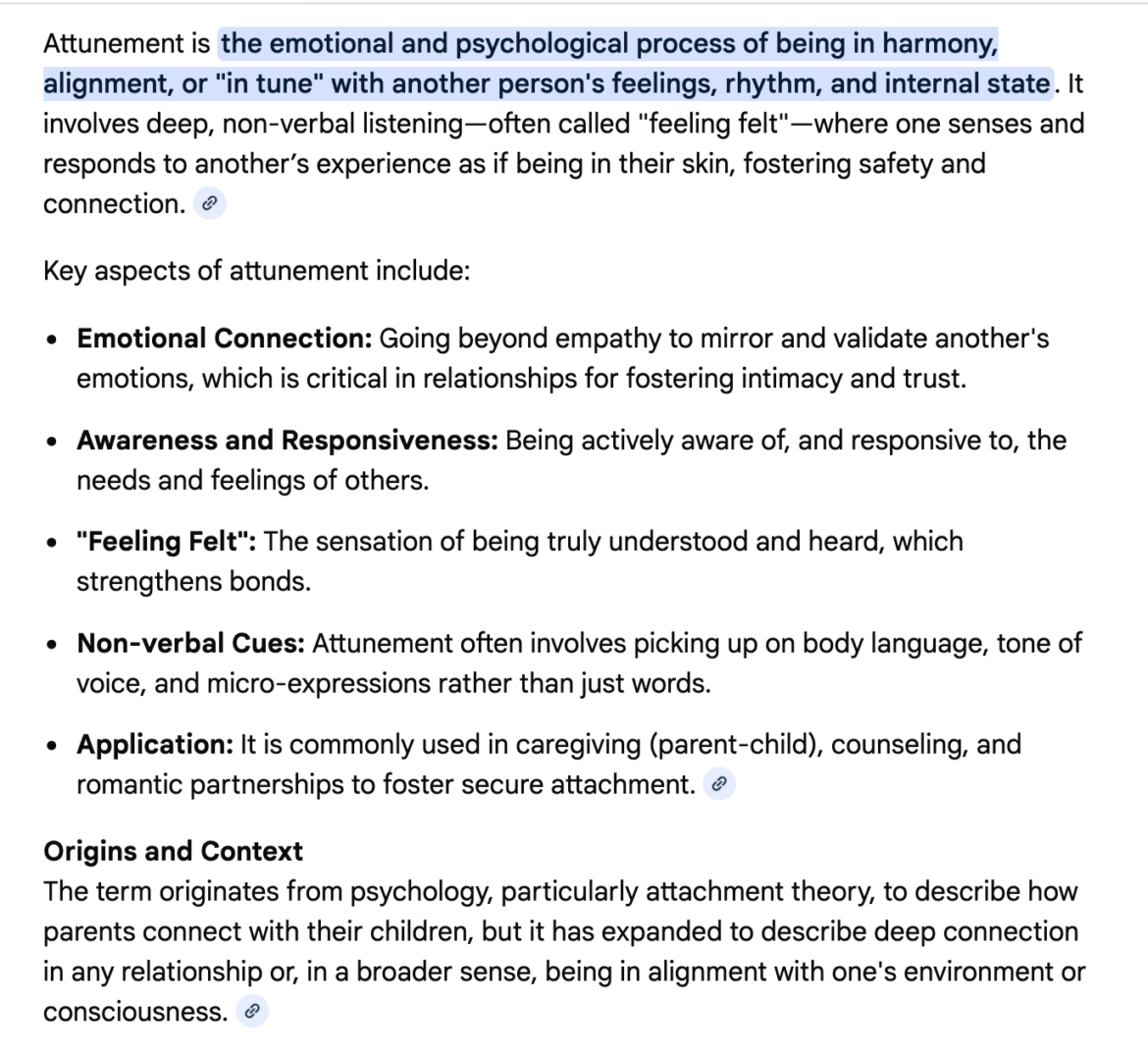
When Louis saw Marie’s injury, that egg-sized lump, and said, “Wow,” something deep inside me shifted. It wasn’t just validation. It was attunement.
For years I’d told that monkey-bar story half-laughing, half-performing it—a childhood war story with a punchline. Sometimes, I’d let people rub the bump on my forehead. But that day, Louis’ “Wow” wasn’t teasing. It wasn’t minimizing. It wasn’t smoothing it over with humor.
It was recognition.
Finally — someone tracking the truth of what I had been describing all along.
Attunement is when one nervous system accurately registers another. When someone really sees what happened to you, your body knows. The threat response eases. The bracing softens. Something unclenches.
That’s what it felt like.
Like a hidden tension thread I didn’t even know I’d been holding for decades finally loosening.
Like my nerves stopped preparing for dismissal.
Like some small, stubborn part of me that had been whispering, It was bad. It was bad. It was bad, finally hearing back:
Yes. It was.
Yes.
It was.
And in that simple, grounded, untheatrical “Wow,” there was a release so quiet and so profound it startled me.
Not drama.
Not pity.
Just… finally… a shared reality.
Sometimes the wound quiets because you ice it.
And sometimes it quiets because someone finally sees it for what it was.
Real.
Real bad.
And released.