Difference between expectations and desires
The key difference between expectations and desires lies in their emotional tone, level of attachment, rigidity, and how they affect our happiness when reality doesn’t match what we want.
Core Distinctions
| Aspect | Desire | Expectation |
|---|---|---|
| Definition | A wish, want, or preference for something | A strong belief or assumption that something will happen or should happen in a specific way |
| Emotional tone | Hopeful, open, aspirational | Entitled, demanding, often rigid |
| Flexibility | Flexible — you’re okay with alternatives or “no” | Rigid — reality “should” match it |
| Attachment | You enjoy the wanting itself; disappointment is milder | High attachment to the outcome; disappointment feels like betrayal or failure |
| Source | Often comes from heart/imagination/dreams | Usually lives in the mind; can include entitlement or reciprocity (“I did X, so Y must happen”) |
| When not fulfilled | May feel mild sadness, but you can still appreciate the desire or pivot | Frequently leads to frustration, anger, resentment, blame (self or others), or suffering |
| Psychological impact | Can motivate positively; leaves room for surprises and joy in the process | Often creates stress; sets up conditions for unhappiness (“I’ll be happy only if…”) |
Everyday Examples
- Desire: “I would love to get a promotion this year — that would be amazing!”
→ If it doesn’t happen → “Oh well, it would have been nice. I’ll keep working toward it or find other paths.” - Expectation: “I’ve worked hard for two years — I expect to get promoted this year.”
→ If it doesn’t happen → “This is unfair! They owe me this! Why am I even trying?” - In relationships:
Desire → “I hope my partner surprises me with something thoughtful for my birthday.”
Expectation → “My partner has to plan something special for my birthday because that’s what good partners do.”
Many psychological and spiritual perspectives (including Buddhism-inspired views) point out that unmet expectations are a major source of suffering, while desires — when held lightly — can actually bring pleasure even if they’re never fulfilled.
Quick Summary
- Desire = “I would like this to happen” → leaves space for life to surprise you
- Expectation = “This must / should / will happen” → creates pressure and potential pain
The healthiest approach is often to keep your desires alive (they fuel motivation and joy), but release or soften expectations (especially of other people, exact outcomes, or timing). This small mental switch dramatically reduces disappointment while still allowing you to pursue what matters to you.
Why would someone create an expectation that requires a (possibly unaware) external force to be met… isn’t this outsourcing agency?
Yes — creating an expectation that depends on someone else (especially when they’re unaware of it or never agreed to it) is a form of outsourcing your agency, and often your emotional regulation too.
It’s one of the most common, subtle ways people give away control over their own well-being without realizing it. Here’s why people do it anyway, and what maintains the pattern psychologically.
Main Reasons People Outsource Agency This Way
Cognitive shortcut / mental model of the world
Humans are pattern-seeking, prediction machines. We build internal models of “how things/people should work” to reduce uncertainty and cognitive load.
- “Good partners do X”, “Friends who care remember Y”, “If I do A then B should happen”.
Once the model exists, the mind treats it as reality rather than as one possible scenario → it feels like a fact, not a preference. Communicating or negotiating the preference would require effort and risk (rejection, conflict), so the brain defaults to the low-effort version: assume it’s already “true” and hold others accountable to the invisible contract.
Assumed similarity bias + projection
We unconsciously assume other people think/feel/value roughly the same things we do (especially people we like or are close to).
→ “I would naturally do this for someone I care about → therefore they should/would do it too.”
This turns your own values/desires into an unspoken “should” that you project outward. No explicit agreement needed because “anyone decent would already know”.
Avoidance of vulnerability and direct communication
Stating a desire openly requires:
- Admitting you want/need something
- Risking “no” or negotiation
- Potentially looking “needy” or demanding
An unspoken expectation sidesteps all of that — you get to feel entitled to the outcome without the scary interpersonal risk. If it doesn’t happen → you can feel morally superior (“they failed”, “they’re inconsiderate”) instead of exposed (“I wanted this and asked for it and didn’t get it”).
Reciprocity heuristics & entitlement from past investment
“I’ve invested so much (time, emotion, favors) → the world/they owe me balance.”
This is the mind turning a desire (“I want reciprocation”) into an entitlement (“they must reciprocate because fairness demands it”). Again, no conversation required; the “debt” is assumed to be self-evident.
Pygmalion / self-fulfilling prophecy hope (sometimes unconscious)
Some part of us believes that holding a high expectation might shape the other person’s behavior (we treat them as-if they’re already that way → they rise to it).
Research on the Pygmalion effect shows this can work in limited contexts (teachers/students, managers/employees), but it fails dramatically when the other person doesn’t share the frame, doesn’t want to, or literally doesn’t know the expectation exists.
Childhood & attachment templates
Many people carry forward early templates where needs were (or weren’t) met without having to ask.
- If caregivers intuitively anticipated needs → adult expects partners to “just know”.
- If needs were inconsistently met → adult may create rigid expectations as a defense against uncertainty (“If I expect it strongly enough, maybe it won’t fail again”).
The Agency Trade-Off in Practice
| Choice | Agency Level | Emotional Risk | Typical Outcome if Unmet |
|---|---|---|---|
| Pure desire + communicate | High (you own the ask) | Medium (rejection possible) | Disappointment possible, but no betrayal narrative |
| Unspoken expectation | Low (outsourced to other) | Low short-term, very high long-term | Resentment, blame, victim narrative, repeated suffering |
In short: yes, it’s outsourcing agency — you’re handing the keys to your happiness/peace to someone who didn’t ask for them and may not even know they have them.
People keep doing it because:
- It’s emotionally cheaper in the moment (no vulnerability)
- It preserves the fantasy of being “right” when things go wrong
- It feels safer than owning the desire and risking a real no
The painful irony is that this strategy almost guarantees more disappointment over time, while direct (but light) communication of desires usually produces better results — even when the answer is no — because at least you’re steering your own ship.
What does it mean when the person assumes the worst about you despite evidence to the contrary
When someone consistently assumes the worst about you — interpreting your actions, words, or intentions in the most negative possible light — even when clear evidence contradicts that view, it almost always reflects more about their internal world than about your actual character or behavior.
This pattern is common in psychology and usually stems from protective mechanisms, cognitive distortions, or unresolved emotional wiring rather than deliberate malice toward you specifically.
Key Psychological Reasons This Happens
Hostile Attribution Bias (most direct match)
The person habitually attributes hostile, selfish, or malicious intent to others’ neutral or ambiguous actions.
- A delayed text → “They’re ignoring me on purpose.”
- You set a boundary → “They’re selfish and don’t care.”
Even strong counter-evidence (your history of reliability, explanations, past kindness) gets discounted because the bias filters reality through a “people are out to hurt me / will hurt me” lens.
Brain imaging shows this pattern lights up specific areas (like the ventromedial prefrontal cortex) tied to emotional regulation and social interpretation — it’s not just “thinking,” it’s how their threat-detection system is calibrated.
Past Trauma, Betrayal, or Attachment Insecurity
If they’ve been repeatedly hurt, abandoned, cheated on, gaslit, or invalidated (especially in childhood or prior relationships), their nervous system learns: “Better to expect betrayal than be blindsided again.”
- This creates a hyper-vigilant filter — assuming the worst feels safer than hoping and being disappointed.
- Insecure attachment styles (anxious or avoidant) strongly correlate with negative attribution bias: they read rejection or hostility into situations where none exists, and evidence to the contrary gets overridden by old emotional templates.
- It’s a form of emotional outsourcing gone extreme: they’re protecting themselves by pre-emptively “rejecting” you in their mind.
Negativity Bias + Confirmation Bias Combo
- Negativity bias (evolutionary holdover): bad things register faster and stronger than good ones. One ambiguous action outweighs ten positive ones.
- Confirmation bias then locks it in: once they form a negative story about you (“they’re unreliable / manipulative / uncaring”), their mind selectively notices or remembers info that fits — and discards or downplays disconfirming evidence.
Over time this becomes a self-reinforcing loop: the worse they assume → the more defensive/closed they become → the more strained interactions look → which “proves” their assumption.
Cognitive Distortions Like Mind-Reading & Catastrophizing
- They “mind-read” your motives without asking (and assume the darkest version).
- They catastrophize small things into proof of a larger character flaw (“This one mistake means you’re just like everyone else who’s hurt me”).
These are hallmark anxiety-driven patterns — the brain treats uncertainty as danger and fills the gap with the scariest story possible.
Projection or Defensive Self-Protection
Sometimes they project their own feared traits (“If I were in their position, I’d be selfish → therefore they must be”) or use the negative assumption as armor: “If I decide you’re bad first, I can’t be hurt when you inevitably disappoint me.”
What It Means for You (and the Relationship)
- It’s rarely personal in the sense of “they see the real bad you.” It’s usually their unresolved pain wearing tinted glasses.
- Evidence doesn’t penetrate easily because it’s not a rational belief — it’s an emotional survival strategy. Challenging it head-on often triggers defensiveness (“You’re just gaslighting me / denying the truth”).
- If this is chronic, it can erode trust both ways: you feel constantly misjudged and on trial, while they stay stuck in fear.
- Healthy change usually requires them to do internal work (therapy, self-reflection, slowly practicing trusting positive evidence), not just you proving yourself harder.
In short: assuming the worst despite contrary evidence is their brain’s outdated alarm system stuck on high alert. It protects them from potential pain but at the cost of connection and accuracy. Recognizing this can help you respond with boundaries and compassion instead of taking it as a verdict on your worth — while still protecting your own peace if the pattern doesn’t shift.
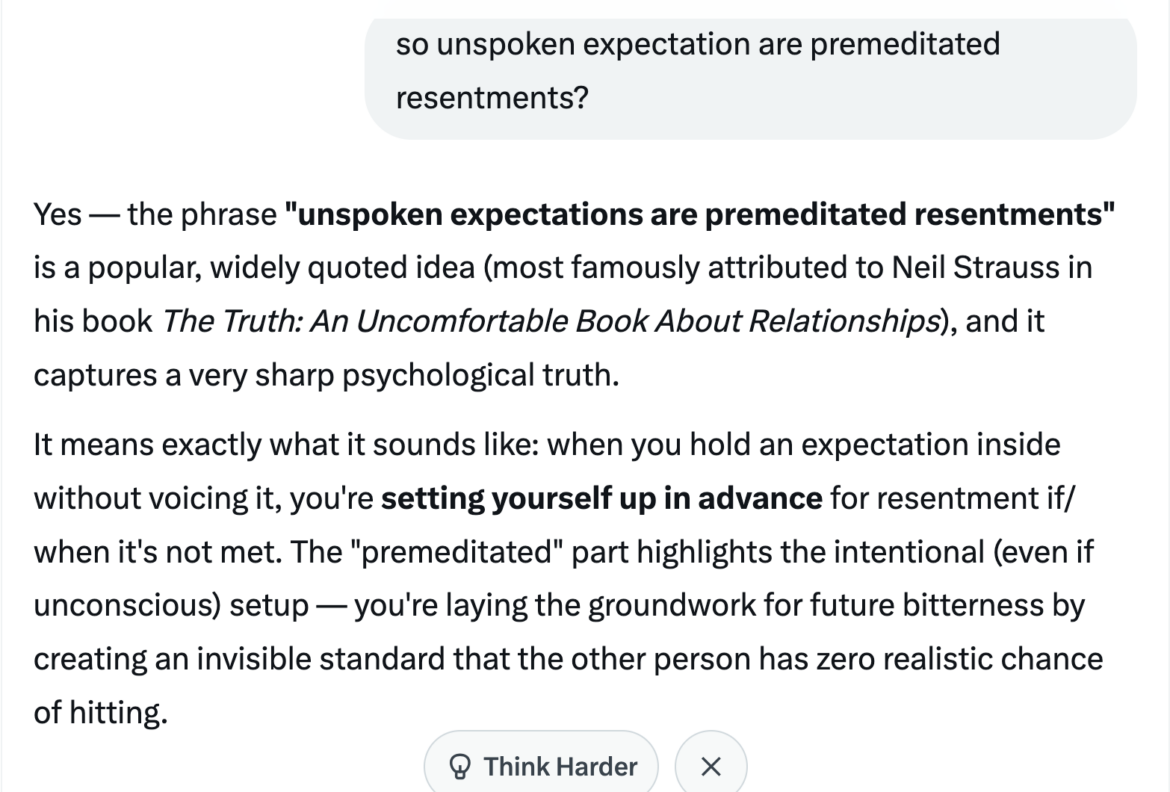
so unspoken expectation are premeditated resentments?
Yes — the phrase “unspoken expectations are premeditated resentments” is a popular, widely quoted idea (most famously attributed to Neil Strauss in his book The Truth: An Uncomfortable Book About Relationships), and it captures a very sharp psychological truth.
It means exactly what it sounds like: when you hold an expectation inside without voicing it, you’re setting yourself up in advance for resentment if/when it’s not met. The “premeditated” part highlights the intentional (even if unconscious) setup — you’re laying the groundwork for future bitterness by creating an invisible standard that the other person has zero realistic chance of hitting.
Why This Framing Feels So Accurate
- It’s a silent contract: You mentally sign both parties up for rules they never agreed to. When reality violates the contract → resentment feels justified (“They should’ve known!”).
- Resentment is baked in from the start: The disappointment isn’t accidental; it’s the predictable outcome of the setup. You’re not surprised by the failure — you’re prepared for it emotionally, even if you don’t admit it.
- It protects the ego short-term: By not communicating, you avoid vulnerability (“What if they say no?”). But long-term, it guarantees pain — either quiet buildup of bitterness or explosive fallout.
- The other person is innocent (mostly): They can’t read minds. The resentment isn’t truly about their actions; it’s about your unexpressed need colliding with their freedom to act differently.
Real-World Nuances & Variations
- Sometimes it’s mild → a low-key grudge that fades.
- Other times it’s chronic → people who repeatedly do this end up in cycles of feeling betrayed, which reinforces cynicism (“People always let me down”).
- A darker read (from some therapy/recovery circles): For certain folks with deep wounds, unspoken expectations can become an unconscious way to manufacture betrayal — it confirms old beliefs (“See, no one can be trusted”) without requiring them to risk real intimacy or direct asks.
- Not every unspoken want turns toxic → light preferences (“It’d be nice if…”) that stay desires don’t count. The “premeditated resentment” label fits best when the expectation is rigid, entitled, or tied to core needs/values you treat as non-negotiable but never negotiate.
Bottom Line
Yes, it’s a brutally honest way to describe the mechanism: Unspoken expectations aren’t innocent hopes — they’re pre-loaded emotional landmines.
The antidote remains the same as we’ve discussed: turn them into spoken desires (flexible, ownable) or drop them entirely if they’re unrealistic. Communication isn’t just polite — it’s the only way to disarm the premeditation and give the relationship a fair shot.
This one line has gone viral in self-help, recovery, relationship, and leadership spaces for good reason — it hurts because it’s true.