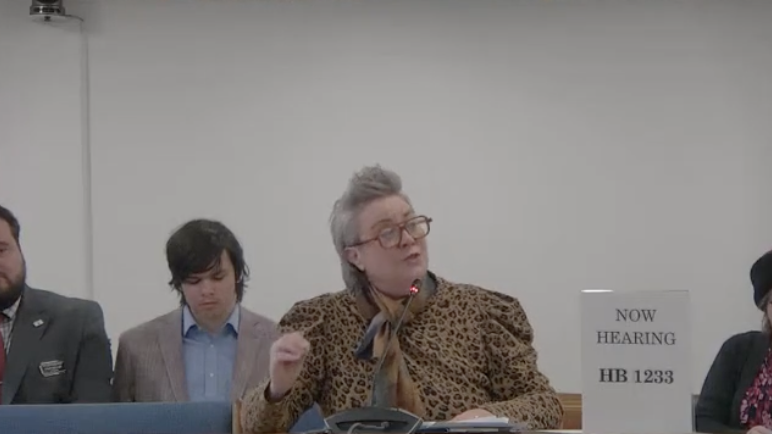
Spent the morning at House Judiciary with Laurie Ortolano to testify on HB 1233, which is just a technical tweak to make public minutes reflect the motion citing the reason for the non-public session (from 91-A), and record the start and end time of the non-public session. Our testimony is at the start of the video.
Testimony (I did go off script):
Thank you, Chair and members of the Committee, for the opportunity to testify today on behalf of Right To Know NH in strong support of this act to amend RSA 91-A:3, III, relative to the minutes of nonpublic session.
My name is Carla Gericke, and I am president of Right To Know NH, a nonpartisan, nonprofit citizen coalition dedicated to promoting open government and strengthening New Hampshire’s Right-to-Know Law, RSA 91-A. Our mission is to ensure the greatest possible public access to the actions, discussions, and records of all public bodies, fostering accountability and trust in our institutions.
This bill addresses longstanding gaps in transparency that have allowed public bodies to withhold more information than necessary from the public eye during nonpublic sessions. Under the current law, minutes and decisions from these sessions must generally be disclosed within 72 hours, with limited exceptions. However, without clear guidelines, entire sets of minutes are sometimes sealed indiscriminately, even when only a small portion qualifies for exemption. This practice undermines the spirit of RSA 91-A, which emphasizes openness as essential to democracy.
The amendments in this act provide critical clarifications and safeguards. First, by specifying that only the portion of minutes or decisions directly covered by the motion may be withheld from public disclosure, the bill prevents blanket secrecy and ensures that unrelated discussions are released promptly. This targeted approach respects legitimate exemptions—such as protecting personal reputations or sensitive security matters—while maximizing public access to the rest of the record.
Second, requiring the list of withheld minutes to include the start time and end time of the nonpublic session adds a layer of accountability. This simple addition allows citizens to better understand the scope and duration of secret deliberations, helping to track patterns and ensure that nonpublic time is used judiciously and not as a default for routine business. In our experience, reviewing cases under RSA 91-A, we’ve seen instances where lack of such details has led to prolonged withholding and reduced public oversight, eroding trust.
These changes align with recommendations from the Attorney General’s Memorandum on RSA 91-A. They will make compliance easier for public officials while empowering citizens to hold their government accountable without resorting to costly litigation.
We urge the Committee to pass this act as written, effective 60 days after passage, to further New Hampshire’s commitment to transparent governance. Thank you for your time, and I am happy to answer any questions.
PROBLEMS SOLVING FOR:
This proposed amendment to RSA 91-A:3, III targets several persistent transparency issues in how New Hampshire public bodies handle minutes and decisions from nonpublic (executive) sessions under the Right-to-Know Law.The core problems it solves stem from longstanding practical challenges and complaints about overbroad or indefinite secrecy, which undermine public trust and accountability. Here’s a breakdown of the key issues addressed, based on guidance from sources like the New Hampshire Municipal Association, Attorney General memoranda, ombudsman cases, and common citizen experiences:
Indiscriminate or blanket sealing of entire minutes
Under current law, when a public body votes (by 2/3 in public session) to withhold minutes/decisions due to one of the narrow exemptions (e.g., adverse effect on someone’s reputation, rendering action ineffective, or terrorism-related security), the practice has often been to seal the entire set of minutes—even if only a small portion actually qualifies for protection. This leads to unnecessary withholding of non-sensitive discussions, violating the law’s emphasis on openness.
The bill’s new language—”Only the portion of minutes or decisions directly covered by the motion may be withheld from public disclosure”—forces a more precise, redaction-style approach. This ensures the rest of the record is released promptly (within 72 hours), preventing overuse of secrecy for routine or unrelated matters.
Lack of clarity and detail about what is being withheld and why
Citizens and watchdogs frequently struggle to understand the scope of sealed sessions because public records often lack specifics on duration or exact basis. Without details like start and end times, it’s hard to spot patterns of abuse (e.g., excessive nonpublic time for non-exempt topics) or verify that sessions stayed within the allowed exemptions under RSA 91-A:3, II.
By expanding the required public list of withheld minutes to include “start time, and end time” (in addition to date, public body, exemption cited, decision dates to withhold/release), the bill adds meaningful accountability. This helps the public monitor compliance without needing costly litigation or ombudsman complaints.
Prolonged or indefinite withholding without adequate review
Minutes can be sealed indefinitely in some cases (though not ideal practice), and there’s sometimes lax follow-up on whether the justifying circumstances (e.g., ongoing negotiation sensitivity or reputation risk) no longer apply. While the law allows release by majority vote when conditions change, transparency suffers when the public has no easy way to track these sessions.
The enhanced list requirement indirectly promotes timely review and release, as citizens can more readily identify old sealed items and push for reconsideration.
Broader erosion of trust in open government processes
Nonpublic session minutes have been described in municipal guidance as one of the “thorniest problems” under RSA 91-A, with issues around sealing decisions leading to complaints, ombudsman rulings (e.g., cases where boards failed to properly justify or document nonpublic reasons), and calls for reform. Over-sealing reduces public oversight of government actions, fuels perceptions of hidden dealings, and increases reliance on formal disputes.
By clarifying limits on withholding and improving record-keeping, the bill aligns with the law’s core purpose: maximum feasible openness while protecting only truly sensitive information.
In short, these changes make compliance clearer for public bodies (reducing accidental violations), empower citizens to hold officials accountable more effectively, and prevent secrecy from becoming the default rather than the narrow exception. They build on prior reforms like the Right-to-Know Ombudsman role and aim to reduce friction in an area that’s long been a flashpoint for transparency advocates like Right To Know NH.
From RTK Member in Grafton:
We all know that non-public meetings are abused to discuss matters in secrecy that shouldn’t, but even when there is a legitimate reason, after the non-public too often there is a vote to seal the minutes.
There are a few allowable reasons under statue:
- Reputation, other then members of the board.
- The decision would render ineffective if public.
- All the new stuff, terrorism, emergency, etc.
it is often too easy to use the exemptions in a broad manner, hence introducing the new language makes the minutes as a whole available but redactions would be made to only the portions that fall under this exemption.
With this amendment, boards will no longer be able to hide entire meetings by using one of the few options when it only narrowly applies.