Some of this is shockingly accurate… Like my CA BAR number and RE License… telling me these databases are linked in some way (interesting)… Some of it makes me curious, like the UFO stuff because I definitely wouldn’t say that’s a forward thrust theme in my life… some I need to double check (hey! I have been busy!)… and I would love to see more of my lifestyle, health choices, fasting, alcohol-free etc show up too.
Carla Gericke
Carla Gericke is a South African-born American libertarian activist, author, former attorney, and real estate professional who served as president of the Free State Project—a nonprofit organization promoting the relocation of 20,000 liberty-minded individuals to New Hampshire to foster limited government and individual rights—from March 2011 to March 2016.[1][2] During her tenure, the project reached its relocation threshold of 20,000 signers, triggering a formal call for participants to move to the state.[3] Gericke, who immigrated to the United States in the 1990s after winning a diversity visa lottery as the daughter of a South African diplomat, achieved national recognition in 2014 through Gericke v. Begin, a U.S. First Circuit Court of Appeals decision that upheld the First Amendment right of citizens to openly record police officers conducting official duties in public spaces, rejecting claims of qualified immunity and setting a precedent for transparency in law enforcement interactions.[4] As president emeritus and current chairman of the Free State Project, she continues advocacy for New Hampshire’s political independence, transparency via Right-to-Know NH, and voluntary secession efforts through the Foundation for New Hampshire Independence, while running unsuccessfully as a Republican for the New Hampshire House of Representatives in 2024 and previously for state senate.[2][5] Her work emphasizes first-principles defense of personal sovereignty, authoring books and essays on self-reliance and critiquing overreach in governance.
Early Life and Background
Childhood and Family in South Africa
Carla Gericke was born in South Africa during the apartheid era and raised primarily in the country despite periods abroad due to her family’s circumstances.[6] Her upbringing occurred in a diplomatic household, where her father’s career postings led to the family living temporarily in the United States, Sweden, and Brazil during her early years, though she spent most of her childhood in South Africa.[6] [7]Gericke’s family emphasized values of strength and independence, particularly through her mother’s influence, who instilled in her daughters—including Gericke and her sister Lizette—the importance of self-reliance and forging their own paths.[8] She attended high school in Johannesburg, experiencing the social and political environment of apartheid-era South Africa firsthand.[9] These formative experiences included direct exposure to the restrictive policies and divisions of the regime, which she later reflected upon in discussions of her background.[10]
Immigration to the United States
Gericke immigrated to the United States in 1996 after winning the Diversity Visa Lottery, also known as the green card lottery, while living in South Africa.[6][11] The program, established by the Immigration Act of 1990, allocates up to 55,000 visas annually to promote immigration from underrepresented countries, and Gericke’s selection provided her lawful permanent resident status upon arrival. This opportunity allowed her to relocate from post-apartheid South Africa, where she had been raised under the apartheid regime that ended in 1994, to pursue greater individual liberties and economic prospects in America.[12]Upon arrival, Gericke initially settled on the West Coast, experiencing a stark contrast to South Africa’s centralized governance and recent political transitions, which she later described as reinforcing her appreciation for decentralized American institutions and personal autonomy.[13] Her early adaptation involved navigating the immigrant bureaucracy to secure employment and housing, steps that underscored the relative openness of U.S. markets compared to South Africa’s emerging challenges with crime and regulatory hurdles in the mid-1990s. These experiences, predating her formal activism, fostered her emerging libertarian worldview by highlighting causal differences in systemic incentives for self-reliance versus state dependence.[14]Gericke’s green card win and subsequent integration laid foundational groundwork for her American identity, as she began building community ties through professional networks without immediate reliance on government programs, contrasting sharply with the collectivist echoes she perceived in South Africa’s evolving political landscape.[15]
Education and Professional Development
Legal Training and Bar Admission
Carla Gericke earned her law degree in South Africa, completing her legal education by the age of 21.[16]After immigrating to the United States in the 1990s, she relocated to California, where she worked as a paralegal while preparing for the state bar examination.[17] She passed the California Bar Exam on her first attempt and was admitted to practice under license number 193258.[18][17]Gericke initially practiced as an attorney in South Africa prior to her immigration, providing her with early professional experience in the legal field before pursuing bar admission in the U.S.[16] Her U.S. bar admission enabled subsequent roles as in-house counsel at Fortune 500 companies in California.[16]
Career as Attorney and Real Estate Professional
Gericke practiced law in South Africa prior to her immigration to the United States in 1996.[10] Following her move to California, she became licensed to practice as an attorney, holding California State Bar number 193258.[18] Her legal work focused on high-tech matters in Silicon Valley, where she engaged in corporate legal roles before transitioning away from the profession.[19]In her California practice, Gericke handled matters typical of technology sector attorneys, though specific case details or client volumes are not publicly detailed in professional records.[18] Her bar status later shifted to ineligible to practice, reflecting a departure from active legal work.[18]Gericke entered the real estate field in New Hampshire, serving as a licensed salesperson with Porcupine Real Estate in Manchester.[20] Holding New Hampshire license number 080148, she assists clients with property transactions, emphasizing features like natural light to appeal to buyers in the region’s climate.[20][21] Her role involves guiding investments and relocations, leveraging her professional network for sales in the local market.[2]
Activism in New Hampshire
Leadership in the Free State Project
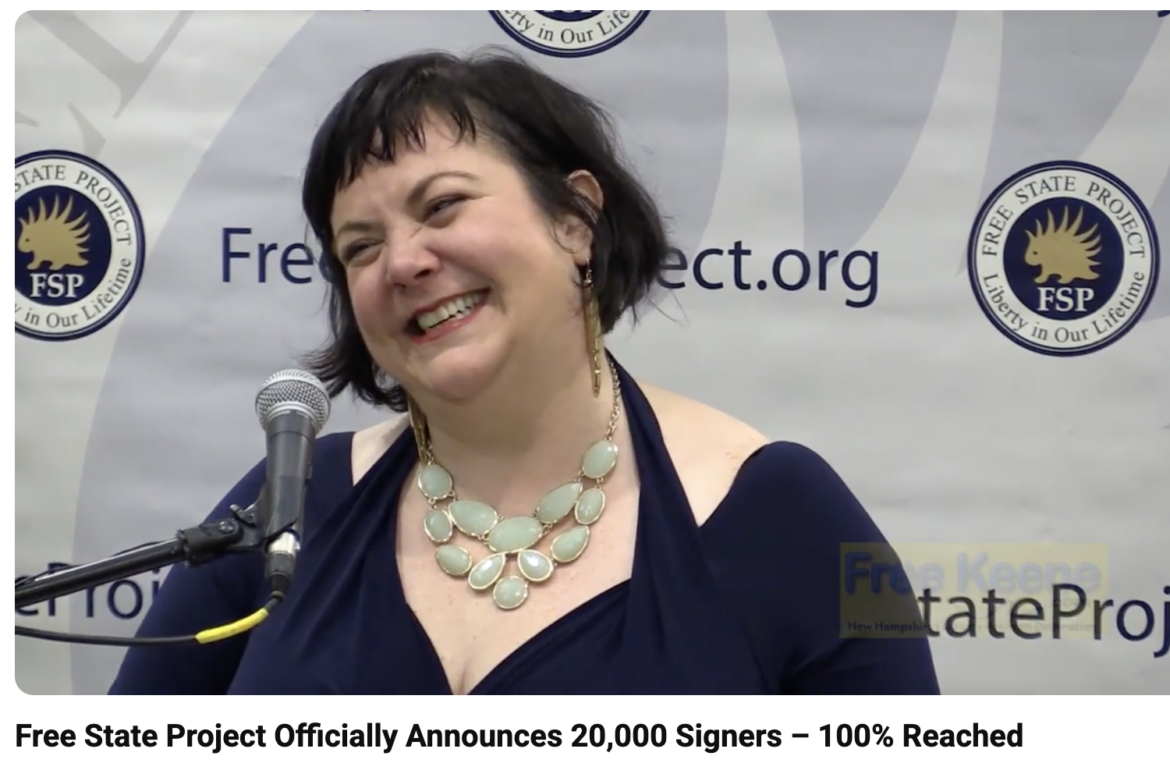
Carla Gericke assumed the presidency of the Free State Project (FSP) on March 1, 2011, succeeding Varrin Swearingen, and held the position until March 1, 2016.[22] During her tenure, she focused on expanding the organization’s recruitment efforts to fulfill the FSP’s core pledge of attracting 20,000 libertarians to relocate to New Hampshire, thereby concentrating political influence to advance limited-government principles. Under her leadership, the FSP intensified outreach through events, media campaigns, and online pledges, crossing the 90% threshold of its goal by early 2016 with over 18,000 signatories and nearly 2,000 “early movers” who had already relocated to the state.[23]A pivotal achievement during Gericke’s presidency was the official “triggering” of the mass migration on February 3, 2016, when the FSP announced that exactly 20,000 individuals had signed the statement of intent to move within five years.[24] This milestone, reached after 15 years of the project, validated the strategy of voluntary political migration and positioned New Hampshire as a hub for libertarian activism, with early movers contributing to local governance reforms such as reduced business regulations and opposition to income taxes. Gericke’s emphasis on community-building initiatives, including PorcFest events and liberty-focused networking, helped sustain mover commitment and amplified the FSP’s visibility, leading to sustained influxes that by 2016 had established a critical mass of over 1,900 in-state participants actively engaged in political advocacy.[25]Following her presidency, Gericke transitioned to President Emeritus and assumed the role of board chairwoman, continuing to guide strategic recruitment and organizational resilience.[22] In this capacity, she supported ongoing migration drives that built on the 2016 trigger, fostering empirical gains in libertarian representation within New Hampshire’s political landscape, including the election of FSP-affiliated individuals to state legislature seats by the late 2010s. Her leadership underscored the FSP’s model of causal migration yielding measurable policy shifts, such as the defeat of broader tax proposals, through concentrated voter blocs rather than dispersed national efforts.[25]
Transparency and Right-to-Know Advocacy
Carla Gericke serves as a member at large on the board of Right to Know NH (RTKNH), a nonpartisan nonprofit founded in 2013 to enhance public access to New Hampshire state, county, and local government records and meetings under RSA 91-A.[26] In this capacity, she has advocated for updates to outdated guidance on right-to-know laws, including formal written requests to the Attorney General’s office at least five times over the year prior to March 2024.[27] These efforts contributed to the release of a revised 2024 memorandum on March 14, 2024, replacing the 2015 version and providing updated interpretations amid evolving case law and a new constitutional privacy amendment.[27][28]Gericke’s advocacy emphasizes addressing government opacity at executive levels, as detailed in her October 22, 2023, op-ed critiquing the governor’s office for incomplete responses to RTKNH requests on policy decisions and communications.[29] She highlighted misapplications of privacy exemptions, such as Manchester’s denial of shelter logs to elected officials under the 2018 Article 2-b amendment, arguing these undermine public accountability without balancing public interest.[29] RTKNH, under board involvement including Gericke, supported broader wins like the New Hampshire Supreme Court’s overturning of the Fenniman precedent, which for nearly 30 years shielded police personnel files and now requires case-by-case balancing of privacy against public access needs.[29]Her work has aligned with RTKNH’s legislative pushes, including annual bill proposals since 2014 to strengthen RSA 91-A, such as efforts to curb excessive fees in proposed legislation like HB 1002, which sought to impose use-based charges but faced opposition leading to moderated outcomes.[30][27] The establishment of a Right-to-Know Ombudsman office in 2023, enabling low-cost ($25 fee) complaint resolutions appealable to court, has facilitated faster access to records, though backlogs persist; this mechanism has registered unappealed rulings as enforceable judgments, enhancing compliance.[29][27] Gericke’s op-eds and board role underscore RTKNH’s role in cases like former president Laurie Ortolano’s Nashua victory, where courts awarded $63,400 in fees for non-compliance and mandated official training, directly improving local government adherence.[29]
Legal Challenges to Government Authority
In March 2010, Gericke was arrested in Weare, New Hampshire, after attempting to videotape a traffic stop involving a friend, during which she refused an officer’s demand to produce her driver’s license and vehicle registration.[31] The officer cited her refusal as disobedience of a lawful order, leading to charges of disobeying a police officer under RSA 642:2, obstructing a government official under RSA 642:1, and unlawful interception of communications (felony wiretapping) for the recording attempt.[32] Gericke maintained that no lawful order existed to compel document production absent reasonable suspicion of her own wrongdoing, framing the incident as an overreach infringing on public observation of police conduct and personal privacy in a public space.[31]The charges against Gericke were not pursued to trial by the New Hampshire Attorney General’s office.[33] In 2011, she filed a civil rights lawsuit in the U.S. District Court for the District of New Hampshire against the Town of Weare, its police department, and involved officers, alleging First Amendment retaliation for recording and Fourth Amendment violations from the warrantless arrest.[34] The district court dismissed the claims in 2012, ruling that no clearly established right to record police existed at the time.[31]On appeal, the U.S. Court of Appeals for the First Circuit reversed the dismissal in May 2014, holding that Gericke plausibly stated a claim for exercising a clearly established First Amendment right to record police performing official duties in public spaces, even if her equipment malfunctioned during the attempt.[32] The ruling emphasized that such recording serves democratic oversight without requiring prior approval or interference, provided it does not obstruct operations, and remanded for further proceedings on qualified immunity and other claims.[35] This decision contributed to federal precedents affirming the right to record as a tool for accountability, influencing subsequent cases in the circuit and aligning with broader libertarian efforts to limit unchecked police discretion.[36]Gericke’s opposition to the Concord Police Department’s 2013 acquisition of a BEARCAT armored vehicle through a federal grant involved public critiques of militarized equipment deployment against civilians, including testimony at city council meetings highlighting risks of escalated force in routine operations.[37] Although no direct lawsuit ensued from her involvement, the advocacy amplified scrutiny of funding mechanisms under programs like the Department of Homeland Security’s grants, prompting debates on local control versus federal incentives for equipment that could undermine due process in community policing.[38]
Opposition to COVID-19 Mandates and Surveillance
Gericke emerged as a vocal opponent of New Hampshire Governor Chris Sununu’s COVID-19 emergency orders, which included stay-at-home directives and business closures beginning in March 2020. In an April 21, 2020, op-ed, she argued that all individuals and businesses were essential, criticizing the government’s role in designating “non-essential” activities and calling for immediate reopening to mitigate economic harm, including what she described as over 125,000 job losses in the state.[39]She participated in the ReOpen NH rally on April 18, 2020, at the State House in Concord, where hundreds gathered despite a statewide ban on assemblies larger than 10 people; organizers had expected under 100 attendees but were surprised by the turnout of business owners, nurses, teachers, and others demanding an end to closures.[40] Speaking as a state Senate candidate, Gericke emphasized that the job losses equated to the combined populations of Amherst and Manchester, asserting, “We are all essential. It is not the role of government to decide who are winners and losers,” and no arrests occurred despite warnings of misdemeanor charges.[40] Sununu responded by advocating a phased reopening, with the state progressing to partial reopenings in late May 2020 and lifting most restrictions by June 2021, though he attributed decisions to data on case rates rather than directly to protests.[40]Gericke also spoke at a June 2020 rally outside Manchester City Hall against a proposed local mask mandate, contending that such measures exceeded governmental authority by compelling individuals to alter their bodies, amid broader critiques of uniform policies ignoring personal risk assessments and available data on efficacy.[41]In parallel, Gericke opposed government surveillance expansions, serving as a plaintiff in a June 11, 2019, ACLU of New Hampshire lawsuit challenging Manchester’s plan to install live-video cameras on Elm Street, which would transmit feeds to police dispatch and store footage for 14 days.[42] The suit argued the cameras violated a 2006 state privacy law barring capture of motorists’ identifying information, such as faces or license plates, as the wide-angle feeds would inevitably record such details despite claims of traffic monitoring only; Gericke, who organized a protest of about 40 people, highlighted risks of unchecked intrusion without community input.[42] Manchester proceeded with installation in August 2019 despite a preliminary court order questioning aspects of the program, underscoring ongoing tensions over privacy versus public safety claims.[43] Her stance aligned with critiques of monitoring tools that could enable broader tracking, though no direct link to COVID-era contact tracing efforts was documented in her advocacy.[42]
Political Involvement
Candidacy for Public Office
Gericke first sought public office in the 2016 New Hampshire State Senate election for District 20 as a Republican candidate. She advanced unopposed from the primary but lost the general election on November 8 to incumbent Democrat Lou D’Allesandro, garnering 8,695 votes or 39.74% in a district spanning parts of Manchester and surrounding areas.[44]She ran again for the same seat in 2018, securing the Republican primary unopposed and appearing on the general ballot as both Republican and Libertarian. On November 6, Gericke received 7,047 votes or 41.6%, again falling short against D’Allesandro.[44]In 2020, Gericke won the Republican primary for District 20 on September 8 with 1,785 votes (49.9%) against Jack Kenny, but lost the general election on November 3 to D’Allesandro, receiving 10,276 votes (44.2%).[44][45]Gericke’s 2022 bid targeted the New Hampshire House of Representatives in Hillsborough District 22 (a two-seat race), where she won the Republican primary on September 13 with 284 votes (53.2%) before receiving 966 votes (22.5%) in the general election on November 8, insufficient for election.[44]Her most recent candidacy occurred in 2024 for one of four seats in the New Hampshire House Hillsborough District 40, encompassing Manchester’s Ward 11. Gericke qualified for the general ballot after winning the Republican primary on September 10 with 1,679 votes (24.1%). In the multi-candidate general election on November 5, she obtained 7,889 votes (11.3%) out of 69,843 total, placing outside the elected positions held by Democrats.[44][46] Her platform prioritized limited government, personal freedoms, fiscal restraint, and transparency in governance, including a pledge to support constitutional term limits for Congress.[47][48] These repeated challenges reflect a pattern of advocacy for libertarian-leaning reforms amid consistent electoral defeats in competitive districts.[44]
Policy Positions and Electoral Impact
Gericke’s policy positions center on bolstering individual liberties and curtailing government expansion. She champions expansive gun rights, receiving a 100% rating from the New Hampshire Firearms Coalition in its 2024 candidate evaluation and a 92% score from the National Rifle Association in 2020, reflecting her opposition to firearm restrictions.[49] Her repeated endorsements by the New Hampshire Liberty Alliance— in 2020, 2024, and other cycles—align her with stances favoring minimal taxation, deregulation, and resistance to bureaucratic overreach, contrasting mainstream preferences for progressive revenue measures and centralized authority.[49]She also backs structural reforms to limit political entrenchment, pledging in 2020 to support an Article V convention specifically for imposing congressional term limits, committing to cosponsor and defend the relevant state resolution.[50] This position underscores skepticism toward perpetual incumbency, diverging from conventional views that prioritize institutional stability over enforced turnover.Electorally, Gericke’s libertarian emphases yielded a 44.2% vote share (10,276 votes) in the 2020 New Hampshire State Senate District 20 race against incumbent Democrat Lou D’Allesandro, signaling traction in a competitive district amid debates over government scope.[51] In the 2024 multi-member House race for Hillsborough District 40, she captured 7,889 votes (11.3%), falling short in a field emphasizing similar freedom-oriented themes but highlighting persistent challenges in translating ideological appeal into seats against establishment contenders.[52] While her runs have not produced legislative wins, they correlate with heightened voter engagement on anti-overreach issues in New Hampshire, where libertarian critiques have informed broader GOP shifts toward fiscal conservatism without direct causal attribution to her campaigns.
Writings and Intellectual Contributions
Authored Books
Carla Gericke authored The Ecstatic Pessimist: Stories of Hope (Mostly), published independently in 2020. The book is a collection of her award-winning short stories, flash fiction, essays, and speeches, drawing from her personal experiences including her upbringing in apartheid-era South Africa, career as a Silicon Valley attorney, and later embrace of libertarian principles in New Hampshire.[53]Central themes emphasize individual resilience, skepticism toward state overreach, and the pursuit of personal liberty amid adversity, reflecting Gericke’s transition from corporate law to activism with the Free State Project. Pieces critique dependency on institutional systems and advocate self-reliance, aligning with her broader intellectual stance on voluntaryism and limited government, though presented through narrative rather than systematic treatise.[54]Reception has been niche, primarily among libertarian audiences, with discussions on platforms like C-SPAN highlighting its blend of pessimism and optimism rooted in real-world liberty struggles; no broad sales figures are publicly available, but individual components earned writing awards prior to compilation.[55] Gericke has not published additional full-length books as of 2023.
Articles, Op-Eds, and Public Commentary
Gericke has authored several op-eds for the New Hampshire Union Leader, emphasizing government accountability and open records laws. In her October 22, 2023, piece “Transparency starts at the top,” she contended that public officials must lead by example in complying with Right-to-Know statutes, citing the need for the state Attorney General to update a 2015 memorandum to incorporate developments like the 2018 constitutional amendment on privacy (Article 2-b) and the New Hampshire Supreme Court’s Fenniman decision narrowing exemptions for personnel records.[29] She highlighted cases such as Laurie Ortolano’s successful challenge against Nashua over tax records, which resulted in a $63,400 attorney fee award and mandated training for city officials, as evidence of evolving judicial support for access to public information.[29] Gericke advocated for the new Right-to-Know Ombudsman office under the Secretary of State, which processes complaints for a $25 fee, as a mechanism to streamline resolutions without lengthy litigation.[29]On her personal website, Gericke maintains a series of essays titled “AI and I,” examining artificial intelligence’s implications for perception, policy, and societal narratives. In pieces exploring predictive programming, she analyzes media depictions—such as the 2012 London Olympics ceremony and The Simpsons episodes—as potential conditioners for public acceptance of events like pandemics, attributing apparent foresight to coincidence, satire volume, and hindsight bias rather than orchestrated elite planning.[56] These writings critique how such theories can veil underlying institutional dynamics, including skepticism toward official health data and capacity claims during crises.[56]Gericke’s commentary extends to unidentified aerial phenomena (UAPs), framing UFO/UAP crash narratives as part of broader “alien stories” that intersect with AI-driven misinformation and archetypal myths.[57] In related essays, she questions the reality of such phenomena amid debates over truth discernment, linking them to repressed cultural archetypes and the challenges of distinguishing verifiable data from fabricated or symbolic content in an era of advanced simulation technologies.[58] Her analyses underscore causal patterns in public distrust, urging scrutiny of normalized narratives that may obscure governmental or technological overreach without empirical substantiation.[57]
Controversies and Public Reception
Achievements and Supporter Perspectives
During her presidency of the Free State Project from 2011 to 2016, Carla Gericke led the organization to its milestone of 20,000 pledges by February 2016, accelerating recruitment through targeted strategies and demonstrating measurable expansion in libertarian commitment to New Hampshire.[3] By 2013, under her direction, over 1,100 individuals had relocated as “early movers,” fostering community hubs in urban centers like Manchester and rural enclaves, which laid groundwork for sustained influence.[13] This growth correlated with electoral gains, including 14 Free Staters serving in the New Hampshire House of Representatives by 2016, enabling blocks on expansions of licensing, gun controls, and seatbelt mandates.[59]Gericke’s legal efforts yielded precedents bolstering individual rights against state authority. In the 2014 U.S. Court of Appeals for the First Circuit ruling in Gericke v. Begin, the court upheld the First Amendment right of citizens to record police during traffic stops, directly stemming from her arrest for filming an officer and establishing circuit-wide protection for such transparency measures.[4] She subsequently obtained a $57,500 settlement from the town of Weare in 2014 over the same incident, compensating for unlawful charges of wiretapping.[60] In transparency advocacy, a 2023 right-to-know dispute with Nashua resulted in an award of $63,400 in attorney fees to Gericke, unprecedented for the city’s non-compliance and forcing procedural reforms in public records access.[29]Libertarian supporters attribute these outcomes to Gericke’s strategic focus on practical activism, crediting her with maturing the Free State Project into a vehicle for verifiable policy shifts, such as repealing all state knife carry restrictions in 2010 and enacting jury nullification provisions in 2012, which diminished prior government intrusions on personal autonomy.[13] Commentators in economic and liberty-oriented outlets praise her tenure for catalyzing demographic diversification—drawing younger participants and women post-Ron Paul campaigns—and for leveraging New Hampshire’s accessible legislature to achieve incremental reductions in regulatory scope, countering narratives of marginal impact with data on mover influxes comprising up to a quarter of new state residents.[59] These advocates view her contributions as causally linked to enhanced local resistance against overreach, evidenced by sustained FSP-driven vetoes of intrusive legislation.[13]
Criticisms and Opponent Viewpoints
Critics, primarily from New Hampshire’s Democratic and progressive factions, have portrayed the Free State Project (FSP)—formerly led by Carla Gericke as president from 2011 to 2016—as pursuing a concerted political takeover that undermines local governance and state identity. New Hampshire State Representative Kat McGhee, in a 2025 Union Leader op-ed, contended that the FSP has spent 15 years redefining New Hampshire’s ethos, imposing “unworkable mandates,” slashing state funding for services, and creating budgetary chaos that elevates property taxes while eroding community stability.[61] She described these efforts as “reckless disruption” rather than conservatism, accusing FSP-aligned lawmakers of advancing a national agenda that prioritizes fringe ideology over responsible rule.[62]Media outlets have amplified fears of extremism tied to FSP influence, including under Gericke’s leadership. A 2025 Concord Monitor opinion piece labeled FSP participants as “invasive extremists” who migrated to the state two decades ago with intent to overhaul its political fabric, urging their ideological uprooting to preserve traditional norms.[63] Such portrayals often highlight associations with controversial rhetoric, such as FSP-linked figures invoking “war” against perceived threats, framing these as breaches of public trust that foster division rather than democratic engagement.[62]Opponents have also critiqued Gericke’s and the FSP’s resistance to COVID-19 mandates and surveillance measures as endangering collective welfare. Left-leaning commentators, wary of libertarian priorities, have dismissed such opposition as prioritizing individual autonomy over evidence-based public health protocols, potentially prolonging outbreaks in a densely populated region like southern New Hampshire. These views stem from broader institutional skepticism toward anti-mandate activism, often sourced from outlets exhibiting systemic progressive bias against deregulation.[64]Countervailing data, however, underscore the limited scale of FSP involvement: roughly 6,000 to 10,000 verified movers amid New Hampshire’s 1.4 million residents, comprising under 1% of the population via voluntary relocation rather than imposition.[65] No verifiable metrics link FSP presence to governance collapse; the state sustains the second-lowest overall crime rate nationwide at 2,000 incidents per 100,000 residents, surpassing national averages for both violent and property offenses.[66]
Legacy and Ongoing Projects
Gericke’s tenure as president of the Free State Project helped achieve its relocation goal, contributing to increased libertarian influence in New Hampshire, where the organization has supported candidates and policies favoring limited government.[67]She serves as chairwoman of the FSP board, continuing to guide efforts to attract liberty-minded individuals to the state.[68]Gericke also leads advocacy for New Hampshire independence through the NHEXIT movement, authoring essays on its history and feasibility, and supporting legislative resolutions for secession, though a 2022 constitutional amendment proposal was rejected by a vote of 323-13. In July 2024, she appeared on the Dr. Phil show to discuss these efforts.[69][70][71]
References
- https://www.nbcboston.com/news/local/life-liberty-and-the-pursuit-of-new-hampshire-an-nbc10-boston-original/2920007/
- https://porcupinerealestate.com/our-agents/carla-gericke/
- https://www.seacoastonline.com/story/news/local/portsmouth-herald/2016/02/04/free-state-project-reaches-milestone/32572065007/
- https://media.ca1.uscourts.gov/pdf.opinions/12-2326P-01A.pdf
- https://www.citizenscount.org/candidate/carla-gericke
- https://www.manchestergop.com/candidates/2018-gop-candidates/
- https://www.carlagericke.com/category/blog/page/85/
- https://www.thewoodmortuary.com/m/obituaries/madalein-gericke/
- https://www.nhpr.org/nh-news/2018-04-12/you-asked-we-answered-what-is-the-free-state-project
- https://www.youtube.com/watch?v=Pp8g2tOu0fE
- https://www.fsp.org/move/moving-resources/immigration/
- https://www.carlagericke.com/my-living-xperiment-day-225/
- https://reason.com/2013/05/15/the-free-state-project-grows-up/
- https://www.nbcnews.com/id/wbna32145266
- https://freedomfest2015.sched.com/speaker/carla_gericke.1tu75nft
- https://www.carlagericke.com/about/
- https://www.carlagericke.com/stay-tuned-for-the-high-notes/
- https://apps.calbar.ca.gov/attorney/Licensee/Detail/193258
- https://www.amazon.com/Ecstatic-Pessimist-Stories-Hope-Mostly/dp/B08BDYYLPF
- https://primemls.com/agents/carla-gericke/18881768
- https://www.carlagericke.com/category/porcupine-real-estate/
- https://legacy.fsp.org/team/
- https://reason.com/2016/01/03/free-state-project-crosses-90-percent-th/
- https://www.prweb.com/releases/free_state_project_triggers_the_move_20_000_libertarians_to_move_to_new_hampshire_in_next_5_years/prweb13196648.htm
- https://www.unionleader.com/news/politics/libertarian-group-free-state-project-says-it-is-nearing-its-goal-to-move-to-nh-with-20000-people/article_7e7defef-afcf-521f-b78b-45e3f5bf50cf.html
- https://righttoknownh.wordpress.com/about-us/
- https://www.carlagericke.com/right-to-know-updates-with-ags-new-memo/
- https://www.doj.nh.gov/news/2024/documents/03142024-ag-memorandum-right-to-know.pdf
- https://www.unionleader.com/opinion/op-eds/carla-gericke-transparency-starts-at-the-top/article_d6b22328-03c7-5313-ae5a-5abbb4dfa0df.html
- https://righttoknownh.wordpress.com/2019/03/11/sunshine-week-right-to-know-nh-bills/
- https://www.nhd.uscourts.gov/sites/default/files/Opinions/12/12NH184.pdf
- https://caselaw.findlaw.com/court/us-1st-circuit/1667549.html
- https://jonhopwood.medium.com/victoria-sullivan-ally-carla-gericke-was-arrested-at-police-stop-of-armed-motorist-in-2010-1d32e56b7533
- https://law.justia.com/cases/federal/appellate-courts/ca1/12-2326/12-2326-2014-05-23.html
- https://www.abajournal.com/news/article/1st_circuit_says_woman_had_right_to_video_traffic_stop_oks_civil_rights_sui
- https://scholarship.law.wm.edu/cgi/viewcontent.cgi?article=1939&context=wmborj
- https://www.wmur.com/article/concord-armored-vehicle-application-draws-protest-1/5183737
- https://patch.com/concord-nh/groups/politics-and-elections/p/hundreds-sign-antibearcat-petition-in-concord
- https://insidesources.com/point-we-are-all-essential-its-time-to-reopen-nh/
- https://patch.com/new-hampshire/concord-nh/hundreds-rally-concord-demanding-governor-reopen-nh-watch
- https://manchester.inklink.news/rally-against-covid-19-mandates-comes-to-city-hall/
- https://www.aclu-nh.org/press-releases/aclu-nh-files-privacy-lawsuit-manchesters-planned-surveillance-cameras/
- https://www.nhpr.org/nh-news/2019-08-13/manchester-moves-forward-with-surveillance-cameras-despite-court-order
- https://ballotpedia.org/Carla_Gericke
- https://www.jsonline.com/elections/results/race/2020-11-03-state_senate-NH-31133/
- https://ballotpedia.org/New_Hampshire_House_of_Representatives_District_Hillsborough_40
- https://www.carlagericke.com/donate-to-carla-gerickes-nh-rep-race/
- https://termlimits.com/carla-gericke-pledges-to-support-congressional-term-limits/
- https://justfacts.votesmart.org/candidate/172587/carla-gericke
- https://www.termlimits.com/carla-gericke-supports-term-limits/
- https://www.commercialappeal.com/elections/results/race/2020-11-03-state_senate-NH-31133/
- https://www.heraldtribune.com/elections/results/2024-11-05/race/31905/new-hampshire
- https://www.c-span.org/program/book-tv/the-ecstatic-pessimist/596808
- https://archive.org/details/CSPAN3_20211225_235000_Carla_Gericke_The_Ecstatic_Pessimist
- https://www.c-span.org/person/carla-gericke/131316/
- https://www.carlagericke.com/ai-and-i-predictive-programming-in-2010-olympics-and-the-simpsons/
- https://www.carlagericke.com/tag/aliens/
- https://www.carlagericke.com/ai-and-i-if-know-one-knows-whats-real/
- https://www.econlib.org/archives/2016/02/congratulations_2.html
- https://arstechnica.com/tech-policy/2014/06/woman-charged-with-wiretapping-for-filming-cops-wins-57000-payout/
- https://www.unionleader.com/opinion/op-eds/rep-kat-mcghee-we-must-stand-up-for-the-new-hampshire-we-love/article_6f671221-8487-46f5-b70b-b4cd485700a5.html
- https://digginginnh.substack.com/p/the-free-state-projects-war-on-new
- https://www.concordmonitor.com/2025/08/19/opinion-free-state-project-invaders/
- https://pmc.ncbi.nlm.nih.gov/articles/PMC10127050/
- https://free-cities.org/jeremy-kauffman-new-hampshire-free-state-project/
- https://worldpopulationreview.com/state-rankings/crime-rate-by-state
- https://freethepeople.org/kol-how-new-hampshire-became-the-freest-state-in-the-union-guest-carla-gericke-ep-276/
- https://fsp.org/learn/leaders/
- https://www.carlagericke.com/ai-and-i-summarize-the-history-of-the-nh-independence-movement/
- https://www.bostonglobe.com/2024/07/29/metro/dr-phil-new-hampshire-secessionist-carla-gericke/
- https://manchester.inklink.news/nh-independence-constitutional-resolution-gets-house-hearing/
Later I was prompted “Gericke’s UFO Essays.” I bit.
Details on Gericke’s UFO essays
Searching the web
24 results
Searching on X
9 results
Carla Gericke’s writings on UFOs/UAPs appear primarily on her personal website (carlagericke.com), where she frames the topic through a libertarian lens of government skepticism, disinformation, and psyops.Her most direct and detailed piece is the essay titled “AI and I: We’re Not Visited; We’re Veiled” (published or updated around late 2025). In it, she argues that the dominant “alien story”—including classic UFO/UAP crash narratives like Roswell (1947)—is not evidence of extraterrestrial visitation but rather a long-running US government psychological operation (psyop). She traces this back to Cold War-era origins, such as the CIA’s 1953 Robertson Panel, which recommended using media ridicule to discredit UFO reports as part of anti-communist gray propaganda efforts.She describes a multi-decade “psyop ecosystem” involving unattributed “hybrid” elements in propaganda, suggesting the narrative serves to veil (hide or misdirect) rather than reveal genuine non-human intelligence or visitors. The title itself—”We’re Not Visited; We’re Veiled”—captures her core thesis: what people interpret as alien encounters or tech are more likely human-engineered deceptions or misattributions designed to manipulate public perception, possibly for military, industrial, or control purposes.Related content on her site includes a tag page for “Aliens” that expands on this timeline:
- 1950s–1970s: Focus on “Gray Propaganda” tactics, like the Robertson Panel’s push to ridicule UFOs in media.
- This ties into broader themes in her “AI and I” series, where she explores epistemology, reality, and how AI intersects with discerning truth amid disinformation (e.g., repressed archetypes or myths like UFOs persisting in culture).
She has occasionally touched on the topic elsewhere:
- In older X posts (e.g., from 2022–2023), she shows mild engagement with NH’s UFO history (like promoting the Exeter UFO Festival) and comments on “psyop” vs. “propaganda” framing in related discussions.
- A 2025 post notes drone strikes misidentified as UFOs in conflict zones.
- But her substantive skeptical analysis remains concentrated in the blog essays questioning official/extraterrestrial narratives as government-orchestrated misdirection.
Overall, Gericke’s view aligns with libertarian distrust of state power: she sees UFO lore not as proof of aliens but as a tool for elite control, echoing classic psyop critiques (similar to views on other alleged operations). No evidence suggests she endorses extraterrestrial visitation; instead, she leans heavily toward human-origin explanations and institutional deception. For the full text, check her site directly at carlagericke.com (search for the “AI and I” series or “aliens” tag).
[SPOILER ALERT: I don’t have an “aliens” tag.]